
























 |
| VOL. 23, NO. 23 | MAY 20, 1998 |
|
Commencement 1998
For This Student Who Has Battled Cancer, Commencement Day Is a Rebirth
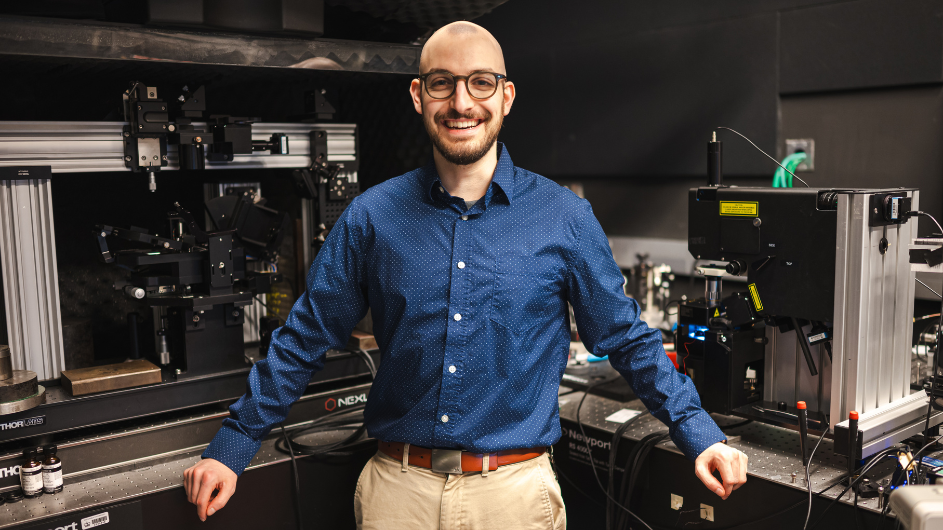
 | | Derek Schwartz, feeling fine on campus last week. Record Photo by Eileen Barroso. |
|
BY A. DUNLAP-SMITH
erek Schwartz will celebrate commencement at Columbia in much the same way the 9,200 other graduates will: Hell wear a light-blue mortarboard and gown; cheer his school and congratulate his classmates; pose in shuffled line-ups with family and friends for innumerable snapshots, arms laced around shoulders, beaming with joy and pride and relief and even sadness.
But for this 24-year-old psych major at GS, commencement celebrates more than the end of his struggle with undergraduate academics and the beginning of a new life after Columbia; for Derek, it celebrates nothing less than the end of his near seven-year struggle with death and, simply, the beginning of life again.
When the doctors told me I had one month to live in July 1991, I thought they were talking about someone else, Schwartz says. It was as though I was watching a movie.
But he wasnt, and to stay aliveto beat leukemiaDerek would ultimately undergo a bone marrow transplant. So Dereks graduation day will be momentous for yet another reason: For the first time he will meet the man who saved his lifethe man who, though a stranger, is to a degree as intimately connected to Derek as his mother and father. Dereks bone marrow donor will join the Schwartz family at commencement.
Five years ago on June third, Derek woke up in the middle of the night and glanced from his hospital bed through a little window in the wall of his perfectly sterile room. Framed in it, on the other side, two small plastic bags hung, dripping someone elses blood and bone marrow that eased down translucent tubes in red lines, lengthening as they worked their way toward Derek and the holes in his chest where they would at last burrow into his body. Its begun, he thought, and fell back to sleep.
That night was a beginning, but it had begun almost two years before. The results of a blood test ordered by his chiropractor after Derek complained of headaches, head-rushes and fatigue revealed he had T-Cell Acute Lymphocytic Leukemia (ALL), one of the diseases worst types that usually attacks children. The robust 17-year-old, an athlete who played football and ran track and was Connecticuts number-two powerlifter in his weight class, had no history of cancer in his family.
Treatment was started immediately. Derek withstood intense radiation sessions and heavy doses of chemotherapy. Despite the gravity of his condition and the violence his treatment did to his body, Derek could not conceive of dying. Even now, after the entire experience, I have no conception of death. I believe that may be one of the reasons I survived.
Swift action sent the leukemia into remission. Derek became healthy enough to take classes at the local community college and later at UConn/Storrs, sometimes going from a class or exam to a chemotherapy maintenance appointment. But after returning to his dorm from treatments, Derek found himself becoming irritated with the behavior of his classmates who took their health for granted by abusing their bodies with drugs and alcohol.
Then, as suddenly as it had come, the leukemia returned. This time, though, it flared up in Dereks central nervous system where it had not been detected before. In just the space of a few hours, between the moment on the night in January of 1993 that he warned his father something was wrong and the time he got to the emergency room, Derek says, I was wacko. His speech slurred badly and his memory shutdown. The doctor told Dereks father not to go back to fetch his wife because by the time they returned his son might be dead.
A bombardment of chemo and radiation saved him for awhile, but the doctors saw that the only long-term possibility of keeping their patient alive was a bone marrow transplant. In the words of one of the attending physicians, it was time to bring out the big guns. A search for a donor was initiated. It took five months to find 28 potential donors, whittle them down to three good matches and finally arrive at the perfect one.
Often a donor is a family member or is related to the marrow recipient, but not Dereks. He would learn that his donor was a man living in Seattle, in his 40s, in the Navy, and that his name was Michael Longanecker. But it was a year after the transplant that Derek could have this information; the doctors wanted to be sure Derek had a good chance of making it before he and Michael got in touch.
The transplant process was long and harrowing. Derek spent 49 days in the sterile room, a stay necessitated by the complete destruction of his immunological system. At the time, YaleNew Haven Hospitals bone marrow transplant ward held six patients in sterile rooms. Besides Derek, only one other survived.
After his release from the hospital, Derek was quarantined in his house for a year, not allowed visitors for fear of germ contamination. He left the house only at night because the sun could have set off a potentially fatal illness. His diet was sharply restricted, but as his immune system re-learned how to function he was allowed more varied foods. In the summer of 1994, about a year after emerging from the hospital with the immune system of a six-month-old fetus, Derek was permitted to eat a cheese pizza.
Feeling that his ordeal had made of him a modern-day Rip Van Winkle by shutting out any- and everything that wasnt essential to his struggle for life, Derek decided to attend GS rather than return to Storrs and to classes with younger students less likely to have much in common with him. He also decided to study psychology at Columbia because he wanted someday to become a counsellor to hospital patients in life-and-death struggles such as his.
But at present Derek is concerned with collecting his diploma and with getting to know the man a part of whose body is now a part of his own, and with a very important anniversary: In just a few weeks it will be five years since his bone marrow transplant. Medical science says that after five years in remission, Dereks fight with ALL will be over; on June 3, he is cured.
|