












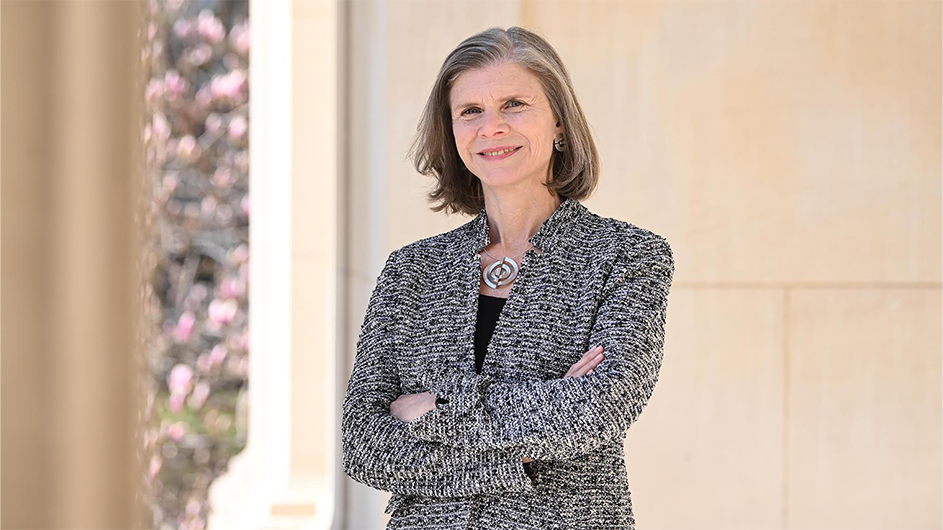
























COLUMBIA UNIVERSITY RECORD March 25, 1994 Vol. 19 No. 21 BRYN MAWR PROVOST TO LEAD BARNARD Judith R. Shapiro, provost of Bryn Mawr College, was named president of Barnard College Monday at a special meeting of the Board of Trustees. She will be the sixth president of the 105- year-old college. The announcement was made by Patricia F. Green, chairwoman of the Board. Shapiro will take office this July. She succeeds Ellen V. Futter, who headed the college for 13 years before becoming president of the American Museum of Natural History in November, 1993. In assuming the Barnard presidency, Shapiro--who was born and raised in New York City--returns to her roots. A noted anthropologist, she received her Ph.D. from Columbia in 1972. She joined the Bryn Mawr faculty in 1975 and became provost in 1986. Like Barnard, Bryn Mawr is a select and independent liberal arts college for women. "In Judith Shapiro, Barnard has had the good fortune to find the perfect combination of scholar and academic administrative leader," said Green. "Deeply engaged in the academic enterprise, she is familiar with issues of curriculum and scholarship, and well-suited to maintain the high intellectual and teaching standards that characterize Barnard and its faculty. She has a demonstrated commitment to undergraduate liberal arts education for women as well as an impressive record of curricular innovation. "Her extensive scholarship on gender and diversity and her academic training prepare her, too, for dealing with the kind of student life issues that are current on campuses nationwide. "This is an exciting moment for Barnard, which enjoyed 13 years of outstanding leadership by Ellen Futter. In choosing Professor Shapiro, we go from strength to strength; with her extraordinary intellect, vision, perspective, and dynamic presence, we know she is the person who will best position Barnard for the 21st century." Shapiro was selected by a committee of trustees, faculty and students who met over a period of eight months. More than 250 candidates were nominated and 25 individuals were interviewed for the position. "It is with enormous enthusiasm and a sense of privilege that I come to Barnard," Shapiro said. "It is an institution that reflects my deepest values and commitments. As my own history suggests, I have a profound dedication to women's education, and Barnard not only has an important heritage as a pioneer in this mission, but it also stands at its forefront today. It is a rigorous, liberal arts college where young women learn to play to their strengths. "It is also blessed with the kind of student body coveted by college administrators and faculties everywhere--spirited women with bright and lively minds, as inquisitive in intellect as they are cosmopolitan in character. That they choose this school, in this most cosmopolitan of cities, is hardly surprising, and I look forward eagerly to working with them. "Barnard's affiliation with a major research university like Columbia and its location in New York, my home town, makes this position all the more exciting. Being offered the opportunity to lead this college is a gift, and I am very grateful." As provost at Bryn Mawr, where she was the chief academic officer with both budgetary and programmatic responsibilities, Shapiro successfully helped navigate the institution through the financial challenges facing higher education while forging a partnership with the faculty that maintained the highest standards of academic excellence. In her tenure, she played an active role in recruiting, hiring and retaining a highly regarded faculty. She provided critical support and resources for junior faculty to engage in research. She also played a key role in revitalizing the undergraduate curriculum through innovative new interdisciplinary programs with neighboring Haverford College, a cooperating, coeducational school. She strengthened the cooperative curricular arrangements among Bryn Mawr, Swarthmore and the University of Pennsylvania and was an important participant in the effort to create an integrated computerized library catalogue system for Bryn Mawr, Swarthmore and Haverford. Barnard Trustee Helene L. Kaplan, who headed the search committee, said, "After considering more than 250 nominees, we have found in Judith Shapiro someone who not only met, but indeed, surpassed our criteria. She is an outstanding scholar and teacher; a proven academic administrator whose eight years as provost have prepared her, as few other positions can, for a college presidency. That she held that position at a sister school, whose mission and profile so closely match our own, makes her all the more appealing. While there, she developed a keen understanding of the relationships between institutions which will serve Barnard well." In assuming the Barnard presidency, Shapiro goes from an institution of 1100 undergraduate and about 600 graduate students, a faculty and staff of over 600 and an endowment of $214 million to an undergraduate institution of 2200 students, a faculty and staff of over 700, and an endowment of $70 million. The colleges are among the five remaining "sister" schools of the Ivy League-- liberal arts colleges dedicated to the education of women. Both Barnard and Bryn Mawr, however, have connections to nearby coed institutions. Barnard is affiliated with Columbia University. President George Rupp said, "We are proud to welcome Judith Shapiro back to the Columbia community, where 22 years ago, she earned her Ph.D. in anthropology. During her distinguished career, she has become a leading figure in undergraduate liberal arts education as well as a noted scholar and teacher. Her presence as Barnard's president will enhance all of undergraduate education in the Columbia community. I look forward very much to working with her." As a scholar, she is noted as an early and significant contributor to the crosscultural study of gender differences. Her field work has taken her to the Great Basin of North America, and the tropical forest societies of central and northern Brazil. She has also done original anthropological studies of Catholic missionaries. She received a Bachelor of Arts in History from Brandeis University magna cum laude in 1963 and then entered Columbia where she studied with Barnard alumna Margaret Mead '23, as well as with current members of Barnard's distinguished anthropology faculty. From 1970 to 1975, she was an assistant professor of anthropology at the University of Chicago. After joining the Bryn Mawr faculty in 1975, she became an associate professor of anthropology in 1978. From 1982 to 1985, she chaired the department. Appointed professor in 1985, she also served as acting dean of the undergraduate college (1985-86) and as acting president in the summer of 1988. She has published widely over the years in scholarly journals and books. Shapiro, who was born on Jan. 24, 1942, grew up in the New York City borough of Queens. Educated in the city's public schools, she started at PS 26, moved on to George Ryan Junior H. S. in Flushing, and attended Jamaica High School, from which she graduated in 1959. Her parents, Herman and Lillian Shapiro, now live in Manhattan and are both retired. Mr. Shapiro worked as an accountant; Mrs. Shapiro, a librarian and Latin teacher, once headed the high school library system for the New York City Board of Education. Shapiro, who is divorced, has one sister, Susan Skea, who is a psychiatrist in Boston. Besides Green and Kaplan, Trustee members of the search committee included Miriam G. Cedarbaum, Gedale B. Horowitz, Carol M. Lane, Donald A. Pels, Anna Quindlen, Patricia C. Remmer and Lynn Walker. The four Barnard faculty representatives were Professors Sally Chapman, Susan R. Sacks, Alan Segal and Mirella Servodidio. Barnard seniors Lena Bretous and Inessa Onefater were the student representatives. And Corrine Rieder, Secretary of the University, represented Columbia. Flora S. Davidson, associate dean of the Barnard faculty, served as Secretary to the committee.