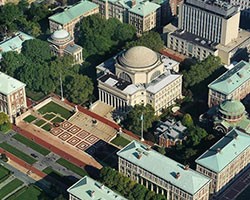
































COLUMBIA UNIVERSITY RECORD May 6, 1994 Vol. 19 No. 27 DALAI LAMA GIVEN HONORARY DEGREE AT CONVOCATION Tenzin Gyatso, the 14th Dalai Lama of Tibet and winner of the 1989 Nobel Peace Prize, received an honorary Doctor of Humane Letters degree from Columbia at a special University Convocation in Low Rotunda on Apr. 26. The degree was conferred by President Rupp, who was joined on the dais by Provost Jonathan Cole and Robert Thurman, the Jey Tsong Khapa Professor of Indo-Tibetan Studies. Speaking in English, and occasionally in Tibetan through an interpreter, the exiled Tibetan leader delivered a 25-minute speech to a capacity crowd of 500 faculty, students and members of the Tibetan community in New York. His subject was the importance of teaching human affection and compassion. "One constructive criticism I have of the modern education system is that not enough care is placed on the human heart side, as compared to the intellectual and human knowledge side," he said. "Perhaps the main reason is that in the past the development of the human heart was placed [upon] religion, but as interest in religion diminished, I feel the interest to [encouraging] values has also diminished." A GOOD BRAIN AND A GOOD HEART He said training the intellect in a university is only part of a complete education, and that "a good brain and a good heart must be put to use together. So in an institution like this it is important to pay more attention to affection, not only working to foster academics, but to create a better world for all humans," he said. "I believe an affectionate mental attitude is the fundamental basis of human life. "Any human beings who receive affection--even animals--get from this a deep satisfaction; it makes us very happy," he said. "According to medical scientists, the mother's physical touch to the baby in the first few weeks after birth is crucial to the development of the mind. At that moment the baby has less feelings of fear, more self-confidence. A person who has a compassionate mind finds it much easier to communicate with other people. This produces happiness. "Happiness produces health ... Money of course is important. But the real key to happiness is human affection. This is my main belief, and so, whenever I get the opportunity, I express this," he said. In his introductory remarks, Rupp read from the Tibetan leader's "Freedom in Exile," and said: "A remarkable and beautiful part of Buddhism is the union of the ordinary and extraordinary." During his two-day visit to New York, the Dalai Lama participated in a conference on religion, philosophy and science sponsored by the Center for Buddhist Studies of Columbia's department of religion and Tibet House of New York. This was his third visit to the University. In 1989, he spoke during the formal establishment of the Center for Buddhist Studies, headed by Thurman, and in 1984, he was an invited speaker at the University. During his two-week trip to the U.S., he spoke at Stanford, U.C.-Berkeley and the University of Michigan. Tenzin Gyatso serves as the spiritual leader of six million Tibetans and is head of state of a government in exile comprising approximately 130,000 Tibetans in South Asia, Europe and North America. Born to a peasant family in northeastern Tibet, he was recognized at the age of 2 in 1938, in accordance with Tibetan tradition, as the reincarnation of the 13th Dalai Lama. In 1950, he was called to political leadership at the age of 15. In 1951 Tibet was occupied by the Chinese Communists. In 1959, after a failed uprising against Chinese forces, he fled with about 100,000 Tibetans to India, where he currently resides in the northern city of Dharamsala.