















German Resistance Exhibit from Berlin Opens in Low Rotunda Next Week


Photograph: At left, brother and sister Hans and Sophie Scholl, whose distribution of leaflets at the University of Munich was considered a serious political crime, were convicted and executed by the Gestapo in 1943.

Photograph: Arvid and Mildred Harnack, an economist and teacher, respectively, were leaders in the German resistance movement.

Photograph: Count von Stauffenberg, whose failed attempt to assassinate Hitler in 1944 led to his execution.


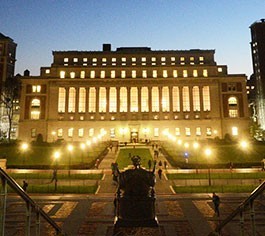
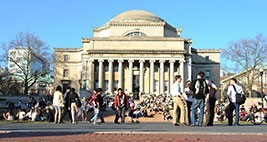
A traveling exhibition depicting the German resistance to Nazism will be on view at Columbia University Sept. 13 through 26 in Low Rotunda.

Titled "Against Hitler: German Resistance to National Socialism, 1933-45," it traces strands of resistance from religious and political groups, the army and others who shared a moral repugance to the Nazi dictatorship. The exhibition marks the 50th anniversary of the July 20th attempt on Hitler's life.

"With this exhibit and panel discussion, we hope to advance greater understanding of one of the darkest chapters of the history of the world," President Rupp said.

The exhibition opened at the Library of Congress July 14 and will be next on view Oct. 17-22 at the University of North Carolina at Chapel Hill. Peter Steinbach, professor of history at the University of Berlin and director of the German Resistance Memorial Center in Berlin, curated the exhibition, which consists of 43 freestanding panels with photographs of resistance leaders and wartime scenes, documents from the underground and text describing the various resistance movements.

Several panels are devoted to the failed assassination attempt on Hitler carried out by Claus von Stauffenberg July 20, 1944. Stauffenberg, chief of staff of the Home Army Command, and his friends acted despite the knowledge that their chances of killing Hitler and then seizing control in Germany were extremely slender. "I know that he who will act will go down in German history as a traitor; but he who can and does not, will be a traitor to his conscience," Stauffenberg wrote.

Average Citizens Noted

Other panels describe resistance circles among Jews and Christians, Communists and Socialists, and in the army, universities and the labor movement. A panel on "Resistance in Daily Life during the War" documents the heroism of average German citizens who sought to protect the persecuted.

The history of the German resistance is the subject of a permanant exhibition at the German Resistance Memorial Center at the historic Bendlerblock complex in Berlin, where the chief conspirators of the 20th of July were executed. "Against Hitler" was prepared jointly by the center and by the Research Institute of Military History in Potsdam.

Among leaders of the German resistance featured in the exhibition is theologian Dietrich Bonhoeffer, who wrote and preached widely about the dangers of the Nazi movement. He was a visitor to Morningside Heights in 1931, when he was a student at Union Theological Seminary, and again in 1939, when he held a visiting professorship there.

He returned to Germany to join friends and family members in the resistance, including his brother-in-law, Hans von Dohnanyi, who was later executed by the Nazis. As a leader of the Confessing Church of Germany, Bonhoeffer communicated with the Allies and smuggled Jews to Switzerland, and was arrested in 1943. His published Letters and Papers from Prison are still widely read in theological circles. He was executed in 1945. Last year, Union established the Bonhoeffer Chair in Theology and Ethics and, in cooperation with German institutions, it holds a biannual lecture in Bonhoeffer's memory.

Fritz Stern Describes "Heroic Effort"

The idea for the exhibition grew out of discussions between German and American officials last year. In August 1993, President Clinton appointed Richard C. Holbrooke ambassador to the Federal Republic, and the new ambassador promptly asked Rupp whether he could "borrow" Fritz Stern as a senior adviser to the Embassy. Stern, University Professor at Columbia and a noted historian of modern Germany, while on leave from Columbia last fall, discussed with Klaus Naumann, chief of staff of the German Armed Forces, and Holbrooke the possibility of mounting such an exhibition.

Stern, who has a longstanding interest in the history of the resistance, sees the exhibition as an effort to acquaint students and a wider audience with an essential part of 20th-century history. "The history of the resistance in Germany has been controversial, and the 50th anniversary offers an excellent opportunity for dispassionate discussion," Stern said. "Few, if any, would deny that it was a heroic effort and that what all resisters had in common was the absolute moral certainty that Hitler had to be eliminated."

The exhibition reflects a surge in scholarly interest in the German resistance. In 1988, Goethe House of New York sponsored, and Columbia hosted, a symposium on the German resistance at which prominent scholars from the United States and Germany presented their research. Among the participants were Willy Brandt, former chancellor of the Federal Republic; Theodore Ellenoff, then president of the American Jewish Committee, and Stern.

Opening Ceremony and Seminar

An opening ceremony will be held Sept. 12. Speakers will include Holbrooke, who is Assistant Secretary of State-Designate; Naumann; Klaus von Dohnanyi, former Mayor of Hamburg and son of Hans von Dohnanyi; Erhard Holtermann, Consul General of the Federal Republic of Germany; Provost Jonathan Cole, and Stern.

A seminar on resistance to the Nazis will be held the following day, Sept. 13. Moderated by Dean of the School of International and Public Affairs John Gerard Ruggie, it will include Karl-Dietrich Bracher, professor emeritus of history at the University of Bonn and a leading German historian of the Nazi period; Klemens von Klemperer, professor emeritus of history at Smith College; David Clay Large, professor of history at Montana State University; Naumann; Ismar Schorsch, chancellor of Jewish Theological Seminary, and Steinbach and Stern.


Columbia University Record -- September 9, 1994 -- Vol. 20, No. 1