





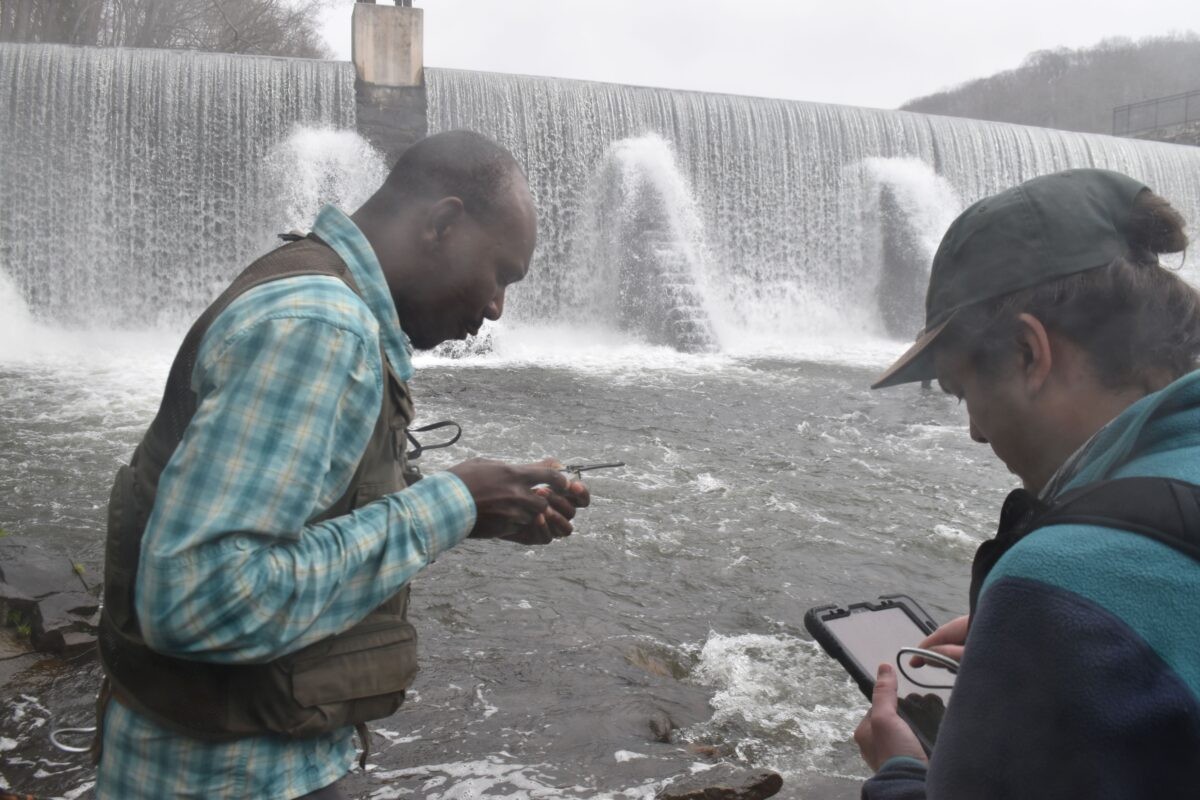


































Photograph: Jerry McManus, research scientist at Lamont-Doherty, in the North Atlantic.
New clues from deep-sea sediment cores, reported Sept. 22 in Nature, cast doubt on previous reports of rapid and dramatic shifts in climate before the last ice age, seen by some scientists as a warning for the future.
Scientists led by Columbia's Lamont-Doherty Earth Observatory said new evidence showed that the Eemian period, the last time earth's climate closely resembled today's, was more stable than had been reported last fall by a European scientific team that drilled cores into the Greenland ice sheet.
According to the European Greenland Ice-core Project (GRIP) team, oxygen isotope measurements of the ice cores revealed that air temperature over Greenland repeatedly rose and fell in the past by as much as 18 degrees F within 20 years.
Most stunningly, the European team said, dramatic frigid spells also occurred during the Eemian, a 10,000-year period between 125,000 and 115,000 years ago, when the earth was as warm as today. The finding raised new doubts about the stability of the earth's current climate, and the Eemian became a prominent focus of global climate change research.
The question could not be settled by a second set of ice cores drilled at a nearby site by the U.S. Greenland Ice Sheet Project 2. These cores showed the same rapid climate shifts as the GRIP cores from 100,000 years ago to the present.
Ice layers corresponding to times before 100,000 years ago were too folded and scrambled to provide reliable information.
For the new research, the Lamont-Doherty team analyzed two deep-sea sediment cores from the eastern North Atlantic for clues to earth's climate from 135,000 to 65,000 years ago. The sediment cores showed evidence of rapid climate swings between 100,000 and 65,000 years ago, which matched those seen in both the European and American ice cores.
"The correlation between our records and the Greenland ice core records is good throughout the period in which the two ice cores agree," but during the earlier Eemian, "our marine records show a more stable climate than that implied by the GRIP ice core," the scientists concluded.
The research was conducted by Jerry McManus, Gerard Bond, Wallace Broecker, and Sean Higgins, all scientists at Lamont-Doherty, Columbia's earth sciences research center in Palisades, N.Y.; Sigfus Johnsen of the University of Copenhagen's Neils Bohr Institute and the University of Iceland's Science Institute, and Laurent Labeyrie of the CFR Laboratoire mixte CNRS-CEA in France.
The Lamont-Doherty scientists examined the cores for preserved shells of microscopic animal life that thrive in cold surface waters and for limestone fragments scraped off continents by advancing glaciers, carried out to sea by icebergs and deposited on the ocean floor. Icebergs are further indicators of cold climates and sea temperatures.
They found high amounts of shells and ice-rafted materials at times corresponding to cold air temperatures revealed by the ice cores. But those materials nearly disappeared in layers older than 110,000 years. Over the past year, Lamont-Doherty scientists Bond, Broecker and colleagues have demonstrated that ocean temperatures, as revealed by ocean sediment cores, fluctuated in lock-step with air temperatures revealed by the Greenland ice cores--making deep-sea sediment cores a powerful new way to track climate changes over North Atlantic regions that occurred over as short a period as a lifetime. Until seafloor cores were correlated with the newly drilled ice cores, scientists did not think marine records could provide such detailed information.
For some 10,000 years, the earth has enjoyed steady and dependable climate, an interglacial period known as the Holocene.
For the preceding 100,000 years, the earth experienced an ice age marked by wildly fluctuating air and ocean temperatures and waxing and waning ice sheets.
Scientists have speculated that rapid climate shifts might be just an ice-age phenomenon triggered by glaciers and sea ice. But if the previous interglacial, the Eemian, was also erratic, it raises concerns that our seemingly even-keel climate system of today could also switch suddenly--perhaps pushed into another mode of operation by rising greenhouse gases in the atmosphere. It also would have meant that the stable climate of the Holocene, which has allowed agriculture and human civilization to flourish, may be a fluke in earth's history.
The Lamont-Doherty research was supported by the National Science Foundation, the National Aeronautics and Space Administration, the National Oceanographic and Atmospheric Administration and the Joint Oceanographic Institutions/U.S. Science Advisory Committee.