





















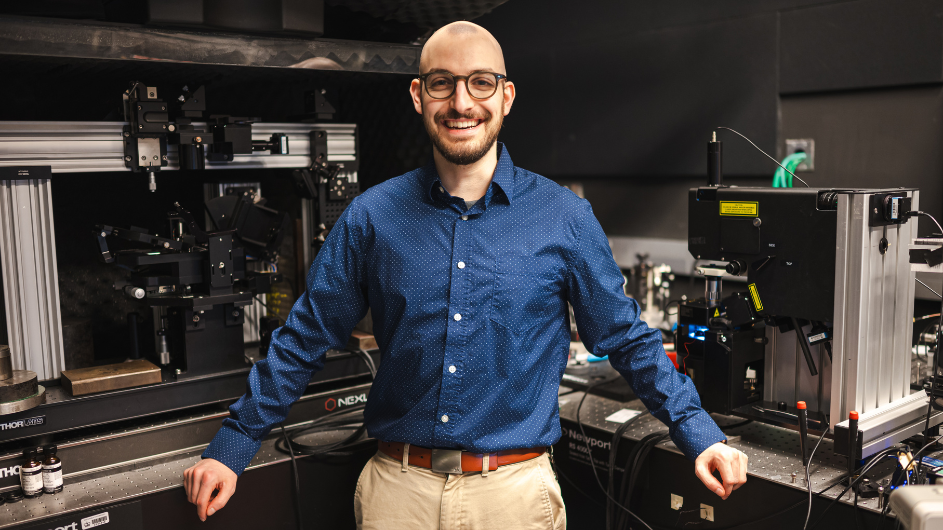


















Photograph: Allen H. Boozer.
Photograph: Columbia's doughnut-shaped High Beta Tokamak-Extended Pulse, a plasma physics experiment located in Mudd Engineering Terrace. Photo Credit: Joe Pineiro.
Allen H. Boozer, a highly regarded plasma physicist who formerly directed the theory group at Princeton's Plasma Physics Laboratory, has been appointed professor of applied physics with tenure at Columbia.
Boozer has made a number of fundamental contributions to understanding the behavior of plasmas, clouds of extremely hot, charged particles in which scientists have produced controlled atomic fusion.
The research is expected to lead to safe, economical sources of electric power in the next century.
"He's one of a handful of top theoretical plasma physicists in the country," said Gerald Navratil, chairman and professor of applied physics. "We are absolutely delighted to have him here."
Navratil headed the search committee created to fill a vacancy in the department of applied physics at Columbia's School of Engineering and Applied Science.
"Allen Boozer was our number one candidate," Navratil said. "He will be extremely effective in the fusion program at Columbia."
In the largest controlled fusion experiments, the plasma is confined inside a tokamak, a doughnut-shaped stainless steel chamber, by magnets located along the tokamak's rim.
As hydrogen nuclei fuse to form helium nuclei, they release huge quantities of energy. The tokamak design was first developed in the Soviet Union in the 1960s and is still the leading approach to containing the high temperatures and pressures needed for controlled fusion.
Columbia plasma physicists conduct their research both at the nationally renowned Plasma Physics Laboratory at Princeton, home of the Tokamak Fusion Test Reactor, and at Columbia's own High Beta Tokamak - Extended Pulse, located in the Plasma Physics Laboratory in S.W. Mudd Engineering Terrace.
Columbia's fusion team is experimenting at Princeton with a mix of fuel that could power a fusion reactor, using a mix of deuterium and tritium, heavy isotopes of hydrogen. The group is planning experiments in November and December that could break the existing fusion power record of nine megawatts set by Princeton scientists in May.
He attempts to develop theories that will explain the behavior of particles in plasmas and has focused on three main problems associated with controlled fusion inside a tokamak.
Boozer likens controlled fusion to starting a fire: the fuel must be assembled, it must be ignited, it must reach a certain temperature--about 100 million degrees Fahrenheit--and it must not be cooled more rapidly than the fire heats it.
One, scientists do not know whether the helium nuclei created by the fusion of deuterium and tritium promote fusion by increasing the plasma pressure limit or impede it by destabilizing the plasma. If helium helped stabilize the plasma, less energy could be injected to start the fire and break-even fusion would be closer.
Also, predictions of the behavior of particles in a plasma rely on the assumption that particles will collide, but in high-energy plasmas, particles can often travel around the tokamak for tens of kilometers before such collisions occur.
That, too, affects predictions of how hot the plasma must be kept. "It's sometimes very tricky to get the right answer," Boozer said.
Finally, in controlled fusion, particles can leak out of the magnetic confines of the tokamak, a factor that may cool the reaction too quickly--like blowing out a fire.
As a theoretical plasma physicist, Boozer is helping to design the Tokamak Physics Experiment, Princeton's next large tokamak, expected to begin operation in the year 2000. Researchers hope that experiment, which will use superconducting magnets to confine the plasma, will attain continuous operation.
"We would, of course, like to get more energy out of a tokamak than we put in," Boozer said. "Even then, you still need to get five to ten times more energy out before fusion could be considered practical."
Boozer comes to Columbia from the College of William and Mary, where he had been professor of physics since 1986. From 1974 to 1986, he was a research physicist at Princeton's Plasma Physics Laboratory, holding ranks up to the most senior, principal research physicist.
He was acting director of the Theoretical Division from June 1985 to May 1986, and was a member of the Theoretical Division Steering Committee and the Laboratory Program Committee.
Prior to his work at Princeton, Boozer was from 1970 to 1974 an officer in the U.S. Air Force, stationed first at the Air Force Armaments Laboratory, Eglin Air Force Base, Fla., and then at the Air Force Cambridge Research Laboratories, Hanscom Field, Mass.
Born in Orangeburg, S.C., he earned the B.A. degree in physics from the University of Virginia with high distinction, Phi Beta Kappa, in 1966, and the Ph.D. in physics from Cornell in 1970. His thesis, under E.E. Salpeter, was titled "Late Stages of Stellar Evolution."
He held the first U.S.-Japan Fusion Theory Visiting Professorship at Nagoya University in Japan in 1982. He was elected Fellow of the American Physical Society in 1982 and served as secretary/treasurer of its Division of Plasma Physics, 1989-1990. He was elected External Scientific Member of the Max Planck Society, Germany, in 1989. He was president of the University Fusion Association in 1992. Boozer has published more than 75 papers in refereed journals and jointly holds three United States patents.