
































The Donald Keene Center of Japanese Culture at Columbia will present a variety of programs during March and April to commemorate the life and creativity of the late Japanese writer Kôbô Abé.
Repeatedly considered a candidate for the Nobel Prize for Literature, Abé died of a heart attack in January, 1993. The multi-faceted Kôbô Abé Commemoration will consist of a major international symposium; three exhibitions; presentations of films based on Abé's novels, including Woman in the Dunes; a new production of his play, Friends, by the Pan Asian Repertory Theater, and a concert of music associated with Abé's films and works for the stage.
Abé's complete literary works, which encompass numerous novels, plays, essays, and short fiction, will be published in a new multi-volume edition in Japanese by Shinchô-sha in Tokyo this spring.
Kôbô Abé (1924-93) is best known outside of Japan for his novels, which have found broad international readership in translations into English and more than 20 other languages.
Among his novels that have been translated into English are: Woman in the Dunes, Face of Another, The Box Man, Secret Rendezvous, The Ruined Map, and Inter Ice-Age 4.
Abé collaborated closely with director Hiroshi Teshigahara on film adaptations of a number of his novels. Woman in the Dunes, directed by Teshigahara, with a screenplay by Abé and a musical score by Tôru Takemitsu, won the "Best Film" award of the Cannes Film Festival in 1964, and is one of the best known works of modern Japanese cinema.
Kôbô Abé was a giant of postwar Japanese literature, but his creative genius was not limited to writing. Preoccupied with the human condition in modern urban society, the themes of alienation and isolation run through all his writings as well as his films and photography. He kept a camera close at hand through most of his adult life, and his superb photography--revealing a keen eye for the essence of contemporary urban existence--was considered revolutionary in Japan during the early postwar period.
As a man of the theater, Abé was fascinated both by dramatic storytelling and by non-linguistic means of human expression as represented in film, dance, and abstract stage movement. During the 1960s and 1970s, he wrote more than a dozen plays and often directed his own theatrical works as well as Japanese productions of the plays of Harold Pinter, Eugene Ionesco, Samuel Beckett, and other European and American playwrights. From 1973 to 1979, he directed what was known as The Abé Studio, a group of actors and other artists seeking new forms of theatrical expression through experimentation with language, movement, and innovative stage techniques. The Abé Studio toured the United States in 1979 with Abé's play, The Little Elephant is Dead.
Kôbô Abé's ties with Columbia have been particularly close. He was a longtime friend of Professor Donald Keene, America's foremost translator and specialist in Japanese literature and culture, who has taught at Columbia for four decades.
In the early 1980s, Abé was instrumental in raising funds in Japan that made possible the creation of the Donald Keene Center of Japanese Culture at Columbia, and he was awarded an honorary degree by the University in 1975.
The Kôbô Abé Commemoration will include the following programs:
Symposium (Apr. 19-21):
The Kôbô Abé Commemorative Symposium will bring together from Japan, Europe, and the United States, scholars, writers, literary critics, translators, and other specialists interested in modern Japanese literature. Many of Abé's closest associates--actors, writers, composers, and filmmakers--will also be present to offer personal recollections of Abé and his work. The symposium will take place at the Kellogg Conference Center.
Exhibitions (April-May):
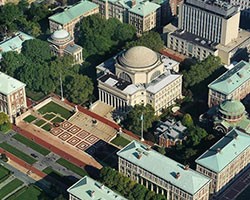
Four exhibitions at Columbia will reveal various aspects of Abé's life and work. "Art Photography by Kôbô Abé" and "Drawings, Costumes, and Set Designs by Machi Abé," two exhibits curated by Noriko Fuku, will be on view at the Miriam and Ira D. Wallach Gallery (Schermerhorn Hall, 8th floor) from Apr. 8 to 21. "Kôbô Abé's Life and Literature," a collection of photographs, documentary materials and memorabilia, will be on view in Low Rotunda from Apr. 8 to May 3. "Manuscripts and First Editions of Kôbô Abé's Works" will be on view in the C.V. Starr East Asian Library (300 Kent Hall) from Apr. 8 to May 31.
Film Series (March-April):
On Sun., Mar. 24 (3:00-9:00 P.M.) three films with screenplays by Kôbô Abé--Woman in the Dunes, Face of Another and Pitfall -- will be presented at the Kathryn Bache Miller Theatre at Columbia.
On Wed., Mar. 27 (6:00 P.M.), the Film Society of Lincoln Center will present a special screening of Woman in the Dunes at the Walter Reade Theatre, followed by a discussion with famed Japanese film director, Hiroshi Teshigahara.
Additional screenings of these films and video programs related to Kôbô Abé will also be scheduled at Columbia during the period of the symposium.
Theater (Apr.-May):
A new production of Abé's 1967 play Friends (Tomodachi), directed by Ron Nakahara, will be presented by the Pan Asian Repertory Theatre at the St. Clement's Theater (423 W. 46th St.). Previews of Friends will begin Apr. 16, and the play will open on Apr. 19.
Artistic director is Tisa Chang.
Concert (Apr. 20):
Continuum, the renowned modern-music ensemble directed by Joel Sachs, will present a program of music associated with Kôbô Abé's works at the Kathryn Bache Miller Theatre.
Composers represented will include Tôru Takemitsu, Toshiro Mayuzumi, and Abé.
Convocation (Apr. 18):
Awarding of posthumous honorary degree to composer Toru Takemitsu, who died Feb. 20.
Columbia University Record -- March 22, 1996 -- Vol. 21, No. 20