

























Gov. George Pataki joined Columbia officials on Mon., Oct. 16, to open the first of five buildings in New York City's first biomedical research and biotechnology park. The Audubon Business and Technology Center, located in the Washington Heights section of Manhattan, is expected to jump-start the city's biotechnology industry.
Pataki told the large gathering that the building will help rejuvenate the entire Washington Heights area, which he remembers fondly from his student days at Columbia Law School, when he lived two blocks from Columbia-Presbyterian Medical Center.
While New York State represents the fifth largest concentration of biotechnology companies in the United States, less than 1 percent of them are located in New York City. Despite sources of venture capital and the presence of many academic medical centers with intellectual and scientific talent to spark business development, New York City is home to only 10 small biotechnology companies that employ about 220 people.
"We have all the resources here to make a vibrant biotech industry cluster, but it hasn't happened because of lack of a facility designed for commercial biotechnology development," says Jack Huttner, executive director of the New York Biotechnology Association. "Now, with Audubon, we finally have it."
Columbia developed the $28 million Center in partnership with the City and State of New York. Located across the street from Columbia-Presbyterian Medical Center, the facility is an incubator for young biotechnology and biomedically related companies and the linchpin in efforts to help the city attract its share of this $11.2 billion industry.
The first tenant is Dobelle Institute Inc. , developers of permanently implanted electronics to stimulate the brain and central nervous system. Dobelle has signed a 10-year lease with Audubon. The company's long-term goal is development of artificial-vision technology that will help the blind to see.
Four additional biotechnology companies are in lease negotiations for portions of the 60,000 square feet of laboratory space in the Center:
Melville Biologics Inc. - developers of a process that kills blood-borne viruses In human plasma;
Ortec International Inc. - developers of a skin replacement technology for burn victims and other types of wound healing from reconstructive and cosmetic Surgery;
Fluid Motion Biotechnologies Inc. - developers of an exercise device for the temporomandibular jaw joint;
Health Sciences Consultant Group Inc. - developers of a method for platelet preservation to improve the quality of platelets used for transfusion in cancer patients.
"This is a proud day for New York and Columbia," says Jonathan Cole, provost and dean of faculties at Columbia. "Audubon will promote science, provide new modes of health care, stimulate business, create jobs, and help improve neighborhood life. It is a win-win situation for everyone."
"Audubon is important because it will provide a vehicle for translating the discoveries of new medical science into innovative new treatments for a wide range of illnesses," says Herbert Pardes, vice president for health sciences and dean of the Faculty of Medicine at Columbia. "The health of Americans will benefit directly from work done here."
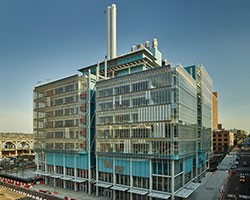
The facility rises six stories on Broadway between 165th and 166th Sts. It sits behind the restored facade of the Audubon Ballroom and adjacent to the reconstructed portion of the ballroom where Malcolm X was killed in 1965. The Center is the first of what will be a five-building complex known as the Audubon Biomedical Science and Technology Park. Development of the Audubon Business and Technology Center began in 1983. The New York City Economic Development Corp. and the Empire State Development Corp. invested $11.2 million and $8.1 million, respectively, with the remainder a combination of Columbia investment and debt. Columbia is required to repay the public investors within 15 to 25 years. The University is also the developer and manager of the park.
"Columbia took on the role of developer because we think we are uniquely situated to lead a science and technology-based business development strategy for New York City," says William A. Polf, deputy vice president for external relations and strategic programs at Columbia's Health Sciences Division. "We are in it for the long haul because we believe this scientific complex ultimately will be one of the most important economic assets in New York City."
All of Audubon's 10,000 square feet of first-floor storefront retail space has been leased to owners of the West End Gate restaurant, who will open a full-service restaurant in the Audubon; Taco Madre, a Mexican takeout restaurant; Joe's Pizza, a Washington Heights-based, family-owned business; a bookstore operated by Barnes and Noble; Chemical Bank, and Cooper's Coffee Bar.
The growing biotechnology industry is primarily made up of small private companies. Many of these are start-ups, companies in the development stage that frequently begin with only an idea and an entrepreneur. Audubon is designed to nurture start-up companies through various stages of development. Cultivating the growth of these small companies is the key to developing a strong biotech industry in New York City and achieving the goal of the Audubon Park, says Mitch Gipson, executive director.
A key feature of the Center is the facility's Business Incubator, 5,000 square feet of finished lab space, financed by the Audubon project. The third floor Incubator is designed in 500-square-foot modules for small companies that will share a conference room and offices and a photocopier and fax machine. A small business assistance program is also in development. Some young companies may qualify for subsidized rents in the Audubon, which begin at $15 per square foot. Columbia also is helping start ups locate investors and providing financing to some companies to construct their laboratory and business space by low-interest loans.
"Funding for most of these start-ups to construct their interior lab space is almost non-existent. Most would have difficulty getting conventional bank loans," says Gipson. "So Columbia is lending its own money to finance the construction of interior space for start-ups. We are doing this because it is important for us and the whole city that these businesses have a chance to succeed."
Columbia University Record -- October 20, 1995 -- Vol. 21, No. 7