




















Columbia ADVENT Advances Internet and Web Information Exchange
As digital multimedia becomes part of most workplaces, schools, and
homes, there is an unprecedented need to develop greater capabilities for
creating, storing, manipulating, and distributing digital images and video.
Advancing these capabilities is the focus of ADVENT, a research project at Columbia that is
investigating all areas of digital image and video technology.
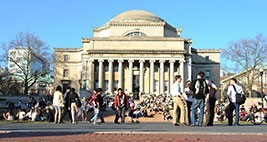
ADVENT is based at the Image and Advanced Television Laboratory in
the School of Engineering and Applied Science and is led by three members of the
Electrical Engineering faculty. Professors Dimitris Anastassiou,
Shih-Fu Chang,
and Alexandros Eleftheriadis
work with over 40 other student and staff members in exploring and
testing video compression techniques, image search and retrieval mechanisms,
video server storage architectures, and many other issues that arise with the
promise of digital multimedia services.
The ADVENT project has partnerships extending to other
schools on campus, nearly 40 companies as sponsoring partners, and to
international standardization efforts. ADVENT has taken a leading role in the work of one such standardization
effort, the Digital Audio-Visual Council (DAVIC).
The primary aim of DAVIC is to ensure compatibility and interoperability of video on demand
(VOD) on a worldwide basis. This will be advantageous to all parties--equipment manufacturers, network operators, content producers, service providers and most
importantly consumers.
In June ADVENT hosted and organized DAVIC's 13th Meeting
which drew more than 300 VOD experts from over 200 companies to Columbia's campus.
The highpoint of the meeting was the first DAVIC global
interoperability event, which connected video servers, set-top boxes, and
applications from DAVIC-compliant VOD from Europe, Asia and North
America. In addition to Columbia University, the companies that participated in the event were
CSELT (Italy), DeTeBerkom (Germany), GCL (Japan), GTE Laboratories (USA),
Hewlett Packard IDACOM (Canada), NIST (USA), and NTT (Japan). According to
DAVIC President Jules Bellisio, "the event at Columbia demonstrated that the
DAVIC specifications can successfully provide assured, immediate access to
broadcast quality video and other multimedia services around the globe. Such
capabilities have been a dream of many Internet users.... DAVIC is now
working on the convergence of the DAVIC specifications with the Internet to
turn this dream into a reality."
All participants in the global interoperability event interconnected with the
VOD testbed at Columbia, a state-of-the-art server to end user equipment
that includes digital set-top boxes, mobile clients with real-time MPEG-2 hardware and
AIRLAN PCMCIA adapters, wired-to-wireless gateways to support mobile clients, and
MPEG2 real-time encoder for content generation, and additional ATM switches to
support additional clients. The event also tested ADVENT's MPEG real-time
video pump, which supports an architecture that can deliver different
data types over a variety of networks, including ATM/AAL5, IP, and wireless.
ADVENT has also played an active role in the development of the MPEG-2
international standard for digital video compression, and Columbia has become the only
university--accompanied by several corporations--to be included in the
MPEG-2 patent pool.
Editing image and video content in the compressed domain has been another
area addressed by ADVENT. In conjunction with research, ADVENT has
developed a system for real-time content analysis and manipulation of
compressed video. Scene changes, and special effects such as fade-in,
fade-out, and dissolve can be detected. MPEG compressed bitstreams can be
cut and pasted, and tools for blend, film, key and motion effects are being
implemented. This compressed-domain approach is about 100 times faster than
the brute-force decode/re-encode approach, and it improves the video
quality.
Searching, browsing, and retrieving images in an image database system
has been another area of investigation, which led to the development of
VisualSeek, a content-based visual query system that allows users to query for images with visual
properties (color, shape, texture) and their spatial layout. Currently,
these content-based search functions are being extended to a powerful image
search engine for the World Wide Web. The prototype system,
WebSEEk, is among the first image/video
search engines to provide advanced search and catalogue capabilities.
Other research topics currently under investigation by ADVENT include
image authentication and watermarking, automatic face detection, and
video traffic models.
Many of the issues under investigation come together in the "Mobile
Journalist's Terminal," a project undertaken in collaboration with the
Center
for New Media in the Graduate School of
Journalism. The Mobile Journalist's Terminal combines a range of digital
multimedia services, including image search and retrieval through content-based
query, multi-view capability, video editing, video conferencing, morphing, and copyright source authentication. In this cooperative endeavor, journalism
students are working with engineering researchers to explore the ways new media technology best accommodates the needs of its users. ADVENT also
enjoys steady interaction with the Institute for Learning Technologies
at Teachers College and the Center for Tele-Information at the Graduate School of Business.
The faculty and staff of ADVENT will be happy hear from anyone who
would like to be kept informed of the project's activities and receive
announcements about upcoming seminars and workshops. Please send mail to sara@itnm.columbia.edu.
|