





















Law Students, Faculty Welcome a Renovated Jerome Greene Hall


Photograph: Cutting the ribbon: from left, Law Dean David Leebron, former Dean William C. Warren, U.S. Supreme Court Justice Ruth Bader Ginsburg, benefactor Jerome L. Greene, Senator Daniel Patrick Moynihan and President George Rupp. Photo Credit: Joe Pineiro.

Photograph: Justice Ruth Bader Ginsburg, Law '59, speaks at the Grand Symposium in Miller Theatre. Photo Credit: Joe Pineiro.

Photograph: John C. Coffee Jr., Adolf A Berle Professor of Law, speaks to the issue of unregulated trading on the Internet during a panel on the modern corporation. Photo Credit: Joe Pineiro.

Photograph: Justice Stephen G. Breyer conversed with Michael Sovern, Chancellor Kent Professor of Law and President Emeritus of Columbia. Photo Credit: Joe Pineiro.


By John Kelly

More than 2,000 students, faculty and graduates of the Law School packed Revson Plaza last Thursday to celebrate the $12 million renovation of Jerome L. Greene Hall. In a ceremony that capped a day of events that brought some of the biggest names in the areas of law, entertainment, politics and corporate America to Columbia, Supreme Court Justice Ruth Bader Ginsburg, Law `59 and former Law Dean William C. Warren joined Jerome L. Greene, Law `26, in the ribbon-cutting that officially reopened the building named in his honor. Also participating in the ribbon cutting were President George Rupp, Law Dean David Lebron and Senator Daniel Patrick Moynihan (D.-N.Y.).

"When I was a teenager taking the subway from Booklyn up to Columbia I never dreamed that there would ever be a building named after me--let alone one at this great law school," said Mr. Greene.

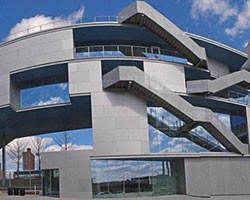
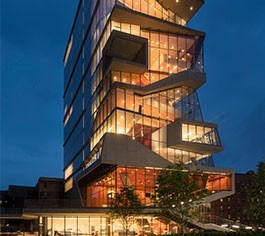
Columbia's Greene Hall recently underwent a $12 million renovation to create a new lobby with 37-foot-high atrium, and a wealth of seating area, including a commons and cafe, that are connected to the School's computer network. Students and faculty can now plug their laptop computers into nearby jacks and gain access to data previously available only within the confines of a library. Columbia is among the nation's first law schools to be "fully wired."

"You've turned a 1960s building into a building for the twenty- first century, a building that is most technologically advanced of any law school in the country," said Warren. He credited Lance Liebman, dean of the School during the project's development, and his choice of James Steward Polshek as architect for the renovation.

Prior to the ribbon-cutting, a series of panels were held, highlighted by the day's grand symposium, "The Great Law School: Changing the Law Through Legal Education and Scholarship." Supreme Court Justice Stephen Breyer, along with Ginsburg, and Guido Calabresi, circuit judge for the U.S.Court of Appeals for the Second Circuit, and Richard A. Posner, chief judge of the U.S. Court of Appeals for the Seventh Circuit, all spoke at a symposium on the effects of law schools on the judiciary and the law. Former Law School dean and University President Michael I. Sovern, moderated the panel, which was simulcast to Low Library and the Law School, as well as shown as a "live-time" broadcast over the University's World Wide Web page.

Ginsburg went on to point out the unique relationship that exists between law schools and the judiciary. "One of the biggest impacts on the courts is made by law professors who turn judge," said Ginsburg. She said that three of the current nine justices came from academia. She also noted that law review articles emanating from law schools continue to play an important role in informing opinions of the justices.

"What a relief it is, when deciding a case, to receive a book or law review article that speaks to that case," said Justice Breyer. "It may not answer the question, but often it helps."

Columbia Law School has played a pioneering role in legal studies in the United States. James Kent, Columbia College's first professor of law before the Law School had been officially established, published the classic Kent Commentaries on American Law in the 1700s. Theodore W. Dwight, the Law School's first professor and dean in 1858, invented the Dwight Method of teaching, which established the superiority of academic training over office instruction. Besides Ginsburg, other Columbians who have gone on to the Supreme Court include the court's first Chief Justice John Jay, and Justices Charles Evans Huges, Samuel Blachford, Benjamin Cardozo, Harlan Fiske Stone, Stanley Reed and William O. Douglas.

Other notable graduates of Columbia Law School participating in the day's events included United States District Attorneys Mary Jo White and Eric Holder, the literary agent Morton Janklow, and Federal Trade Commissioner Robert Pitofsky, and Daniel Greenbers, the head of the Legal Aid Society of New York City, as well as non-grads Arthur Leavitt, head of the Securities and Exchange Commission, and Moynihan.


Columbia University Record -- October 4, 1996 -- Vol. 22, No. 5