

































Photograph.
By Bob Nelson
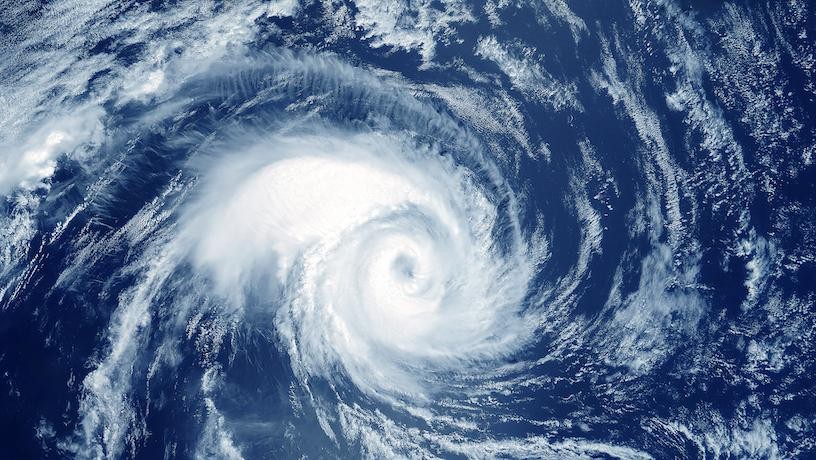
Columbia researchers have for the first time made computer calculations that simulate the atmospheres of the four giant planets, in particular the formation of their horizontal bands and enormous storms like Jupiter's Great Red Spot.
The work, carried out in Columbia's Applied Mathematics Program, is the first to show that a single physical model is able to capture how wind patterns develop on Jupiter, Saturn, Uranus and Neptune, without relying on information that had been thought to be essential and yet is poorly known, such as the effects of heating from the sun or from the planets' inner cores. The model results agree closely with data gathered by the Voyager missions to the outer planets and are supported by data from the Galileo probe that plunged into Jupiter's atmosphere late last year.
James Cho, who recently received a Ph.D. from Columbia's program in applied mathematics and who holds a postdoctoral appointment at the California Institute of Technology, and Lorenzo Polvani, associate professor of applied physics at Columbia, presented the findings to the annual meeting of the American Astronomical Society's Division of Planetary Sciences Oct. 23 in Tucson, Ariz.
The Columbia scientists assumed that the atmospheres of all four giant planets could be modeled by a single thin, fluid-like layer wrapped around a spherical shell, much as Earth's atmosphere is conventionally modeled. In order not to bias the results, the team started the model with a random initial condition of multiple atmospheric vortices, some rotating in the direction of the planet's rotation and others against.
Using only the planets' mass, size, rotation and average wind speed as inputs to the model, they found that after as few as 20 planetary rotations the model's vortices organized to form a steady east-west pattern of horizontal bands similar to those observed on the four planets. The model, the first to reproduce the observed number of bands for each planet, predicted three such bands for Uranus and Neptune, some 10 to 15 for Jupiter and somewhat fewer for Saturn, in good agreement with observations.
"The fact that the four atmospheres are thermodynamically and chemically different while they all share the same characteristic banded appearance has been a major puzzle to planetary scientists," Polvani said. "Our results show that banding occurs spontaneously in a thin shell of rotating fluid, and is a direct consequence of the rotation. Hence the other physical differences among the planets may be unimportant."
Voyager missions since the mid-1970s have photographed the fine structure of both spots and bands of the outer planets. The Columbia computations are the first to produce both bands and spots within the same model, suggesting that both may appear spontaneously in planetary atmospheres. The horizontal bands are wide currents of atmospheric gases that alternate in direction from pole to pole. The spots, found within the bands on all four planets, are gigantic storms tens of thousands of miles in diameter with wind speeds of up to 300 mph.
In December 1995, the Galileo spacecraft orbiting Jupiter dropped a probe that traveled almost 100 miles into the Jovian atmosphere, much less than 1 percent of the planet's radius. As it descended, the probe found surprisingly constant winds of as much as 400 mph, several times faster than upper atmospheric winds on Earth. The constant wind speed found by the probe supports Cho's and Polvani's use of a single uniform layer to model the atmospheres of the giant planets, the scientists said.
"The fact that simple ideas have worked so well to model the outer planets suggest that simplified models may be useful to study Earth's atmosphere as well as those of the inner planets," Cho said. He will continue the work at Caltech with Andrew Ingersoll, a pioneer in planetary atmosphere research.
The work of the Columbia scientists was supported by a National Science Foundation Young Investigator Award to Polvani. The massive computations required for the model were carried out on the Cray C90 supercomputer at the NSF's Pittsburgh Supercomputing Center.
Columbia University Record -- November 1, 1996 -- Vol. 22, No. 8