


























Record Banner
Vol.25, No. 01 Sept. 3, 1999

Community Impact and CitySoft Offer High-Tech Training to Inner City Residents

By Hannah Fairfield

In a small office in downtown Manhattan, David Sheppard, a longtime resident of Harlem, types line after line of computer code. The scene is a familiar one at new Web design companies in the area near Wall Street, but the difference here is striking: two months ago, Sheppard and the computer programmers of this firm, CitySoft, were far removed from the high-paying technology sector.

This summer, the Web design company CitySoft joined with Columbia to recruit and train people from technologically isolated neighborhoods. Through Community Impact, Columbia's community service and outreach program, 24 students with little previous computer training learned hypertext markup language, or html, and Web design.

"Columbia opened its doors to teach Internet learning technologies and helped us to create opportunity where it hasn't existed before," said CitySoft vice-president Jack Smith, who met Community Impact leaders in the spring when Smith gave a talk about CitySoft's socially aware policies at the business school. Under Smith's leadership, CitySoft opened its New York office on July 1.

Several of the Community Impact students now work in that office, where they design Web sites for clients such as the Stonyfield Farm yogurt company and Polaroid. Other students work for Medscape, an on-line medical information and advice Web site.

The students in those jobs all say that they never would have been able to enter the high-paying profession of Internet design without the course through Community Impact.

"I had always thought of Web graphics design as a young person's field, but CitySoft was looking for people who wanted information technology skills," said David Sheppard, the Harlem resident, whose graying mustache hinted that he was a grandfather. "CitySoft people never said, 'You're too old,' or 'You're from Harlem.' They just said, 'Do you want to work?'"

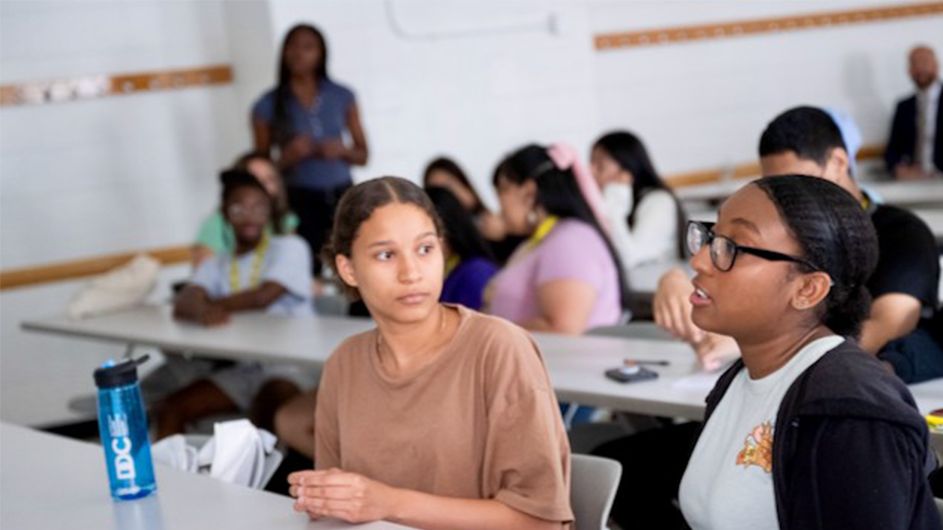
The course brought the 24 students, mostly African-American, Dominican and Hasidic Jewish residents from the South Bronx, Williamsburg and Harlem, to computer labs in Teachers College and seminar rooms in Earl Hall, where they learned the craft of Web design. Students attended the month-long, five-day-a-week training at no charge, but they were expected to arrive on time, be dressed professionally and be ready to put in long hours.

"The course was intense," said Sheppard, who is presently employed by CitySoft. "They taught us that in order to get customers, you have to play to win."

Much of the energy behind the course came from Amanda Birnbaum, CC'99, who designed the curriculum and taught the Community Impact class.

"Teaching people to work in a business environment is as important as teaching them html programming," said Birnbaum, who joined CitySoft as a project manager after she graduated from Columbia College in May.

Birnbaum designated four classes per week to be in the lab, where she taught from a computer projected onto a screen in front of the students. On Fridays, the course met in a seminar room in Earl Hall to work on other aspects of job training: writing a resume, interview and phone skills, job retention and how to be a member of a small business team.

"My goal was to learn Web design, but now my dream is to have a managerial position in the computer field, which I never would have been able to do without this course," said Alla Lorman, a Russian immigrant and resident of Brooklyn.

The students were given homework everyday, and those that did not have computers at home—most of them—were allowed to use the computer lab at Teachers College in the evenings after class. " Columbia provided the laboratory, and by doing so, it opened doors to the Internet," said Smith.

Community Impact is designed to open doors between Columbia and economically disadvantaged urban neighborhoods. With 25 different programs run out of the office in Earl Hall, every week more than 1,200 people find tutoring, community lunches, companionship, youth programs and high school equivalency courses.

"Most students were not employed when they came to the class," said Patrick Howell, a Community Impact coordinator who helped administer the course. "But they came together as a team because they realized what they could do with their new skills. For the last project, the whole class redesigned the Community Impact Web site. I was the client, and I told them what the target audience was—them—and what I wanted. And as a team, they designed a beautiful new site."

The new site will be launched this fall.