








![]() |
|
| Vol.25, No. 11 | Jan. 21, 2000 |
By Suzanne Trimel
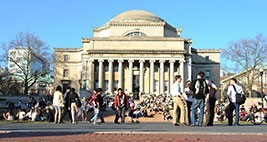
The 200th anniversary of George Washington's death on December 14, 1799 was observed nationwide last month—perhaps most enthusiastically at Columbia. A special tribute was staged in Low Rotunda, organized by a College sophomore who was motivated by his admiration for the Founding Fathers, and particularly for Washington.
Justin Homkow '02 began planning the tribute eight months earlier, contacting well-known historians for guidance, but carrying off the planning on his own. The 21/2-hour program—recognized by Mount Vernon as an official bicentennial event—featured noted Washington historians and a fife and drum corps, and drew 400 guests.
Homkow's admiration for the Foundation Fathers developed in grade school. The native New Yorker, who attended Columbia Grammar and Preparatory School, explained: "They used the greatest thoughts and achievements of mankind as a basis for a new society where individuals would be able to control their destinies and leave a better place for others. They were some of the greatest men to ever walk the Earth."
Washington, he noted, "more than any other person secured our nation's independence and established our legitimacy in the world and national character."
While viewing an exhibit of treasures from Washington's home in Mount Vernon at the New York Historical Society in early 1999, Homkow came across an advertisement for a bicentennial commemoration of Washington's death to be held at Mount Vernon.
"I thought about Washington and all of the events that happen on campus for very specific purposes and I thought there were no celebrations of our common heritage and our common heroes, such as the Founding Fathers," he said. "It dawned on me that this was the perfect year to do it."
In planning the event Homkow, 19, consulted, among others, Columbia Professor Richard Bushman; historian Dorothy Twohig (GSAS '54), former editor of the Papers of Alexander Hamilton at Columbia and the Papers of George Washington at the University of Virginia; Lesley Herrman of the Gilder Lehrman Institute of American History; and Edmund S. Morgan of Yale University, one of the country's foremost scholars of colonial American history.
Homkow lined up contributions and other support to finance the program, at a cost of almost $10,000, from the Gilder Lehrman Institute, the Manhattan Institute for Policy Research, the American Flag Institute, Fraunces Tavern Museum and the Daughters of the American Revolution.
To lighten the academic program, Homkow arranged a fife-and-drum corps to open the program with a pageant of military and patriotic music familiar to Washington, and invited three musician-friends from Columbia and New York Universities, a cellist, violinist and vocalist, to perform popular 18th-century music, including several of Washington's favorites. A dessert reception featuring an elaborate cherry-filled cake concluded the program.