420 West 116th Street, New York City
THE SWEDISH PROGRAM
OF COLUMBIA UNIVERSITY
PRESENTS
October 11, Tuesday, at 7 p.m.
Outlaws or In-laws?
The Effects of Gay Marriage in Scandinavia
A Talk in English by Jens Rydström
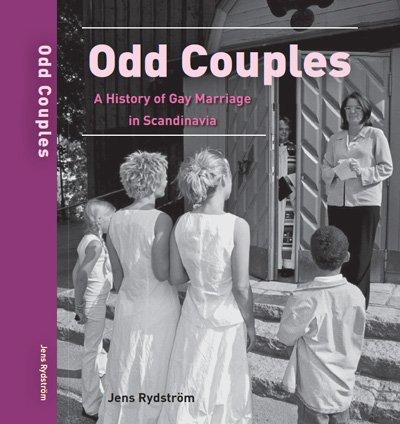
The concept of marriage as a union of a man and a woman was fundamentally challenged by the introduction of registered partnership in Denmark in 1989. Jens Rydstr�m has studied the interaction between gay activism and traditional party politics and traces the origins of laws that at first were extremely controversial � inside and outside the gay community � but have now gained broad popular and political support. What are the consequences of gay marriage after more than twenty years? By looking at positive and negative effects of the legislation, Rydstr�m presents a nuanced assessment of the new ways to assimilate and recognize same-sex relationships within the framework of the Scandinavian welfare state.
Sponsored by the Columbia Swedish Program with the assistance of the American Scandinavian
Foundation, the Consulate General of Sweden in New York, and the Swedish Institute.
November 9, Wednesday, at 7 p.m.
Sweden's Most Puzzling Nonfiction
Murder Mystery:
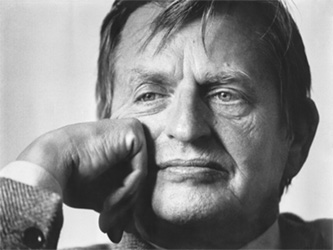
Who Killed Prime Minister Olof Palme?
And Who Was His Unlikely Assassin?
A Talk in English by Hans Hederberg
Sponsored by the Columbia Swedish Program with the assistance of the Consulate General of Sweden in New York and the Swedish Institute.
About the Speaker
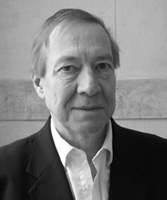
Hans Hederberg is a Stockholm author and director who started his journalistic career as a film critic, studied the history of films at the British Film Institute, then went into radio and TV and published books. In the employ of Swedish Television from 1966 to 1994, he produced and directed cultural and current affairs programs. From 1977 to 1987, he dealt almost exclusively with the theme of terrorism � in television, film, and books (fiction and nonfiction). He wrote and directed The Kroecher Case for TV, a play based on material from police interrogations. He expanded the material and directed it as Operation Leo, which in 1981 played in movie theatres in Sweden and abroad. He also adapted segments of some 20 stage
 productions for his TV series "Theatre Review" ("Teaterkrönikan," 1987-1988). Hederberg was the first person to examine the correspondence of Alva and Gunnar Myrdal in the Swedish Labour Movement Archives in 2000. In 1982 he had directed a documentary portrait of Gunnar, and in 2004 he published a documentary study of the Nobel laureates' letters. His one-act play (based on that book) was presented as a reading at Deutsches Haus in November 2005 and is available as a CD.
From the Swedish reviews of Hans Hederberg's recent book Offret och gärningsmannen: en essä om mordet på Olof Palme (The Victim and the Perpetrator: An Essay on the Murder of Olof Palme)
From "Palmehatet grodde i alla klasser" (The Hatred for Palme Grew in All Classes) by Lars Linder. Published in Dagens Nyheter, February 26, 2011.
The Victim and the Perpetrator by Hans Hederberg consists of two free-standing essays. The first deals with Palme himself and reviews some circumstances that contributed to his ambiguous reputation in the eyes of many: his background in the intelligence service, the conflict with the Security Police, and the efforts to mediate with the Soviet Union in the Cold War. The second deals with Christer Pettersson � who here in plain terms is called �the perpetrator.� Only the formalities of the legal system kept him from being condemned, believes Hederberg, whereas an essayist such as himself has the liberty to base the guilt on relevant documents and his own convictions. Perhaps he should be grateful that Pettersson � who was acquitted nevertheless � is not alive to correct him (or even worse). The material is interesting anyhow: Hederberg has plowed through hearings and investigations and was the first outsider to get access to the classified mental health studies. What emerges, on the whole, is the familiar sad story of a gifted young man�s pathway to drugs and crime � but the profile that emerges has exceptionally sharp edges. Pettersson appears here to be more dangerous as well as more unpredictable than previously, sometimes thoughtful and articulate, sometimes quite confused (to a certain extent also a victim of the lax antipsychiatry of the sixties and seventies, which he managed to manipulate). And quite capable of not just killing.
Review by Åsa Moberg in Helsingborgs Dagblad (June 16, 2010).
Is there anything to add after all these years? Yes, the proof is in Hans Hederberg's book The Victim an the Perpetrator: An Essay on the Murder of Olof Palme. This two-part essay is recommended reading for anyone the least bit interested in Swedish society, its climate of debate, politics and social policy. The focal point is the perpetrator, perhaps because Hederberg is the first writer to get access to Christer Pettersson�s journals and who therefore can present new material.
But on every level of the drama, a long series of
circumstances is recounted here in low key, viewed mainly without comment. This persuades me, as a reader, that it is reasonable to designate Pettersson as the perpetrator, despite the fact that he was acquitted in the Svea Court of Appeals though he was found guilty in the District Court.
Christer Pettersson�. Who was this national lunatic, who with almost frightening bravado displayed condescending forgiveness toward the legal system when he was released by the appeals court? The fact that he had gone to theater school and been a gifted drama student came out at the time in the media�.
The book gives a detailed picture of a remarkable crime career�. A disgruntled drug addict with an extremely short fuse, with access to weapons and zero impulse control: this is the picture that Hederberg gives of how the actual murder occurred. But in a sense that is a less important detail in this broad portrait of how badly things can go when a very aggressive person, acting out, becomes the focal point of political hatred that has been allowed to flow freely even in the most influential circles.
On the Danish television program "Lorry" on March 2, 2011, historian Håkan Arvidsson (a frequent contributor to Svenska Dagbladet) described Hederberg's book as "the best thing that has been written about the Palme murder," adding that "in all likelihood Christer Pettersson was the killer and that all the other leads led nowhere or were dead ends."
For further information: Tel.: 212-854-4015; e-mail: [email protected].