The Zeta Psi Story:
An Illustrated and Annotated History
of the International Fraternity
1847—1860 · Foundation and Early Expansion
On the first of June in 1847, three intrepid men gathered in a New York home with grand purpose in mind: the constitution of a new greek-letter secretsociety. Their names were John Bradt Yates Sommers, William Henry Dayton, and John Moon Skillman; the fraternity they founded that day is Zeta Psi.
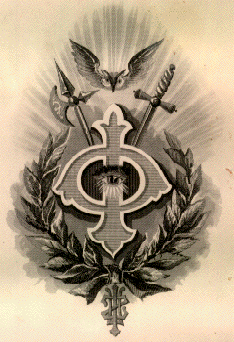
Above left: the Phi chapter at NYU.
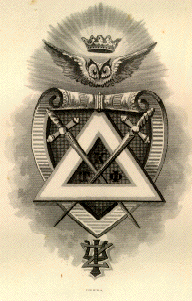
Above right: the Delta chapter at Rutgers.
Below: an 1848 etching of “the founders&rsquo arms”

Then students in the class of 1849 at New York University (itself a young campus, having only been founded in 1831), the three men formed the core of the first chapter, Phi. But William Dayton was stricken with poor health and diagnosed with tuberculosis. On advice of physicians, who followed the common wisdom of the time advising warm climates, he departed New York shortly after the fraternity’ foundation for more temperate climes. He retired to the University of North Carolina, where the warm weather was expected to improve his humors, intending to begin a chapter there. But the move was inauspicious: Dayton died within the year, and the University of North Carolina was without a chapter of Zeta Psi for over a decade. The Phi chapter commemorated his passing when news arrived, and Br Sommers, as part of a eulogy delivered on 23 May 1848, described Br Dayton thusly, “His willingness to labor for others, his uniformity of charity and disposition, meek lustre of a piety that neither blazoned ostentatiously at one time nor wavered and sunk at another, but shone serenly and steadily on, make him deservedly the favorite of all who knew him.”
Meanwhile, Br Sommers, the son of the Rev Dr Charles B Sommers and Sarah Skelding, had been the originator of the idea for a new fraternity, and would remain a leader and model to the organization he had helped create, becoming president at the national conventions in 1850 and 1851. No stranger to secret societies, he had been inducted into the Masonic Order a the Arcturus Lounge in New York City, and would become a Past Master before his untimely passing in 1863, after a long and wasting illness. He was much praised by both Masons and Zetes, and his funeral and interment at the elegant Green-wood Cemetary in Brooklyn was extravagantly attended. The Masonic Grand Master of New York eulogized, “His fine intellect, his scholarly achievements, his professional ability, his courteous manners, and his zeal in every cause for intellectual and social advancement were elements of his character which endeared him to all who knew him...”; meanwhile, the Phi chapter instructed that the following obituary be sent to the several chapters then extant:
The whole Fraternity of Zeta Psi is called upon to mourn the untimely decease of Br J B Yates Sommers, the honored and respected founder of our Order, which he committed to love and adore to the day of his death. His own generous disposition and the debt of gratitude we owe him as one of those who instituted the pure and noble principles of Zeta Psi have made his memory sacred to the heart of every brother.
While bowing in humble submission to decree of infinite love and wisdom, we deeply mourn the sad Providence which has deprived us of this revered patriarch of our Fraternity. While grieving for our own loss we tender our heartfelt to that other circle to which our departed Brother was bound by the fondest of earthly ties. As a faint expression of our deep regret we will observe the ritual of mourning, drape our hall and shroud our badges in the usual manner, and request our sister chapters to unite with us in this tribute of respect.
Br Skillman was a great boon to Sommers in those early days of the brotherhood. He served as the first phi of the Phi chapter, and was instrumental in much of the fraternity’s early expansions. He would outlive both of his fellows in the grand conception of Zeta Psi, though not for long. With the outbreak of the Civil War, he would enlist in the Union Army, serving as a naval pay clerk aboard the USS Potomac, then the USS Bohio, and finally on the ill-fated USS Meteor, on which vessel he would perish in Mobile Bay on 13 June 1865, just over eighteen years since Zeta Psi had begun. Like Br Sommers, we would be interred at the famously pastoral Green-wood Cemetary.
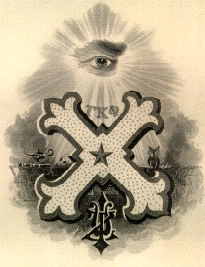
Above left: the Chi chapter at Colby.
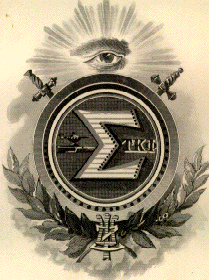
Above right: the Sigma chapter at U Penn.
The Phi chapter at NYU had prospered under the stewardship of Skillman, Sommers and his successors, having graduated its first member in 1948 with George S Woodhull (Φ ’48). The second chapter was established as Zeta at William College in Massachusetts, but it was to be short-lived: in 1952, the faculty of the university voted to proscribe fraternal organizations from campus. The Delta chapter was founded at Rutgers University later that year, and remains the most longevital continuously active chapter of the fraternity (the Phi chapter was briefly inactive in the 1970’s).
Three chapters followed in 1950: Omicron Epsilon at Princeton University, Sigma at the University of Pennsylvania, and Chi at Colby College in Waterville, Maine. The first two are still active, as was the Chi Chapter until 1988. But in the early 1980’s, Colby College prohibited fraternities on campus, despite the long and storied tradition they had enjoyed there. By 1988, ejected from campus and banned from any formal rush, the chapter quietly expired after over 130 years of existence. Problems beset other early chapters as well. The first Alpha chapter was founded in 1852 at Dickinson College in Carlisle, Pennsylvania. But immediate resistance from the administration slowly wore upon the brothers there, and that chapter became in inactive in 1872, permitting its illustrious letter to be used for the later chapter founded at Columbia.
But expansion proceeded apace throughout the 1850’s at a rate of several chapters per year: Epsilon was chartered at Brown and Rho Epsilon at Harvard in 1852; Psi Epsilon at Dartmouth in 1853; Kappa at Tufts in 1855; Theta at Union College in 1856; Tau at Lafayette in 1857; Xi at University of Michigan in 1858. Also in 1858, the Upsilon chapter was finally founded at the University of Northern Carolina, fulfilling the purpose of Br Dayton in his last journey south. And in that year an abortive attempt was made to colonize Amherst College with the Pi chapter, which was rechartered at Rensselaer Polytechnic Institute in 1860 as the war among the several states loomed large.
1860—1864 · The Civil War
The Badge of Zeta Psi
by Br Francis Lawton
written 15 December 1891

You ask me why upon my breast
I wear, tho’ bent and grey,
These ancient characters of gold,
Gem’d with the diamond’s ray.
A band of students long ago,
When life’s bright morning shone,
Gave me this badge, the badge they wore,
To show their hearts were one.
And that is why upon my breast
I wear, as years go by,
These ancient characters of gold,
The Badge of Zeta Psi.
On Chattanooga’s bloody field
A pris’ner left to die,
I saw a chief in Southern grey,
Deck’d with this badge march by.
He nursed me, clothed me, set me free,
And when we said good-bye,
He, silent, pointed at the badge,
And spoke, “Tau Kappa Phi.”
But those chapters were the last before the conflict brewing for nearly a century was unleashed finally. Lincoln was elected president of the United States in 1860, and South Carolina seceded from the Union, followed shortly thereafter by her fellow Southern states. Expansion of the fraternity halted as campuses rallied for war and sent companies of their collegemen to battle. Zeta Psi too contributed her men, and many did not return.
At the outbreak of war, the Upsilon chapter at UNC—itself only chartered three years before—found itself the only chapter of Zeta Psi among all the Southern states, sundered from the North by the sudden lines of enmity. But even as they mustered for war and marched south, the Grand Chapter of Zeta Psi, specially assembled in early July 1862, adopted the resolution of Br William Cooke (Φ ’58) prescribing unity:
RESOLVED, That while we may differ in political sentiment with those of our Brothers who are courageously battling for principles which they deem right, no disaster shall separate them from the union of Tau Kappa Phi.
And the brothers of Upsilon replied by letter in like fashion:
WHEREAS, The present distracted state of our country renders it inexpedient to hold our convention in this State during this year;
RESOLVED, That the Sigma Alpha be instructed to write to all Chapters, assuring them that though our Federal Union has been dissolved, still the Circle of Zeta Psi Fraternity shall never be broken;
RESOLVED, That the bonds of Tau Kappa Phi which bind us to our Brothers in the North are as strong as they ever were.
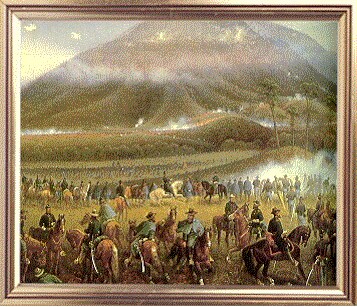
Above: an artist’s depiction of the Battle of Chattanooga. A more comprehensive treatment of the battle can be found here.
Nor was the brotherhood among Zetes limited to mere words; the moving tale of Br Henry Schwerin (Θ ’63) illustrates the embodiment of love even in the most trying of circumstance. Schwerin lay gravely wounded after the bloody Battle of Chattanooga III; pinned on the breast of his Union uniform was the badge of Zeta Psi. A passing Confederate soldier, also a Zete, spied the badge and carried the invalid to medical care and safety, ignoring even the imperatives of war for the sake of his brother. The worthy badge later passed into the hands of his brother, Max Schwerin (Θ ’70), who would one day serve as Phi Alpha. After his death, it was donated by his sister to the fraternity’s archives and remains among its treasures. Br John Day Smith (Ε '72) witnessed the incident on the Chattanooga field, and later related it to Br Francis Lawton (Ε ’69; ΦΑ in 1891), who would author the poem “The Badge of Zeta Psi,” later set to original music and preserved to this day. The reference to “Chattanooga’s bloody field” is not idle hyperbole, but the recollection of a rare triumph among such sorrows.
And amid these sorrows and heroisms, when so many brothers of Zeta Psi perished, so too were even whole chapters swallowed by the War. The Eta (Gettysburg, chartered 1861), Psi Epsilon (Darthmouth), Upsilon (UNC), Epsilon (Brown), and Theta (Union) chapters had vanished by the end of battle, decimated by fallen brothers or disheartened campuses returning from the shadow of death. The Theta and Eta chapters would never survive the staggering losses they suffered, though the others ultimately recovered and reactivated. And the Gamma chapter—chartered 1861 at the Georgia Military Institute, the only new chapter during the War—was annihilated utterly by Sherman’s march, and existed thus only for those few years of tumult. But out of the shadow of war came regrowth and a time for Zeta Psi to expand once more.
1864 to 1914 · Breaking New Ground
The nation was still young indeed even after the end of the Civil War: California has only recently become a State, committing to the side of the victorious Union and contributing its men though the conflict took place mainly across the continent, thousands of miles away. It was then only fitting that to California the fraternities should next have moved. And as in many initiatives, Zeta Psi was first: in 1870 it established the Iota chapter at the Berkeley campus of the University of California and became the first fraternity on the West Coast; indeed, the first fraternity to establish a chapter west of the Mississippi. (Though the Iota chapter would not be joined until 1892 by the next addition, the Mu chapter at Stanford.) Recently, archæologists at UC Berkeley completed an excavation of the original Iota chapterhouse behind 2251 College Avenue, which the chapter occupied until the 1950’s, when they moved off-campus. (The dig was considerably aided by the fact that the Cal archæology department is now located at that very location. Some of the artifacts dated back as early as 1870, when the fraternity first arrived, and demonstrated a rich history of fraternal life between 1870 and 1920. [You can read more about the excavation at the Zeta Psi site or in an article in the Berkleyan.]
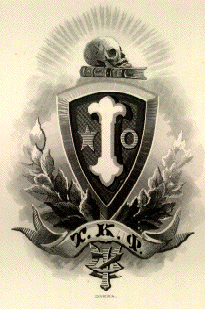
Above left: the Iota chapter at UC Berkeley.
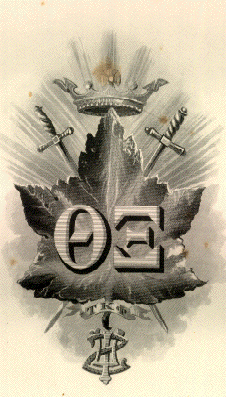
Above right: the Theta Xi chapter at U Toronto.
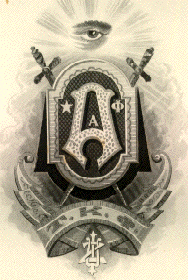
Below:the Alpha chapter at Columbia.
Nor was Zeta Psi content even to remain a national fraternity, but also pressed northward into Canada. The brothers of the Xi chapter at the University of Michigan in 1879 constituted the Theta Xi chapter at the University of Toronto, making Zeta Psi the first international fraternity as well. Since then, Zeta Psi has actively bolstered its Canadian presence, commissioning a director solely for Canadian chapter development and amassing a long list of successful chapters there.
Also in late 1879—an auspicious year for Zeta Psi—on December 12, the Columbia University chapter of Zeta Psi was chartered, taking its name of Alpha from the long-inactive Dickinson College. [Read more about the Alpha Chapter]
The end of the nineteenth century was fecund ground for Zeta Psi. It took root at no fewer than fourteen colleges in those latter days: Omega was founded at U Chicago in 1864; Pi at RPI in 1865; Lambda, Bowdoin, 1867; Beta, U Virginia, 1868; Psi, Cornell, 1868; Iota, UC Berkeley, 1870; Gamma, first at the US Naval Academy in 1874, and then at Syracuse in 1875 after the government proscribed fraternities at its military academies; Theta Xi, U Toronto, 1879; Alpha, Columbia, 1879; Alpha Psi, McGill, 1883; Nu, Case Western, 1884; Eta, Yale, 1889; Mu, Stanford, 1892; Alpha Beta, U Minn, 1899. (The establishment of the Eta chapter at Yale made Zeta Psi the first and only fraternity to establish chapters at all eight Ivy-League schools.)
Below: Br William Comstock. Michigan maintains an archive of Comstock’s papers as governor here.

Br Comstock was also potent in politics, rising to the chairmanship of the Michigan Democratic Party before election to governor in 1933, interrupting a chain of gubernatorial Republicans since 1917—though he would be succeeded by a GOP man two years later. During that time he engineered the “Comstock Agreement” under which the federal government ceded control of Indian lands to State or autonomous regulation. And Br Comstock served as Phi Alpha until his death mid-century, a great statesman and a great Zete.
Even as the physical reach of Zeta Psi made great bounds, so too did the principles underlying its brotherhood. By the turn of the century, the need for some more centralized structure pressed as chapter after chapter was added to the Circle and their correspondence became too much to handle so chaotically. In 1909, an international publication concerning the affairs of Zetes was first published by Br William Comstock (Ξ '99) and distributed among the several chapters: The Circle of Zeta Psi. The periodical, which is still published to this day, contained in that first issue the exhortation which has come to be known as “The Vision of Bill Comstock” for its prescience and wisdom:
We feel that the Fraternity, now that its individual chapters and memberships have grown so strong, is wasting its greatest possibility of strength and growth through the lack of a systematic central organization.
In short, Br Comstock criticized the degree of individualism among the chapters of Zeta Psi, demanding unity among such disparate brothers. He prescribed that every member should receive the fledgling Circle of Zeta Psi, and thus be apprised of the far-flung doings of the fraternity; that a general secretary be commissioned to travel among the chapters and treat with them; and that a foundation be established for the pecuniary support of the general fraternity. And all three of his mandates have been amply fulfilled: The Circle is still published and distributed to the brothers of Zeta Psi (and can be read online here); now the General Secretary is assisted in his rounds by chapter consultants, whose function remains the same; and the Zeta Psi Educational Foundation was to be instituted within Br Comstock’s lifetime, though still in the future. Before Zeta Psi could turn to such collegiate concerns, war again threatened, this time abroad.
1914—1920 · The First World War
In Flanders Fields
by Br Dr John McCrae
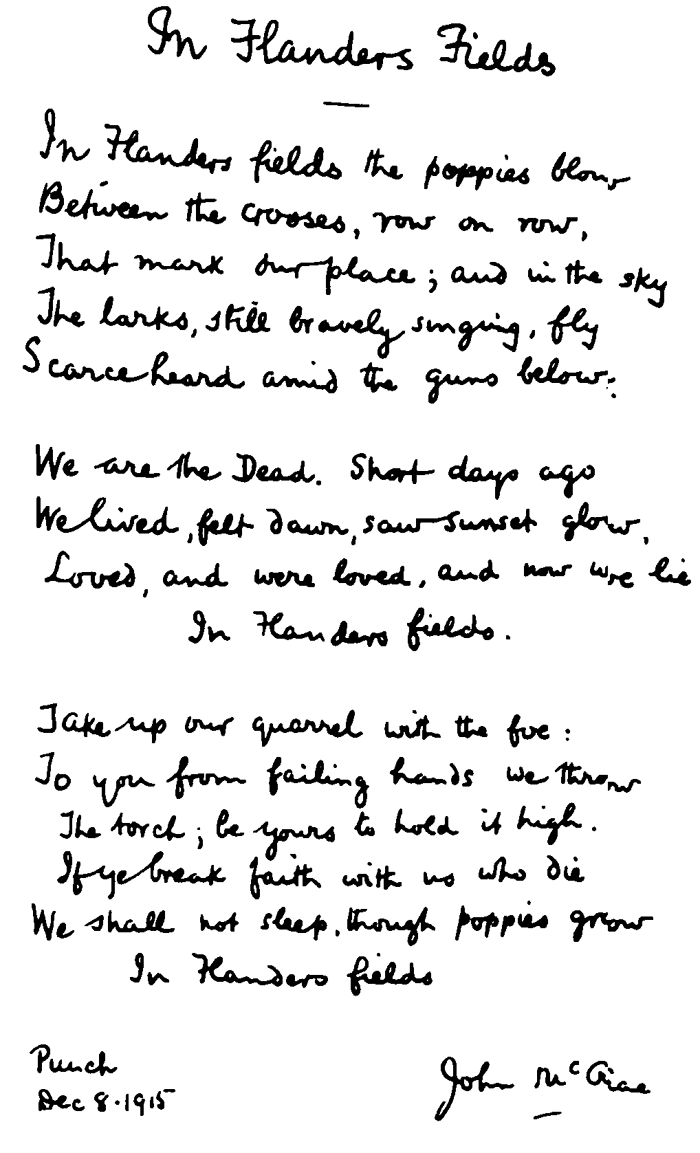
In Flanders Fields the poppies blow
Between the crosses, row on row,
That mark our place; and in the sky
The larks, still bravely singing fly,
Scarce heard amid the guns below.
We are the Dead. Short days ago
We lived, felt dawn, saw sunset glow
Loved and were loved, and now we lie
In Flanders Fields.
Take up our quarrel with the foe;
To you from failing hands we throw
The torch; be yours to hold it high.
If ye break faith with us who die,
We shall not sleep, though poppies grow
In Flanders Fields.
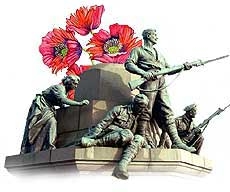
Though already inured to the horrors and trial that War would wreak upon her from the bloody Civil War, war in Europe came suddenly in the 1910’s and caught a nation and fraternity unawares. For some time, the United States did not commit troops to the battle, maintaining an isolationist stance protected. But Canada was a member in good standing of Britain’s Commonwealth, and as war threatened England, the men of Canada were called upon to support their ally abroad.
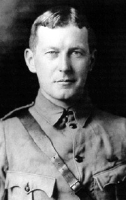
Left: Br Dr John McCrae.
See Ontario’s Guelph Museum’ treatment here, or the Flanders Fields museum in Belgium here, or our international headquarter’s treatment here. Also see Rob Ruggenberg’s excellent article on the poem here. Click here to see the original handwritten manuscript of the poem.
With the first Canadian chapter only founded at Toronto in 1879, her sister chapters were still young when war came to them. Particularly stricken were the Alpha Psi and Theta Xi chapters at McGill and U Toronto. Even in 1914, they were already sending letters indicating their brothers heading east across the sea to the war. In 1915, more than half the workers at the McGill Base Hospital were Zetes from Alpha Psi. By war’s end, the two beleaguered chapters had given over two hundred souls in defense of King and Country.
Perhaps most noted (and noteworthy) among the rolls of the brave Canadian brethren who went overseas is Lt Col Br Dr John Alexander McCrae (ΘΞ '94), a serviceman in the Canadian army, who like so many other men did not return at the close of conflict. But Br McCrae bequeathed to his fraternity more than even his worthy life, but also a poem which has been preserved in great honor as both a historical and literary work: “In Flanders Fields.” The words are a testament to the heroic spirit in man and are treasured still by the brethren of Zeta Psi as the hallowed words of a brother whose time long ago passed.
Br McCrae was assigned to the Canadian 1st Field Artillery Brigade, which was deployed to the marshy lowlands of Flanders, in western Belgium. He was moved to elegy by the sudden death by shelling during the Second Battle of Ypres of his longtime friend Lt Alexis Helmer, a former student from his days of teaching at McGill University, and wrote what would become the famous verses the next day, on 3 May 1915. Other men in his company to whom he showed the words, ink still wet, were struck by its uncanny and evocative verisimilitude. Wrote Sgt Maj Cyril Allinson, “The poem was an exact description of the scene in front of us both. He used the word blow in that line because the poppies actually were being blown that morning by a gentle east wind. It never occurred to me at that time that it would ever be published. It seemed to me just an exact description of the scene”; Lt Col Edward Morrison agreed that “just as he describes, we often heard in the mornings the larks singing high in the air, between the crash of the shell and the reports of the guns in the battery just beside us.” McCrae discarded the poem, but Morrison saved it and submitted it to Punch Magazine, where it would be published later that year on 18 December. Tragically, McCrae lived but a few short years longer, perishing on 28 January 1918 while still serving at the military hospital, from the combined ravages of meningitis and pneumonia.
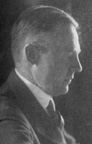
Case Western Reserve University maintains a collection of Crowell’s correspondence and papers; an online catalogue may be found here.
Right: Br Benedict Crowell.
Finally in 1917, America entered the war, and with their country, so too did the many Zetes who called that land their home. At the annual convention of Zeta Psi, the brothers adopted a resolution in support of the war—which the United States Congress had itself only declared a few weeks previously—:
WHEREAS, The United States of America has been forced into the World War in defense of its national honor and for the protection of international justice and democracy;
BE IT RESOLVED, That the Zeta Psi Fraternity of North America, at the Seventieth Annual Convention assembled at Raleigh, North Carolina, hereby pledges to the President and Congress of the United States of America its unqualified support of whatever war measures the Government may deem necessary and expedient, and places at the disposal of the Government its national organization, its Chapters, and its individual members, for service in whatever capacities the government may direct.
Nor was the pledge mere idle words nor fatuous boasting. Over one quarter of all brethren of Zeta Psi would serve during the First World War in foreign lands, and many did not return. Zeta Psi also provided the nation its first Assistant Secretary of War, Br Benedict Crowell (Ν '92), noted for his bold reorganization of civilian military control during World War I. Even after the war, Crowell remained politically powerful, and was later instrumental in engineering the repeal of National Prohibition (read about it here). When battle and country called, the men of Zeta Psi answered.
1920—1946 · Troubled Peace and Another War
The post-war years were marred by the calamity of the Great Depression in the United States, and Zeta Psi suffered with her country. The ranks of brothers at campuses across the nation had been decimated by war, and chapters had struggled to survive. Yet they had persevered—not one chapter went inactive in those years. But expansion was slow, as the chapters rebuilt their strength after the toll. By 1930, the nation had fallen into deep economic trouble, and students struggled to attend college, let alone accede to a brotherhood demanding of time and energy. Not only was the collegiate population averse to expansion; but in the meager times, campuses were reticent to open their doors and resources to new fraternities. Only two new American chapters were chartered during this period, Phi Lambda at the University of Washington in 1920, and Sigma Zeta at UCLA in 1924. By 1930, no more chapters would be chartered until after the Pyrrhic economic boom occasioned by the Second World War that Zeta Psi would reach many of its present chapters.
Below: Br Lewis Pilcher


Above: Brs Julian Carr and Lewis Pilcher shaking hands
Yet these decades were not without moments of profound joy among Zetes. Zeta Psi celebrated its diamond jubilee (the seventy-fifth anniverary of its foundation) in 1922, with fesitivites in its birthtown of New York. Auspiciously, it happened that both the Grand Army of the Republic (the famed organization of Union veterans; their modern web presence can be found here) and the United Confederate Veterans had elected brothers of Zeta Psi as their commanders-in-chief for that year. Thus at a dinner held for Zetes in New York that year, the two men—Brs Lewis Stephen Pilcher, GAR, and Julian Shakespeare Carr (Υ ’68), UCV—shook hands and broke bread as brothers, rather than the leaders of two organizations still as militantly opposed as forty years before. Br Henry Thomas, the evening’s toastmaster, remarked, “If the North and South had only placed the controversy in the hands of Zeta Psi, there would have been no war. At last the mistake has been realized, and now we see our two Brothers, each in command of his old army.” Julian Carr had served in the Third North Carolina Cavalry and witnessed the Confederacy’s surrender at Appomattox, and though he never achieved high officership in the Confederate Army, he was granted the honorary title of Major General by the UCV and was commonly called the “General” by friends. He was major philanthropist of educational and industrial concerns, founder of the eponymous Carrtown near Chapel Hill, and a great benefactor of the South. [Read more about his life at the UNC documentary archive here.]
And while expansion in America had stalled, Zeta Psi’s presence in Canada grew dramatically. The Pi Epsilon chapter was chartered at Univerity of Manitoba in 1921, Sigma at the University of British Columbia in 1926, Mu Theta at the University of Alberta in 1930, Alpha Mu at Dalhousie in 1938, and the Theta Phi chapter would be founded at the University of Western Ontario in 1947.
Copyright © 2002-2005 Jared Sunshine. Permission is granted to copy, distribute and/or modify this document under the terms of the GNU Free Documentation License, Version 1.2 or any later version published by the Free Software Foundation; with the Invariant Section being that entitled “The Zeta Psi Story”, ie the text beginning with first incidence of the words “The Zeta Psi Story” and concluding with the first incidence of the words “Psi Fraternity”, no Front-Cover Texts, and no Back-Cover Texts. A copy of the license is included in the section entitled “GNU Free Documentation License”.
You may feel free to email me at [email protected] regarding licensing, errata, or addenda to this document.