| Gargoyle Man |
New Discovery Throws Anthropological Field in Turmoil
By Henry Lovecraft
Times-Newswire
Lake Eyre, Australia, Aug. 24th - Earlier this August 15th, on what many in the anthropological field say is destined to be known as "Black Tuesday," a collaboration of Australian and American anthropologists uncovered a stunning find: a near-complete skull and the left foot bones of a new species of hominid, dated at around 1.9 to 1.4 million years ago.
Early examination of the fossils uncovered revealed the specimen to be intelligent; it is close to homo sapiens (modern humans) in both brain size and mental distribution; however, this is where the similarity ends. The skull's facial characteristics are remarkably primitive in some aspects, wholly unusual in others, and downright unbelievable in others: the skull shows indication that this human-like species had horns.
"Lord knows what we're going to make of this thing," says Dr. Bedevere Lambert, head of archaeology at the University of Wisconsin in Oshkosh and director of the excavation. "It defies everything we've come to understand about the evolution of hominid dentition, cranial capacity, and appearance of this time period. It's so unusual a find, I'm not even sure it can even be considered among the other hominids of humanity's ancestral tree."
|
| |
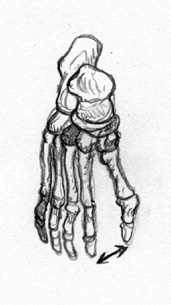
| Above: Fossil Remains of Left Foot. |
While it may not be considered human, the discovery is definitely a hominid, due to the information provided by the foot bones. The heavy structure of the ankle, as well as the presence of an arch in the 80% complete left foot, strongly indicate that the creature was a perpetual biped. However, it also possesses a partially splayed big toe, similar to a chimp's. "This combination of elements is found most early hominids, especially among the australopithecines, who very likely continued climbing behaviors while practicing bipedalism," says Dr. Lambert, "However, this toe is splayed considerably, which is a characteristic that had disappeared altogether by the date of the find."
"Its cranial development is unusual for this time as well, outstripping both homo habilis and homo erectus, both of whose time on Earth the species shared. It's also shockingly old relative to its location on Earth; until now, Australia was thought to have been unpopulated until the coming of homo sapiens, which according to the finds at Lake Mungo was at least 56,000 years ago; but these fossils indicate the species was around for thousands of years previous." The implications of such a mentally advanced and morphologically divergent species found in this time and place are staggering. Dr. Lambert admits that he cannot even begin to muse about what the find will mean for such theories as human mental development, locomotion, and survival styles. "I'm not even sure we can call this thing human. The taxonomic nightmare this find represents is pretty obvious to everyone. We've taken to calling it homo gargolis, out of humor more than anything else."
Times-Newswire
24 August 2000
| Return to Main | Next Article | ||
|---|---|---|---|
All contents © Stephen Grant. All rights reserved.