|
WEEK
11. DEVELOPMENT AND DECENTRALIZATION: THE POST-WAR ERA
|
 |
 |
 |
 |
 |
 |
 |
 |
 |
 |
 |
 |
 |
 |
 |
 |
 |
 |
 |
 |
 |
 |
 |
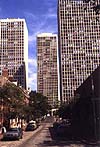
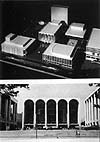
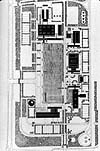
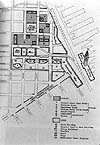
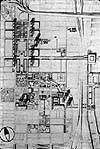
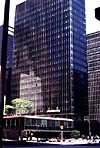
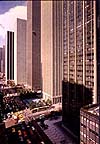
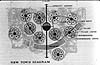
Slum clearance; luxury apartments and convention centers in redeveloped downtowns; the turn toward expressionism and "new humanism" in design; "new towns in town" -- and beyond.
READING:
Catherine Bauer, "Do Americans Hate Cities?" (1956), rep. Architecture
California (Nov.1994)
William H. Whyte, ed., The Exploding Metropolis (l958; Berkeley,
l993), pp. i-iv, 157-84
Carl Abbott, "Five Strategies for Downtown," Journal of Policy History
(l993): 5-27; rep. Mary Corbin Sies, ed., Planning the 20th-Century
American City (Baltimore, l996), pp. 404-427
Recommended:
J. Tyrwhitt, J.L. Sert and E.N.Rogers, eds., CIAM 8: Heart of the City
(London, 1952)
Robert Beauregard, Voices of Decline: The Postwar Fate of US Cities
(Boston, 1993)
Melvin Webber et al., eds., Explorations in Urban Structure (Philadelphia,
l964)
Jane Jacobs, The Death and Life of Great American Cities (New York,
1961)
Peter Wolf, The Future of the City: New Dimensions in Urban Planning
(New York, l974)
Greg Hise, Magnetic Los Angeles: Planning the 20th-Century Metropolis
(Baltimore, 1997)
Ann Markusen,etal, Rise of the Gunbelt:The Military Remapping of Industrial
America (NY, 199l)
QUESTIONS:
l. What were the various ambitions and fears of post-World War II American architects and urbanists? What did they understand to be the advantages and the problems of cities?
2. To what extent was this generation of Americans imitating European modernists, and to what extent were they trying to set new paradigms? How did they see American cities as similar to or different from European cities?
3. What was the role of historic preservation in the modernist urban vision of the 1950s and '60s?
4. Was urban redevelopment intended to be an aid or an antidote to suburban decentralization? What was its effect in particular parts of cities and their surrounding areas? Was there difference from one city or region to another?