|
WEEK
5. MANUFACTURING CIVIC AND COMMERCIAL CULTURE
|
 |
 |
 |
 |
 |
 |
 |
 |
 |
 |
 |
 |
 |
 |
 |
 |
 |
 |
 |
 |
 |
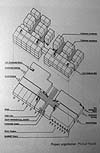 |
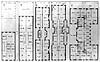
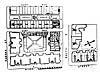
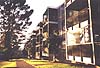
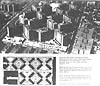
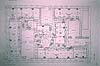
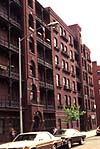
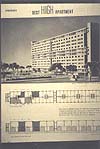
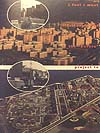
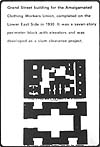
Model workers' housing and model workers; the "project" as an ideal environment; the saga and scale of American public housing; cultural difference versus discriminatory segregation.
READING:
Tenement House Department of the City of New York, For You (New
York, 1917)
Eric Mumford, "The 'Tower in a Park' in America: Theory and Practice,
l920-l960," Planning Perspectives l0 (l995): l7-4l
Catherine Bauer, "The Dreary Deadlock of Public Housing," Architectural
Forum (May1957)
"Bloods/Crips Program," Z Magazine (July/August l992), rep. Architecture
California (l992)
Robin D.G. Kelley, Yo’ Momma’s DisFUNKtional: Fighting the Culture
Wars in Urban America (Boston, 1997), esp. pp. 15-23, 34-46
Recommended:
Robert Halpirn, Rebuilding the Inner City (New York, 1995)
Richard Plunz, A History of Housing in New York City (New York,
1989)
Richard Pommer, "The Architecture of Urban Housing in the United States
during the Early l930s," Journal of the Society of Architectural Historians
37 (December l978): 235 -264
Gail Radford, Modern Housing for America: Policy Struggles in the New
Deal (Chicago, l996)
Peter G. Rowe, Modernity and Housing (Cambridge, l993)
Arnold Hirsch, Making the Second Ghetto: Race and Housing in Chicago,
1940-1960 (NY, l983)
Paul Groth, Living Downtown: The History of Residential Hotels in the
US (Berkeley, 1994)
Douglas S. Massey and Nancy Denton, American Apartheid: Segregation…
(Cambridge, 1993)
Kenneth N. Goines and Raymond Mohl, eds., The New Afro-American Urban
History (NY,1996)
Jan Lin, Reconstructing Chinatown: Ethnic Enclave, Global Change (Minneapolis,
1998)
Sam Davis, The Architecture of Affordable Housing (Berkeley, l995)
Camilo José Vegara, The New American Ghetto (New Brunswick,
1995)
QUESTIONS:
- What are the similarities and differences between "housing" and the
archetypal "house" at different times in American history? How does
this affect Americans¹ attitudes toward cities, where the "dream" of
owning one¹s own home seems so difficult to achieve? Can people care
about their homes without owning them?
- What have been middle-class Americans¹ fears about the housing of
the poor and working class? How has this affected its availability,
architecture, size and location? What are the fears of those who live
in this housing? How h as this affected the built environment?
- What kinds of innovation are possible or even desirable in subsidized
housing for the poor? Who should decide about the appearance of individual
units, hallways and entries, street facades, outdoor space and parking
areas? What do you think is the biggest challenge to an architect?
- There have been many different housing policies on the part of American
governments and philanthropies. What effects have they had? What do
you think each of the major presidential candidates would propose? implement?