BRICK BARGES DOWN THE HUDSON: EARLY INDUSTRIES ALONG THE RIVER
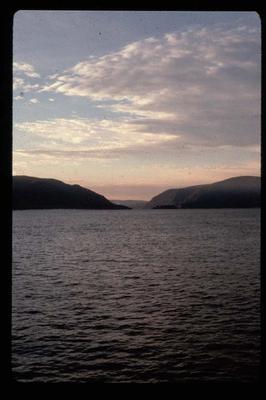
Hudson River at the Highlands (Stanne)
If you were to take a boat trip along the Hudson River, what would you see? For much of its length, it's a beautiful river with green hills and fields on either side. Trains travel alond either bank. You can see some industries and communities, but for the most part, the shoreline of the mid and upper Hudson looks surprisingly untouched.
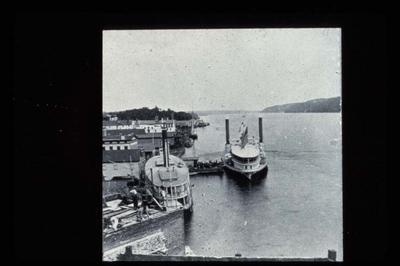
Early Steamboats at Poughkeepsie
Was it always like this? If you took a steamboat ride in 1835, would there be more or less activity on the river?
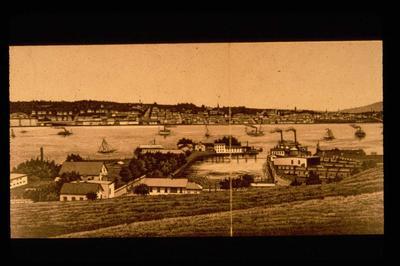
Newburgh from Fishkill Landing (now Beacon)
One hundred and fifty years ago the Hudson River was crowdd with boats carrying passengers and cargo. Every town located by the river had busy docks and businesses which developed because of their access to the river.
Settlers
Three hundred years ago the Hudson had only a hew settlers living in farms or communities along the shore. It was a land rich in natural resources: good soil, forests with game, and a temperate climate.
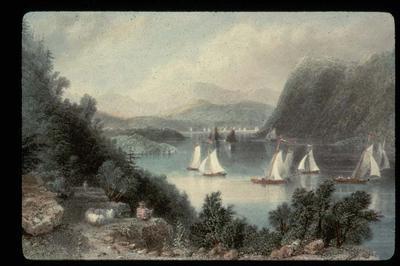
"View from Anthony's Nose"
artist:
William Bartlett
The greatest resource in the area was the river itself. It had a plentiful supply of fish, but its primary importance was as a highway.
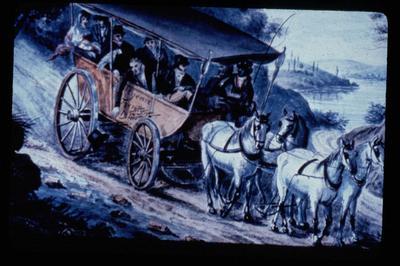
Travelers in a Coach
In the days before good roads, travel by land was tedious and difficult. Travel by waterways was much easier for both passengers and cargo, and the river connected communities along its length.
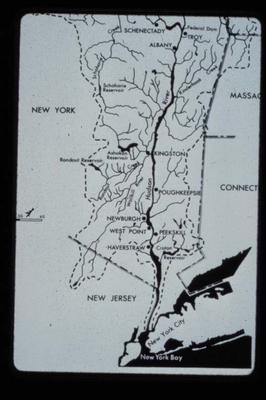
Map of New York State
artist:
Porter
The Hudson River is an ideal river for shipping because it is reasonably straight and deep with no waterfalls or rapids. It also connects two important cities: New York and Albany.
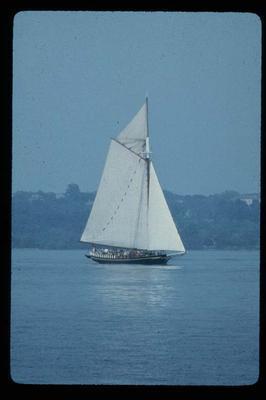
Clearwater Sailing
artist:
Porter
In the days before engines, sailboats dominated river travel. Hudson River Sloops were developed specifically for the Hudson. they were originally of Dutch design with one mast and three large sails. They were wide, to carry lots of cargo, and shallow, to avoid mud flats.
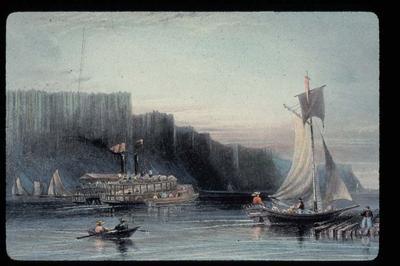
"Palisades"
artist:
William Bartlett
Sloops which carried passengers, called "packets," made regular trips between towns. Cargo sloops carried everything from bricks to hay. Even after the steamboats took over most of the passenger trade, sloops continued to be used as ferries and cargo vessels.
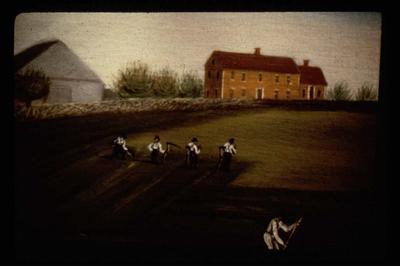
"Ralph Wheelock's Farm"
artist:
George Innes
Early communities along the river were small, and their industries were correspondingly small-scale. Most people were farmers. The Hudson Valley had good farm land, and grain was the first product to be shipped out of the area.
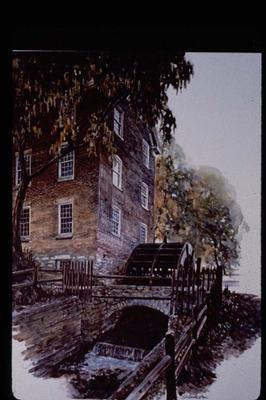
Grain Mill
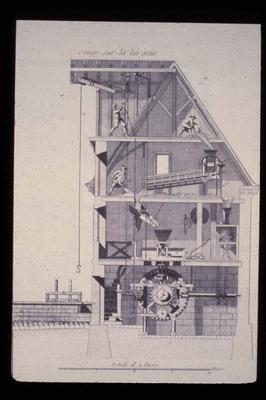
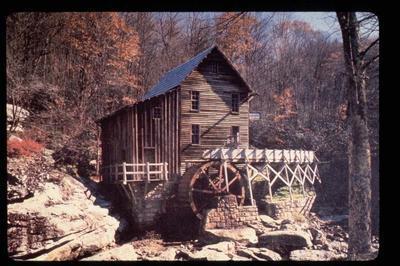
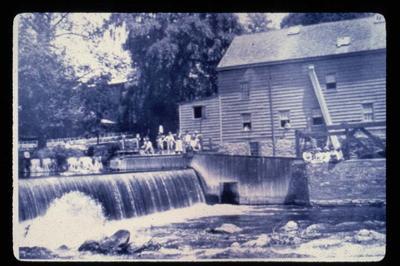
Not all grain was exported however. Most communities had a grain mill which made flour for home use. Streams were dammed in such a way that watrer could be directed over a paddle wheel. As the paddles were pushed by water, they turned gears inside the mill.
Cross Section of Mill
artist:
Diderot
If you look at this cross section of a mill, you can see the gears which are connected to a shaft which turns huge grindstones. The grain is crushed between the grindstones.
Grain Mill 2
The first mills were set up so that the water flowed under the wheel. Later it was found that water falling over the wheel from above exerted greater force, and this became the preferred method.
Grain Mill 3
By the middle of the 19th century, water power was being used to run machines in textile mills which made clothing. while the Hudson River was never used to turn water wheels, many of the streams flowing into it have a history of mills. You can still see the remains of old mills or see them referred to in place names. An example of this is the town of Red Oaks Mill in Dutchess County.
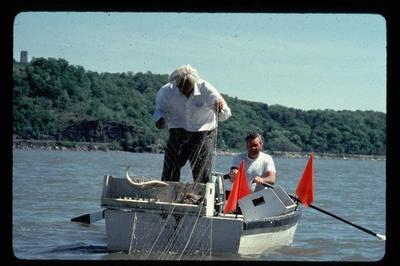
Sturgeon Fishermen
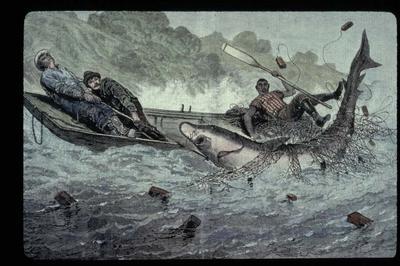
Fishing was another early occupation. The first Europeans to the area were amazed at the site and quantity of the fish. Striped bass, sturgeon, eels, tomcod, and shad were all abundant, and fishermen set nets for them all.
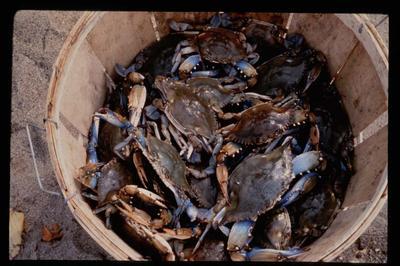
Blue Claw Crabs
artist:
Gore
There were also plentiful shellfish and crustaceans in the shallow, brackish waters of the lower Hudson. Oyster fishermen harvested millions of pounds of shellfish yearly until pollution and overfishing finished the industry. You can still find crabs and lobsters in New York Harbor, but pollution makes them unsafe to eat.
Shad Fishing
artist:
Mylod
Because modern industries contaminated the river with toxic wastes, most fish from the Hudson may not be sold in fish stores. Shad, however, only enter the river to lay eggs and are therefore considered safe to eat.
"Storm King on the Hudson"
artist:
Samuel Coleman
Shad fishing hasn't changed much in teh last two hundred years. Nets are either spread between stakes driven into the mud, or connected to floats. When the shad try to swim through, they are caught by the gills.
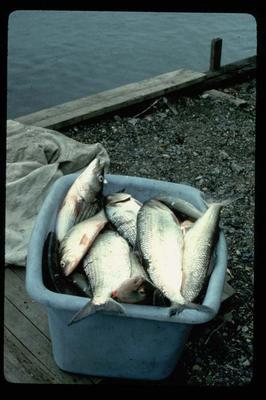
Shad in a Bucket
artist:
Mylod
Shad are delicious - if you can eat around the bones. The eggs of the female, called roe, are a delicacy. The history of fishing on the Hudson illustrates how newer industries (in this case General Electric) sometimes virtually destroyed more traditional ones.
Iron Objects from Van Cortland Manor
artist:
Porter
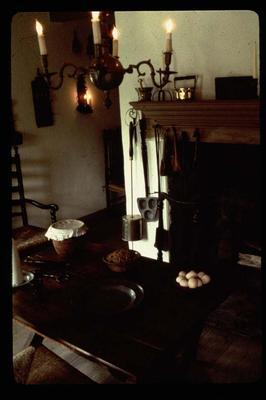
While farming and fishing took care of most of the food needs of early communities, people needed other things as well. One small scale industry which was necessary to the earliest settlers was blacksmithing. Iron was used to cook utelsils, lamps, horse shoes, and many other vital items.
Blast Furnace at Dover
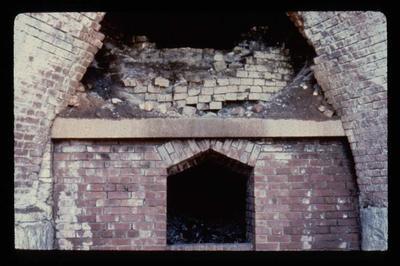
Iron ore was mined from the earth or found in the bottom of bogs. First this raw iron had to be smelted to remove impurities. To smelt iron, limestone and charcoal are combined with the iron and heated in furnaces like this. Blasts of air keep fire hot. The limestone combines with the impurities in the iron ore and rises to the top where it is skimmed off.
Blacksmith at Smith's Cove
artist:
Porter
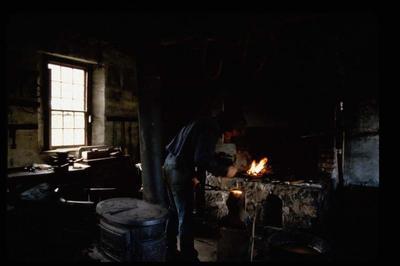
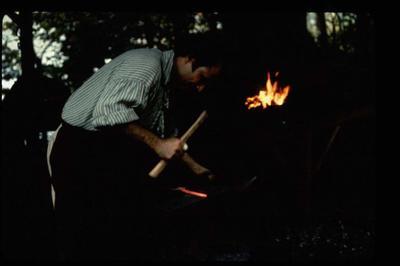
The resulting product is calles "pig iron" and is ready to be heated and formed into objects by a blacksmith. Blacksmiths heat the iron again until it is red-hot and pound it with a hammer. This gets more of the impurities out, otherwise the object would be brittle and might break if dropped.
Blacksmith at Van Cortland Manor
artist:
Porter
After the iron has been heated and pounded a number of times, the blacksmith begins forming the red-hot iron into an object which, when cool, will be very hard.
Chain at West Point Military Academy
artist:
Burger
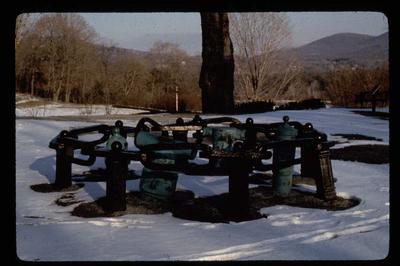
When America was still under British rule, the local people were not allowed to forage iron into objects. They were expected to send the pig iron to England to be made into articles which were then sold back to them. Luckily some Americans kept forging iron. This skill came in handy during the revolution when local iron makers foraged a chain across the Hudson at West Point to keep the British ships out. Links of this chain can be seen at West Point.
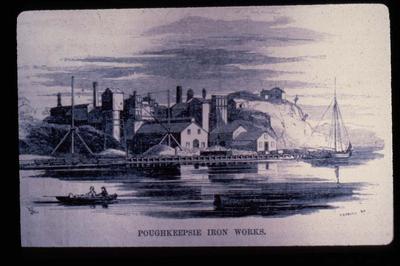
Poughkeepsie Iron Works
The Hudson Valley was the earliest center of the iron industry in America. Many towns had iron foundries which used virtually the sam emethods as blacksmiths but on a larger scale.