|
|
|
|
|
|
|
|
|
1825 Michael Faraday isolates a new
hydrocarbon from illuminating gas. |
|
1834 Eilhardt Mitscherlich isolates same
substance and determines its empirical formula to be CnHn. Compound comes to be called benzene. |
|
1845 August W. von Hofmann isolates benzene
from coal tar. |
|
1866 August Kekulé proposes structure of
benzene. |
|
|
|
|
|
|
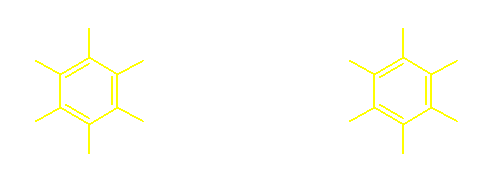
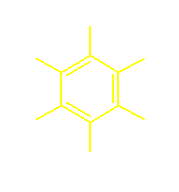
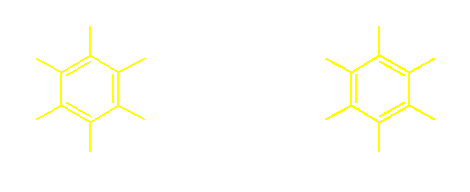
Kekulé proposed a cyclic structure for C6H6
with alternating single and double bonds. |
|
|
|
|
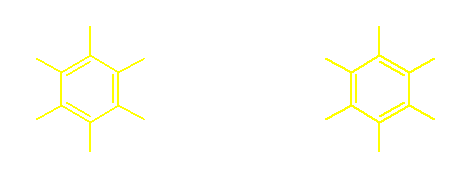
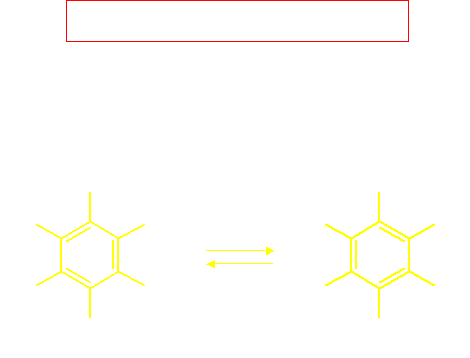
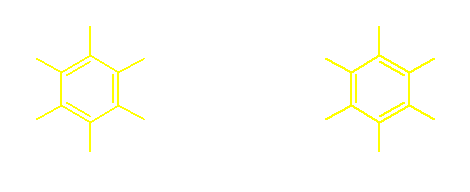
Later, Kekulé revised his proposal by
suggesting
a rapid equilibrium between two equivalent
structures. |
|
|
|
|
However, this proposal suggested isomers of
the
kind shown were possible. Yet,
none were ever
found. |
|
|
|
|
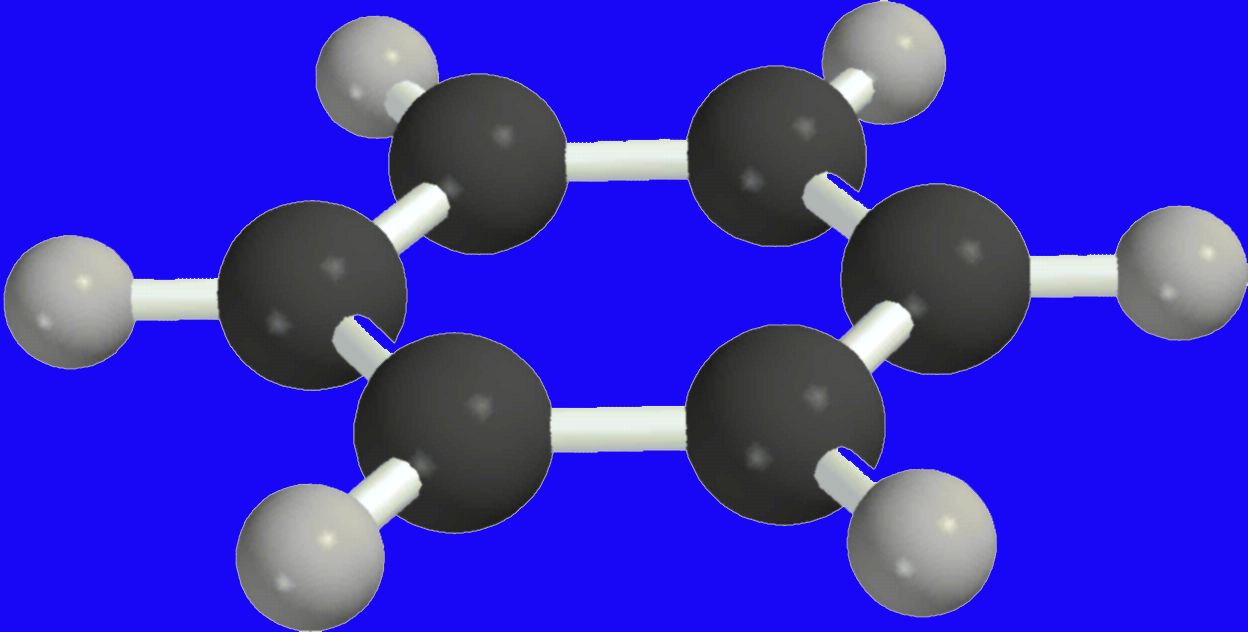
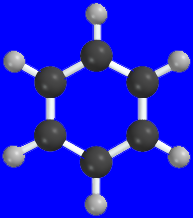
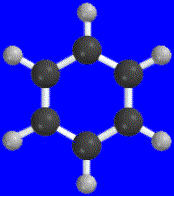
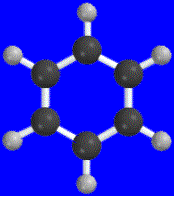
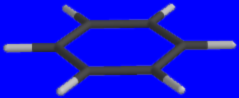
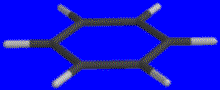
Structural studies of benzene do not support
the
Kekulé formulation. Instead of
alternating single
and double bonds, all of the C—C bonds are the
same length. |
|
|
|
|
|
|
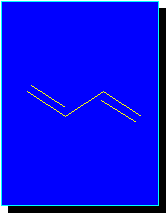
140 pm is the average between the C—C single
bond distance and the double bond distance in 1,3-butadiene. |
|
|
|
|
|
|
Instead of Kekulé's suggestion of a rapid
equilibrium between two structures: |
|
|
|
|
express the structure of benzene as a resonance
hybrid
of the two Lewis structures.
Electrons are
not localized in alternating single and double bonds,
but are delocalized over all six ring carbons. |
|
|
|
|
Circle-in-a-ring notation stands for resonance
description of benzene (hybrid of two Kekulé
structures) |
|
|
|
|
benzene is the best and most familiar example
of a substance that possesses "special stability"
or "aromaticity" |
|
aromaticity is a level of stability that is
substantially
greater for a molecule than would be expected on
the basis of any of the Lewis structures written for it |
|
|
|
|
heat of hydrogenation: compare experimental
value with "expected" value for hypothetical
"cyclohexatriene" |
|
|
|
|
|
|
"expected" heat of hydrogenation
of benzene is 3 x heat of hydrogenation of cyclohexene |
|
|
|
|
observed heat of hydrogenation is 152 kJ/mol
less than "expected" |
|
benzene is 152 kJ/mol more stable than
expected |
|
152 kJ/mol is the resonance energy of
benzene |
|
|
|
|
|
|
hydrogenation of 1,3-cyclohexadiene (2H2)
gives off more heat than hydrogenation of benzene (3H2)! |
|
|
|
|
|
|
|
compared to localized 1,3,5-cyclohexatriene |
|
152 kJ/mol |
|
compared to 1,3,5-hexatriene |
|
129 kJ/mol |
|
exact value of resonance energy of benzene
depends on what it is compared to, but
regardless of model, benzene is more stable
than expected by a substantial amount |
|
|
|
|
|
|
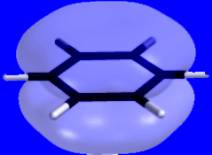
Planar ring of 6 sp2 hybridized
carbons |
|
|
|
|
Each carbon contributes a p orbital |
|
Six p orbitals overlap to give cyclic p
system;
six p electrons delocalized throughout p system |
|
|
|
|
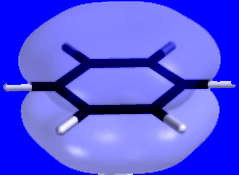
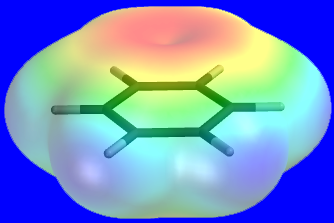
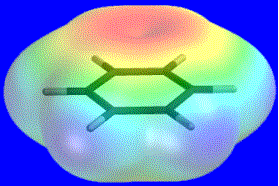
High electron density above and below plane
of ring |
|
|
|
|
|
|
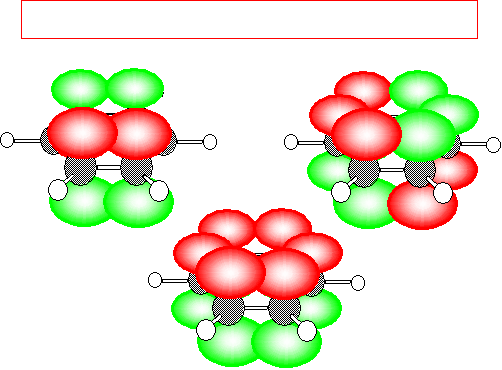
6 p AOs combine to give 6 p MOs |
|
3 MOs are bonding; 3 are antibonding |
|
|
|
|
All bonding MOs are filled |
|
No electrons in antibonding orbitals |
|
|
|

 Notes
Notes