China Achieves a Modern State
The Precedent for Modern Politics
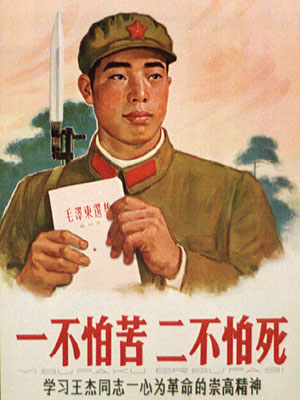
Chinese Cultural Revolution–era government poster encouraging moral leadership. The text reads, "Fear neither hardship nor death: Emulate the lofty spirit of comrade Wang Jie's whole-hearted devotion to the revolution."
Yanker Poster Collection, Library of Congress Prints and Photographs Division
When we think of what becomes twentieth-century China, about its institutions and ideologies, it's important to recognize that some of the possibilities that existed in the twentieth century existed because of the ways in which Chinese ideas and institutions worked in earlier periods. To take, for example, the relationship between politics and culture in late imperial China between the seventeenth and nineteenth centuries especially, the government assumed a responsibility to define what was morally correct for people living throughout the empire.
Moral correctness was a goal of education. And it defined much of what was culturally acceptable. It's therefore not that surprising that political leaders in the twentieth century might have ideas or assumptions that are somehow related to the ways their predecessors considered the relationship between politics and culture. In other words, the fact that after 1949 Communist leaders have had a certain set of assumptions about how government is responsible for cultural orthodoxy is not surprising within a Chinese context.
We tend to think that post-1949 Chinese concerns about correct thought and ideas are a peculiar trait of communism. While these concerns may be related to being communist, they're not solely related to being communist. That's one point. A second point is that we can't assume that practices that existed before 1900 magically become negative and irrelevant after 1900, negative in the sense that they're obstacles to the future or that they became irrelevant because becoming modern must mean doing things differently.
The Tradition of Campaigns [VIDEO]
TRANSCRIPT: For anyone who studies post-'49 China, and for most of us who just have a passing familiarity with what China's about, the notion of (the) political campaign is very fundamental to what we think of as the communist way of governing—big campaigns to change the economy with the great leaps, (the) huge and chaotic campaign of the cultural revolution that was really about politics. But China since '49 has been a country in which different kinds of campaigns are constantly mounted. It struck me about a decade ago that if I thought about various things that I've studied, and that colleagues have studied in late-imperial China, one in fact sees (that) the government, in those periods as well, depended often on extraordinary mobilizations of resources and manpower.
The notion of ruling with campaigns—extraordinary efforts periodically made in order to change some feature of governance—was a feature of China's society that went back quite far. And I understood it to be quite relevant to how a government can rule such a large area with the aspiration of making some sort of penetration at local levels.
It's equivalent, to me, analytically to the following. When we think of nineteenth-century European developments of parliamentary democracy, and we think of the principles that are basic to that, and the institutions that are basic (to that), we think of famous political tracts, and we think of the development of representative institutions. Equally important, at least in my reading of European history, is the fact that the beginning of the fourteenth century, and later in some parts of Europe than that, but gradually throughout Europe, there were assemblies of notables, usually nobles, who negotiated with their rulers over important issues, principally taxation, but also issues of law. And it is from those institutions of representation that first involved only elites and their negotiations with rulers—and it's, by the way, a sign of the weakness of rulers that they have to assemble these assemblies in the first place—but it's out of that series of connections and the ideas associated with them that later ideas of democracy are, in fact, built.