The Mongol Conquests
Chinggis's Mastery of Organization and Military Tactics
Chinggis Khan's organized units were based on the principle of ten.
He organized his people into units of ten, a hundred, a thousand, and ten thousand, and the head of a unit of ten thousand would have a strong personal relationship with Chinggis himself. That kind of loyalty was to be extremely important in Chinggis's rise to power and in his ability to maintain authority over all the various segments of his domain.
Chinggis's military tactics showcased his superiority in warfare. One particularly effective tactic Chinggis liked to use was the feigned withdrawal: Deep in the throes of a battle his troops would withdraw, pretending to have been defeated. As the enemy forces pursued the troops that seemed to be fleeing, they would quickly realize that they'd fallen into a trap, as whole detachments of men in armor or cavalries would suddenly appear and overwhelm them.
Another key tactic was the use of the horse in warfare. Read more about the Mongols' tactical use of horses in warfare in All the Khan's Horses [PDF], by Morris Rossabi (in Natural History, October 1994. Reprinted with permission from the author.)
Further Reading
The Devil's Horsemen: The Mongol Invasion of Europe, by James Chambers (London: Cassell, 1988).
→ NEXT: Three Invasions Led by Chinggis
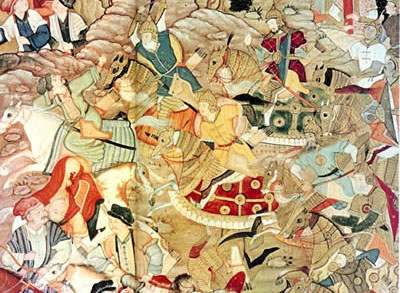
Illustration from History of the Moghuls, a 17th-century Indian text (detail), Gulestan Palace Library, Tehran