The Mongol Conquests
How a Small Group of Mongols Conquered Such a Vast Domain
One answer to this question is that the Mongols were adept at incorporating the groups they conquered into their empire. As they defeated other peoples, they incorporated some of the more loyal subjugated people into their military forces. This was especially true of the Turks. The Uyghur Turks, along with others, joined the Mongol armies and were instrumental in the Mongols' successes.
A second explanation is that the rest of Asia was declining at this point. China at this time was not a unified country — in fact, it was divided into at least three different sections, all of which were at war with one another. Central Asia was fragmented, and there was no single leader there. As for Russia, it was only a series of fragmented city-states. And after four centuries of success, the Abbasid dynasty in Western Asia had by this time lost much of its land.
By 1241, Mongol troops had reached all the way to Hungary but had to withdraw that very year because of the death of Ögödei, the Great Khan. The Mongol elite returned to Mongolia to select a new Great Khan, but they were unsuccessful in their efforts to form a consensus on the matter. For the next 19 years, there would be a variety of disputes over who was the most meritorious of Chinggis Khan's descendants and who ought to be the next Great Khan.
→ NEXT: The Empire's Collapse
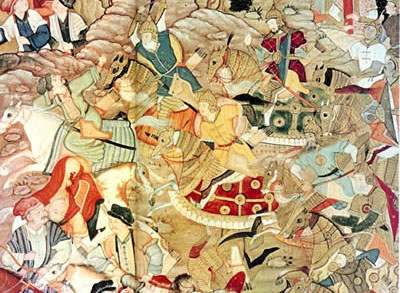
Illustration from History of the Moghuls, a 17th-century Indian text (detail), Gulestan Palace Library, Tehran