The Mongols' Mark on Global History
Support for Foreign Contact and Exchange
The Mongols' receptiveness to foreigners was a critical factor in promoting cultural exchange and a truly "global" history. Their attitude of relative openness toward foreigners and foreign influence led to an extraordinary interchange of products, peoples, technology, and science throughout the Mongol domains.
So it is no accident that Marco Polo reached China during this era [also see Key Figures in Mongol History: Marco Polo]. And also no accident that Ibn Battuta, the great Islamic traveler from Morocco, also reached China during this time, and that Rabban Sauma, a Nestorian Christian from the area around Beijing, reached Europe and had audiences with the kings of England and France and the Pope.
From the Mongol period on, then, we can speak about a Eurasian — if not a global — history, in which developments in one part of Europe would have an impact not only in Europe but also in Asia, with the same being true for Asia. And if we remember that Christopher Columbus was actually looking for a new route to Asia when he landed in America — and that one of the few books he had with him was Marco Polo's account of his travels in Asia — we could even say that global history begins with the Mongols and the bridge they built between the East and the West.
→ NEXT: Support for trade and merchants
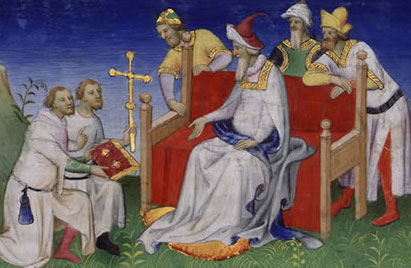
Khubilai Khan Greeting the Polo Brothers (detail)
Livre des merveilles, Bibliothèque nationale de France, Paris