The Mongols' Mark on Global History
Mongols Support Trade, Facilitating East-West Contacts
Along with Western missionaries, traders from the West (particularly from Genoa) began to arrive in the Mongol domains, mostly in Persia and eventually farther east.
The Mongols were quite receptive to this. This attitude, which facilitated contacts with West Asia and Europe, contributed to the beginning of what we could call a "global history," or at least a Eurasian history.
The Mongols always favored trade. Their nomadic way of life caused them to recognize the importance of trade from the very earliest times and, unlike the Chinese, they had a positive attitude toward merchants and commerce.
The Confucian Chinese professed to be disdainful of trade and merchants, whom they perceived to be a parasitical group that did not produce anything and were involved only in the exchange of goods. Mongols altered that attitude and in fact sought to facilitate international trade [also see The Mongols in China: Life for Merchants under Mongol Rule].
In China, for example, the Mongols increased the amount of paper money in circulation and guaranteed the value of that paper money in precious metals. They also built many roads — though this was only partly to promote trade — these roads were mainly used to facilitate the Mongols' rule over China.
→ NEXT: Improved Merchant Status
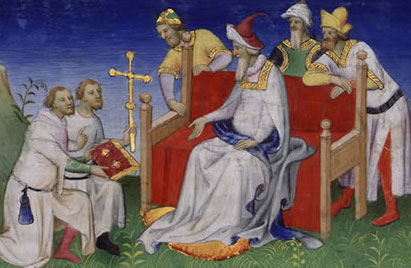
Khubilai Khan Greeting the Polo Brothers (detail)
Livre des merveilles, Bibliothèque nationale de France, Paris