The Mongols' Mark on Global History
Merchant Associations Alleviate the Perils of Caravan Trade
To further support trade and commerce, the Mongols established merchant associations, known as Ortogh, specifically to promote caravan trade over long distances.
The Mongols recognized that the caravan trade across Eurasia was extraordinarily expensive for any single merchant. Often there would be as many as 70 to 100 men on each mission, and all had to be fed and paid and provided with supplies (including camels, horses, and so on) over a lengthy period of time.
Quite a number of the caravans simply did not make it, either because of natural disasters of one sort or another or plundering by bandit groups. Travelers, for example, mentioned coming across numerous skeletons, animal and human, on these routes. Because of the expense involved in such a disaster, just one such failed caravan could devastate an individual merchant's holdings.
The Mongol solution to these concerns was the establishment of Ortogh — through which merchants could pool their resources to support a single caravan. If a caravan did not make it, no single merchant would be put out of business. The losses would be shared, as would any risks, and of course, profits when the caravans succeeded. The Mongols also provided loans to merchants at relatively low rates of interest, as long as they belonged to an Ortogh.
→ NEXT: Missionaries from Rome
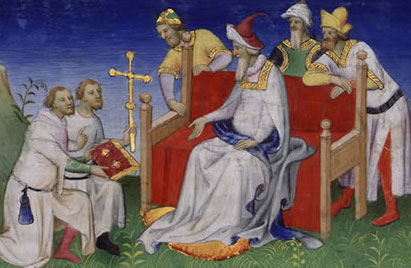
Khubilai Khan Greeting the Polo Brothers (detail)
Livre des merveilles, Bibliothèque nationale de France, Paris