The Mongols' Mark on Global History
Mongol Support of Artisans
The Mongols did not have their own artisan class in traditional times because they migrated from place to place and could not carry with them the supplies needed by artisans. They were thus dependent upon the sedentary world for crafts, and they prized artisans highly.
For example, during Chinggis Khan's attack on Samarkand, he instructed his soldiers not to harm any artisans or craftsmen. Craftsmen throughout the Mongol domains were offered tax benefits and were freed from corvée labor (unpaid labor), and their products were highly prized by the Mongol elite.
The Mongol's extraordinary construction projects required the services of artisans, architects, and technocrats. When Ögödei, Chinggis Khan's third son and heir, directed the building of the capital city at Khara Khorum, the first Mongol capital, or when Khubilai Khan directed the building of Shangdu (also known as "Xanadu"), his summer capital, as well as the building of the city Daidu (the modern city of Beijing), all required tremendous recruitment of foreign craftsmen and artisans [also see The Mongols in China: Civilian Life under Mongol Rule].
→ NEXT: Status of Artisans
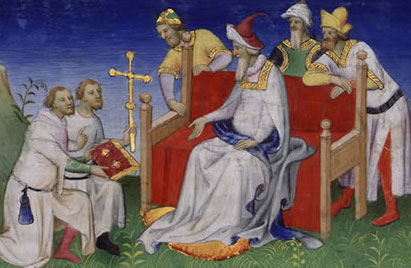
Khubilai Khan Greeting the Polo Brothers (detail)
Livre des merveilles, Bibliothèque nationale de France, Paris