The Pastoral Nomadic Life
Camels
The Bactrian or two-humped camel permits the Mongols to transport heavy loads through the desert and other inhospitable terrain. The camel is invaluable not only for transporting the folded gers and other household furnishings when the Mongols move to new pastureland, but also to carry goods designed for trade.
A camel could endure the heat of the Gobi desert, could drink enormous quantities of water and then continue for days without liquid, required less pasture than other pack animals, and could extract food from the scruffiest shrubs or blades of grass — all ideal qualities for the daunting desert terrain of southern Mongolia.
In addition to the camel's importance for transport, the Mongols valued the animal's wool, drank its milk (which can also be made into cheese), and ate its meat. No wonder then that "in the Mongol epoch the camel enjoyed the highest esteem he was attain in the Chinese lands" [in "The Camel in China Down to the Mongol Invasion" by Edward Schafer, Sinologica, 2 (1950), p. 190].
Further Reading
The Camel and the Wheel, by Richard Bulliet (Cambridge: Harvard University Press, 1975).
"The Camel in China down to the Mongol Dynasty," by Edward H. Schafer, in Sinologica 2 (Basel: Verlag für Recht und Gesellschaft, 1950).
→ NEXT: Horses
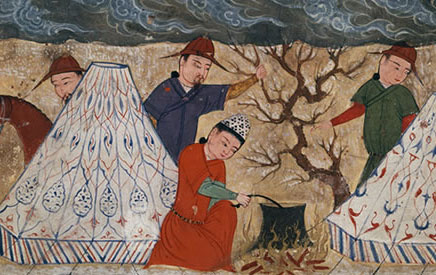
Khubilai Khan and Chabi on a Cookout (detail), Bibliothèque nationale de France, Paris