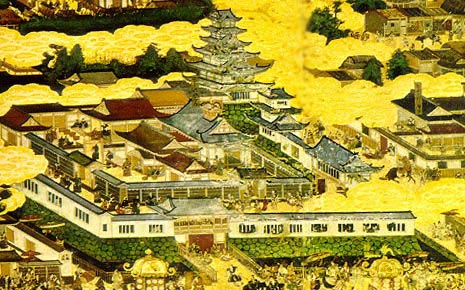
| The architecture of authority in Japan had already taken many forms prior to the 16th century. Since the late 700's, Kyoto had served as the center of political authority in Japan. As the power of the imperial family began to wane under the dominance of the Kamakura bakufu in 1185, the city of Kyoto experienced changes in its architecture and its urban design. Many of | the changes that resulted from Kyoto's decline during the Kamakura period had a lasting effect well through the 16th century. Despite an attempt at restoring imperial power in 1333, the Ashikaga shogunate proved in 1336 that military strength would determine authority in Japan. It was during this time, the Muromachi Age (1336-1573), that the Ashikaga shogunate |
returned political power to Kyoto, albeit in a very different form. The new military regime restructured Japanese cities into feudal domains. In efforts to increase local integration and defense, many of the powerful daimyo began to absorb neighboring estates. As part of the integrative process, each daimyo built a castle in the center of his domain. The result was a new |
urban structure referred to as castletowns. While Nijo Castle reflected many of the social, political and economic trends that were typical of castletowns, its structure was uniquely Kyoto's. |