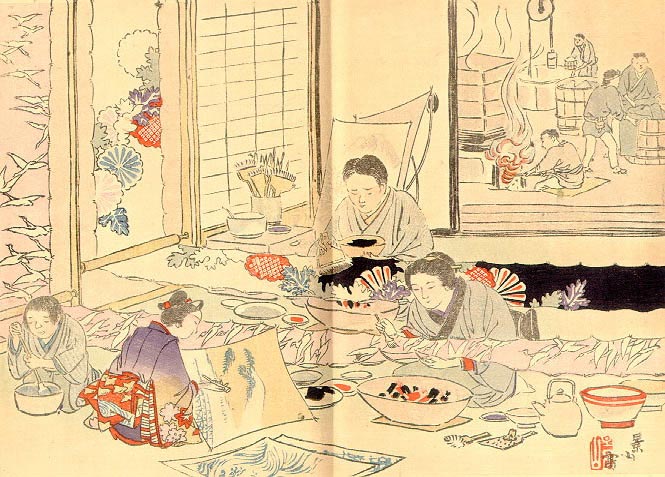
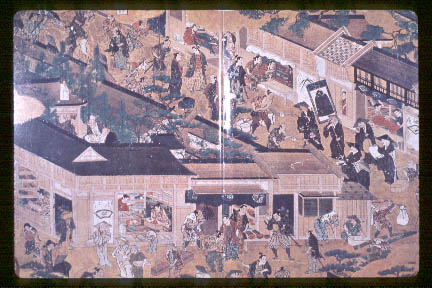
| A change that had already begun to take hold in earlier periods but had not come to full swing until the 16th century was the street market. Two regions of Kyoto were reserved as markets, one in the East and one in the West. Merchants, such as the following scroll makers discovered that by redesigning their houses |
into store fronts, they could potentially earn a considerable amount of money. These houses typically consisted of |
bamboo walls with large doors and windows through which merchants could display and sell their products. Like many urban dwellings, they used planked roofs with logs to hold them down. As many of the houses became storefronts, entire blocks were transformed. Merchants in these city blocks would come |
together to form self-regulating markets. Eventually, these would grow into autonomous townships. |