Artistic Context
Ryoanji features a dry garden (karesansui),
which is principally composed of just sand and stone. While there are many
similar examples, Ryoanji is stemmed as the original. Unlike other landscape
gardens, Ryoanji does not feature stones of special sizes and shapes, but
relies on its intricate composition to create a subtle and harmonic garden.
Its brilliance lies on its subtlety and transcendental sensitivities. The
development of dry garden is influenced by a number of different sources:
the dominant Zen philosophy, the small tray gardens of Japan and China
and the imported Chinese Confucian thinking.
Zen Philosophy
Instead of using landscape as patterns,
elements are used to express feelings and thinking. Its austerity and simplicity
reflect the preferences of Zen philosophy. The serenity of the composition
provides space for the communication and the contemplation of Zen teaching.
Zen teaching is never expressed through elaborate words, but through quiet
parables. The garden of Ryoanji, with its limited but carefully selected
stones, embodies the teaching of Zen philosophy. It is also a perfect setting
for contemplation. The physically bare garden allows viewers to reflect
towards oneself. The beauty of the garden lies peacefully inside the enlightenment
of the viewer, and not in the materialistic exterior. Zen is the art of
the void, and is well-illustrated in the garden of Ryoanji.
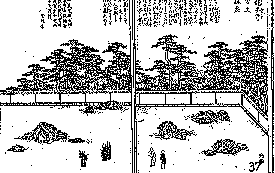
The drawing above depicts workers,
priest and artists all strolling in the garden. It possibly illustrates
the process that went into the design of the garden. As Zen monks
frequently traveled to different monasteries, different ideas were exchanged
in these travels. The garden of Ryoanji probably was a collaborative effort
from the different monks and artists; thus, making it difficult to determine
who was the sole designer.
Tray Gardens
These miniature landscapes (kazan
or kazansui), which are made up of little rocks and soil, are usually created
in bronze or stone squared containers. They hold a strong resemblance
to the dry gardens. They were imported from China, and was very popular
during the Muromachi period. This not only reflects the strong connection
between garden and art, but also the strong Chinese influences.
Chinese Confucian Thinking
As indicated by the name of the
temple, the dragon denotes the power of the Emperor. This sufficiently
represents the Confucian belief in order and hierarchy. Also, one
interpretation of the layout of the garden is that it represents Tiger
Cubs crossing the River.(See Interpretations Page) Tiger crossing
the river symbolizes in Confucian thinking the virtue of the ruler, defending
the country even from wild beasts. All these reflect the deep influences
of Chinese Confucian thinking in the design of the garden.
Previous
Page
Main
Page