Questions on the Reading
|
Week 5
|
|
|
|
|
|
| Questions on the Reading for week 5 |
| Tuesday: |
Sources of Korean Tradition, pp. 18-77. |
| Thursday: |
Sources of Korean Tradition, pp. 78-108,
120-135. |
| |
|
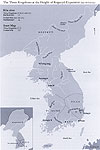
Introduction to "Religion and Politics in Early Korea."
The religious traditions of Six Dynasties China exercised significant
influence on the political formations of the three kingdoms of Koguryo,
Paekche, and Silla (see the map on the penultimate page of this
syllabus).
The early kings of Koguryo maintained diplomatic relations with
northern Chinese states and were introduced to Buddhist texts, images,
and models of royal authority by monks sent by Chinese rulers. Koguryo's
kings also established a Chinese-style legal system and a state
Confucian academy, and they continued to revere local gods an shamanistic
traditions.
Paekche learned of continental traditions through contacts with
southern Chinese states, and Buddhism flourished under royal patronage.
As in Koguryo, the state ordered the construction of Buddhist temples,
the reading of Buddhist sutras, and the performance of Buddhist
rituals.
Silla, although the last of the three kingdoms to be introduced
to Buddhism, was the most active in recognizing its political significance.
The kings of Silla named themselves and members of their families
after Indian Buddhist royalty and even abdicated the throne to become
monks. In their efforts to dominate the peninsula, Silla kings presented
themselves as chakravartins, mythical Buddhist sovereigns
whose moral force assured them universal dominion. This fusion of
political and religious ideals may be seen as well in the institution
of the hwarang, an association of aristocratic youths focused
on the Buddha Maitreya, whose duty was the material and spiritual
defense of the realm.
|
|
Amitabha Triad
Latte Koryo Dynasty
(918-1392)
|
 |
 |
Container from a Sarira Reliquary
Unified Silla Dynasty
(668-935) |
|
Gold Hilt with Oval Pommel
Three Kingdoms Period
Silla kingdom
(57 BCE-668 CE)
|

|
 |
Crown
Three Kingdoms Period,
Silla kingdom
(57 BCE-668 CE) |
|
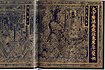
Illuminated Manuscript of the Avatamsaka
Sutra, Vol. 31
Koryo Dynasty (918-1392)
|
 |
|
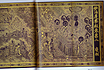
Illuminated Manuscript of the Lotus Sutra,
Koryo Dynasty (918-1392)
|
|
 |
Royal Crown in sheet-gold excavated from the Gold
Crown tomb, Kyongju, in 1922. The antler-and tree-shaped uprights
show links with Siberian shamanism, and the curved jade pendants
are similar to those found in Japan. Silla, 5th-6th century
AD. Ht:27.5 cm |
|
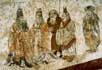
Korean envoy (second from right) with characteristic
head-dress, painted on the wall of the tomb of the Chinese
Tang dynasty prince Zhang Huai (Li Xian), outside Xi'an, showing
the close contacts between the two countries in the 8th century
AD.
|
 |
 |
The storehouse at Hae'in temple on Mt Kaya in
south-central Korea, where the complete Buddhist scriptures,
carved on over 80,000 woodblocks in the 13th century, are stored.
|
|
Gilt-bronze seated Maitreya in meditative
pose.
Silla,7th century AD. Ht: 93.5 cm.
|
 |
 |
Gigantic stone Miruk (Maitreya Buddha) and lantern
at Kwanchok temple in west-central Korea. Somewhat crudely modelled,
the figure may originally have had shamanistic associations.
Early Koryo period, 10th-11th century AD. Ht: 18.1 m. |
|
Paradise scene on the frontispiece to the
Amitabha sutra. Painted and written in silver and gold by
a monk-scribe for his mother, this is an example of the large
numbers of such magnificent Buddhist manuscripts produced
at this time. Koryo period, AD 1341. Ht: 22 cm
|
|
 |
Granite seated Buddha at Sokkuram cave temple
on Mt Toham outside Kyongju, built between AD 751 and 774. This
powerful seated sculpture is a masterpiece of Buddhist art,
surrounded by forty-one other divinities carved in relief in
a domed Indian style chamber. |
|
Stone pagoda at Hwa'om-sa in south Cholla
province, a fine example of Buddhist craftsmanship of the
8th century AD. Decorated in relief around the base with apsaras
dancing and playing musical instruments, this three-storey
pagoda rests on four crouching lions which surround a Buddhist
monk. The lowest storey is carved with doors on all four sides,
each flanked by guardian figures. Ht:5.5m.
|
 |
|
| |
| |
|
| Questions |
|
- How did Confucian, Taoist, and Buddhist traditions contribute
to models of kingship and to state formation in the Three Kingdoms
period?
- How were Chinese traditions combined with native Korean traditions
of political and religious authority?
- How do you understand the relationship between Chinese and Korean
Buddhism? What elements of Korean Buddhist theory and practice
do you recognize from Chinese materials? Which aspects are different?
|
|