Questions on the Reading
|
Week 6
|
|
|
|
|
|
| Questions on the Reading for week 6 |
|
Tuesday:
*Religions of Japan in Practice, pp. 299-333
* Sources of Japanese Tradition, pp. 125-131, 140-142, 145-152,
193-196
|
| |
|
Thursday:
*"A Memorial Presenting a List of Newly Imported
Sutras and Other Items," pp. 140-150.
* Religions of Japan in Practice, pp. 166-184.
|
| |
|
|
|
Introduction to "Buddhism and the Building of the Japanese
Empire."
As in Korea, Buddhism was introduced to Japan as a royal cult.
And as in China, it met with initial resistance as an unwelcome
foreign import. Buddhist texts, theories, and practices became integrated
into Japanese culture only after a prolonged negotiation with native
religious and political traditions. The texts we read this week
suggest some of the ways in which this process occurred. Yet these
sources are ideological, not simply descriptive. The account of
Buddhism's introduction, for example, comes from the same text that
records the divine origins of Japan and of its royal family. Other
texts were written by subjects to emperors, by emperors to subjects,
or by emperors to gods. Thus, these texts construct the notion of
a Japanese Buddhism together with the notion of a Japanese state.
|
| |
|
|
|
|
|
Shakyamuni at Birth, (752) Gilt bronze, H.
(image) 47 cm.
Todaiji, Nara
|
 |
 |
Standing Buddha ( 7th. c.) Gilt bronze, H. 26
cm.
Nara National Museum |
|
Maitreya Buddha ( 7th. c.) Gilt bronze, H.
31 cm.
Tokyo National Museum
|
 |
 |
Komokuten (one of the Four Heavenly Kings), 8th.
c.,
Wood, H. 135 cm.
Daianji, Nara |
|
Tamokuten (one of the Four Heavenly Kings),
8th. c.,
Wood, H. 142 cm.
Daianji, Nara
|
 |
 |
Prince Shotoku Lecturing on the Shoman-gyo, 13th
c.,
H: 195.7 cm, W: 225.1 cm |
|
Facade of Daibutsuden
Todaiji, Nara
|
 |
 |
Daibutsu
Daibutsuden
Todaiji, Nara |
|
Daibutsu and interior of Daibutsuden
Todaiji, Nara
|
 |
 |
Engraving on petal of lotus pedestal of Daibutsu,
756-757, Bronze,
H. 201.5 cm, W. 153 cm.
Daibutsuden, Todaiji, Nara |
|
Four Sainty Persons, Hanging scroll, ink
and colors on silk
H. 201.5 cm., W. 153 cm, 1377
Emperor Shomu (center), Bodhidena (right rear), Gyoki (right
front), Roben (left)
|
 |
 |
Amida crossing the Mountains 13th C. H:101cm W:83cm
|
|
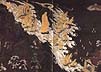
Descent of Amida and Twenty-five Bodhisattvas,
13th C., H:145.1cm, W: 154.5cm
|
 |
|
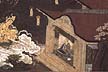
Detail from Descent of Amida and Twenty-five
Bodhisattvas
|
 |
 |
Detail of Kong-kai. Mandala of the Two Worlds
(The so-called Shingon-in Mandara) Later half 9th C. |
 |
Kongoo-kai. Mandala of the Two Worlds (The so-called
Shingon-in Mandara), Later half 9th C. |
|
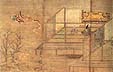
Taima mandara engi emaki (Illustrated handscroll
of the legends of the Taima Mandara), first section of the
second scroll, Mid-13th C.,
H: 51.6 cm, Total L:700.8 cm
|
  |
 |
Taiz-kai. Mandala of the Two Worlds (The so-called
Shingon-in Mandara) Later half 9th C. |
 |
Detail from Taiz-kai. |
|
| |
|
| |
|
|
|
|
|
| |
| Questions |
|
- By what means and in what form was Buddhism introduced to Japan
according to the Founding of the Monastery Gangoji? How
was it promoted? How was it received? How was it evaluated? Who
were the players? What was at stake for them?
- What religious and political ideals do you see informing the
representations of Japanese rulers in the selections from the
Founding of the Monastery Gangoji, the Chronicles of
Japan, the Imperial Record of Shotoku, and the Continued
Chronicles of Japan? How do you understand the relationship
between these different ideals?
- How would you compare the religious practices and goals of the
Shingon, Tendai, and Pure Land Buddhism of the Heian period?
|
|