Questions on the Reading
|
Week 7
|
|
|
|
|
|
| Questions on the Reading for week 7
|
| |
|
| Tuesday: |
*Sources of Japanese Tradition, 238-264,
211-237, 292-335, 346-363. |
| |
|
| Thursday: |
*Religions of Japan in Practice, 415-422. |
|
|
Introduction to "The Latter Day of the Law in Medieval
Japan."
At the end of the 12th century many in Japan feared a millenarian
crisis. Under continuous warfare, power seemed to be shifting from
the imperial court to military clans, in an age that was understood
as the final period of Buddhism. The Buddhist sects associated with
the Kamakura period (1185-1333) -- the traditions of Pure Land,
Nichiren, and Zen -- all sought to distinguish themselves from earlier
forms of Japanese Buddhism, as the teachings and practices most
appropriate to the time. Yet these new sects shared much with the
schools against which they defined themselves, and the religious
culture of the age, as the selection from Sand and Pebbles
suggests, may have been more pluralistic than sectarian.
|
|
|
|
Inner Precinct of Ise Shrine
Mid-14th c
H: 118 cm W: 60.2 cm
|
 |
|
Outer Precint of Ise Shrine
Mid-14th c
H: 117.5 cm W: 59.3
|
 |
 |
Honen Shonin Den Emaki (Illustrated handscroll
of the biography of the monk Honen): Fifth section of the eighth
scroll. First half 14th c.
H: 32.9 cm Total L: 1163.1 cm |
|
Traditionally identified as a portrait of
Minamoto no Yoritomo.
First half 13th C. H:143cm W: 112.8cm
|
 |
 |
Portrait of the Emperor
Go-Toba 1221 H:40.3 cm W:30.6 cm |
|
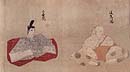
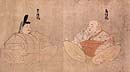
Tenshi-ei Zukan (Illustrated handscroll of
portraits of emperors): The retired Emperors Toba, Sutoku,
Go-Shirakawa and Nijo. Mid-14th c.
H:28.8 cm total L:535.8 cm
|
 |
 |
Heiji Monogatari Emaki (Illustrated handscroll
of the events of the Heiji era): Scroll of the night attack
on the Sanjo Palace. Mid-13th c.
H:41.3 cm Total L: 699.5 cm |
|
Portrait of Dogen.
Hokyo-ji, Fukui.
|
 |
 |
Portrait of Priest Myoe meditating in a tree.
Kamakura period, 13th century. Hanging scroll. Color on paper.
145.0X59.0 cm. Kosan-ji temple, Kyoto. |
|
Fragment of illustrated narrative handscroll,
from the "Shuikotoku Den-e" (Pictorial Record of
the Continuation of Virtue)
Honen inscribing portrait for his disciple Shinran.
Early 14th c. Metropolitan Museum of Art.
|
 |
|
| |
| Questions |
|
- How do different historical texts (the Tale of Flowering
Fortunes, the Great Mirror, the Gukansho, and
the Direct Succession of Gods and Sovereigns) understand
the historical situation of the late Heian period? What historical
and historiographical assumptions and arguments can you identify
in these texts? How do they differ from the examples of historical
writing you have encountered in the Chinese and Korean traditions?
- The Japanese of the late Heian and Kamakura periods believed
themselves to be living in the final phase of a chronological
cycle of decline in Buddhism which suggested important implications
for Buddhist practiioners. How do Honen, Shinran, Myoe, Jokei,
Nichiren, and Eisai recognize and respond to this historical situation.
How do they conceptualize the relationship between history and
Buddhist practice?
- How is the relationship between Buddhism and Shinto understood
in the writings of Yoshida Kanetomo, Kitabatake Chikafusa, and
Muju Ichien?
|
|