Introduction to East Asian Civilizations: Japan

The Tokugawa System


Arnoldus Montanus, Bird's-eye View of the Man-made Island Dejima. Amsterdam, 1669.
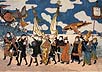
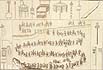
  Like the Japanese daimyo, lords of provincial domains throughout Japan, the Dutch merchants who were permitted to reside on the island of Deshima in Nagasaki harbor were required to journey to Edo to pay homage to the shogun. Initially an annual requirement, the Dutch processions to Edo became less frequent during eighteenth century. Two images of such processions are found below.


Procession of the Dutch to Edo. Edo period, early ninteenth century. Woodblock print; ink and color on paper. Collection of William and Florence Leonhart.
     

Engelbert Kaempfer, The Dutch Retinue on its Journey to Edo (Tokyo). London, 1727.


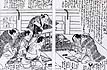
Five Beggars Studying Confucian Texts. Sant Kyden, (1789). Illustrations from Kibyshi, sharebon-sh (Tokyo, 1958).

  Political satire was given free reign in the "yellow covers" genre of small booklets (kiboyshi), and authorities responded by punishing only some of the satirists here and there, almost pro forma. One of those manacled and thrown into jail for a short while was Sant Kyden (1761-1816), a professional satirist whose targets included preachy Confucianism and any illustrations that Confucians might have had about the relevance of their teachings for society. One short work by Kyden (both text and illustrations) presents a mock discussion of Confucian passages, again and again misunderstood by five beggars. Their tense probing faces betraying deep thought, they try to make sense of hallowed passages, but from their down-to-earth perspective.


The great warlord is shown in traditional courtier robes and cap rather than formal samurai costume or armor. He holds a ceremonial scepter, conventional in portraits of warriors, but the only indication of his samurai status is the long sword tucked into his robes. Such a portrait would normally have been commissioned exclusively for family members to use in memorial services for the deceased. But Ieyasu was widely venerated as the Buddhist-Shinto deity Tsh Daigongen (Great Incarnation Illuminating the East), and images were made in great number throughout the Edo period based on portraits made immediately after his death in 1616. The altarlike curtains, raised platform with red lacquer pillars, and guardian lion-dogs, reminiscent of a shrine setting, contribute to the aura of religiosity. The background landscape may be an imaginary early view of the shrine complex at Nikk, the site of Ieyasu's mausoleum.


Portrait of Tokugawa Ieyasu. Early seventeenth century. Hanging scroll: ink and color on silk, 82.9 X 41.3, University Museum, Faculty of Letters, Kyoto University