|
Warriors at Peace
|

Helmet with Symbolic Tower. Eighteenth century.
|
|
This helmet is surmounted by a symbolic Buddhist tower, which
is usually made of five parts to represent the five cosmic
elements: earth, water, fire, wind, and nothingness or ultimate
reality (mu). In Esoteric Buddhism three or five such
forms may be related to the human body and are also used for
tombstones.
This piece is inscribed "Namu Amida butsu," the
invocation of the Pure Land Buddhist sect, and it is pierced
with a Sanskrit character. A crest with the Japanese character
tsuchi (ground) appears on both sides, Although the
tower appears unwieldy, it is a light construction of wood
covered with a "corroded-effect" lacquer (sabinuri)
with gold dust, and it would not be uncomfortable to wear.
The helmet was made for a devout Buddhist, Matsudaira Sadamoto
(1686-1759).
Iron, wood, and lacquer. Height of helmet bowl, 16.9 cm.
Kyoto National Museum.
|
|
| |
|
| |
Composed of iron plates covered with thick red lacquer,
the armor is laced together with smoke-tanned leather bindings.
The suit is of tosei gusoku type, which was fashionable
from the Muromachi period. The armor covers almost the whole
body, but it is lightweight overall in keeping with the
freedom of movement required.
Iron, lacquer, silk, wood, leather, and gold leaf. Height
of cuirass and skirt, 70 cm. Hikone Castle Museum, Shiga.
|
|

Armor with giant horns made for Ii Naotaka.
Seventeeth century.
|
|
| |
|
| |
|

Helmet in the Form of a Turbo Shell. Early seventeenth
century.
|
|
This helmet is basically a simple iron bowl on which paper
(washi) is built up into the helical form of the turbo
shell and covered with gold leaf. The shell of the turbo is
thick and spiked to protect it against predators, and such
helmets were thus thought to give the wearer confidence and
to disquiet his enemies. Despite its bulky appearance, the
helmet is light and designed for use in battle. Helmets of
such exotic form were fashionable during the later part of
the Muromachi and Momoyama periods, when an individual could
rise in status through his own prowess in battle.
Iron, lacquer, paper, and gold leaf. Height of helmet bowl,
18.6 cm. Tokyo National Museum.
|
|
| |
|
| |
|
The basic form of the Japanese saddle and stirrups changed
between the Heian and Edo periods. The saddle is composed
of four pieces, the pomel, the cantle, and two components
that make up the seat. The pieces are tied together with cord,
producing a structure that is highly resistant to shock. The
configuration of the saddle allowed the rider to stand in
the stirrups, gripping the saddle with his legs, in order
to discharge arrows or wield his cutting weapons. Only the
highest ranking samurai were permitted to keep riding horses
during the Edo period, and their saddles and stirrups were
often lavishly decorated, as these are. The stirrups are of
iron with wooden inset bases. Both saddle and stirrups are
lacquered with a design of white powder, but for those who
could afford the luxury, dried nightengale droppings were
considered more elegant. Gold lacquer dust was applied in
various thickness to the adventurine ground to give depth
to the picture.
Saddle of lacquer over wood with makie. Stirrups of iron,
and lacquer over wood with makie. Height of saddle, 38 cm.
Tokyo National Museum.
|
|
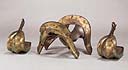
Saddle and Stirrups with Cosmetic Brush Design.
Eighteenth century.
|
|
| |
|
| |
|

Pair of Sword Guards with Carp Design. Dated 1843.
|
|
These sword guards are embellished with inlaid high-relief
black alloy shakud carp, which have details of gold. The ground is of polished
shibuichi (literally, "one part in four"),
an alloy of silver that is one quarter copper. The stream
is depicted with the katakiri bori technique, in which
oblique cuts of the chisel suggest brush painting. Katakiri
bori was popularized around the seventeenth century by
town carvers, craftsmen who were not retained by the warrior
houses and who thus sold their works on the open market.
carp, which have details of gold. The ground is of polished
shibuichi (literally, "one part in four"),
an alloy of silver that is one quarter copper. The stream
is depicted with the katakiri bori technique, in which
oblique cuts of the chisel suggest brush painting. Katakiri
bori was popularized around the seventeenth century by
town carvers, craftsmen who were not retained by the warrior
houses and who thus sold their works on the open market.
Shakud,
gold, and shibuichi. Height 7.9 cm; 7.4 cm. Tokyo National
Museum.
|
|
| |
These sword guards for a matching pair of long and short
swords are decorated with spring and autumn flowers, plants,
and insects inlaid in colored metals on a shakud
ground. The ground is covered with a regular linear array
of small raised protuberances known as nanako (fish
roe), formed with a hollow-tipped punch; the flowers and
insects are sculpted separately and set into sections cut
below the surface.
Shakud,
copper, silver, and gold. Height 8 cm; 7.5 cm. Tokyo National
Museum.
|
|

Pair of Sword Guards with Flowers, Plants, and Insects.
Dated 1857.
|
|
| |
| |
|
