Course Introduction |
|
|
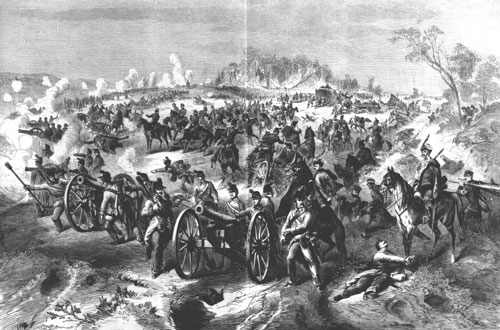
"The last stand." Artillery units sacrifice themselves to cover the retreat of the Austrian army on July 3, 1866 at Königgätz/Sadowa, the battle that established Prussian/German hegemony in Central Europe. |
|
|
The topic is the troubled history of the lands inhabited by Germans, Poles, Czechs, Slovaks, Hungarians, Romanians, and South Slavs. Cultural, political, and economic interaction between the Germans and East Central Europeans is seen, alternately, as a mutually beneficial relationship or as a catastrophe. Reality embraced both, German-speakers having been responsible for much of East Central Europe's cultural flourishing, its cities, churches, administrative and political institutions, shops and factories, but also for the area's devastation in the two world wars. The period between the Napoleonic wars and World War II led to the gradual unification, consolidation, and expansion of German political and military power. Strangely, however, this was accompanied by the continuous decline in the number of ethnic Germans in the region. Finally, World War II brought both the extreme expansion of German power and its sudden end.
|
|
|
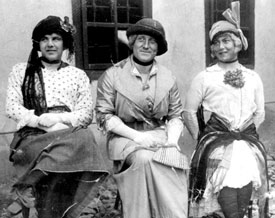
Austro-Hungarian officers perform in a front-line theater during World War I |
|
|
Tragically, East Central Europe today is also without the influence, nay the very presence of that ethnic group culturally most closely related to the Germans: the Ashkenazi Jews. The World War II destruction of the Jews by the German Nazis and their East Central European allies, as well as the subsequent expulsion of the Germans by the post-World War II regimes, provide a terrible conclusion to the long history of close German-Jewish-East Central European interaction, to magnificent achievements and great tragedies. German political and economic influence seems to be re-emerging in the region, but it is nearly inconceivable that masses of Germans -- or Jews -- would settle there again. |
|
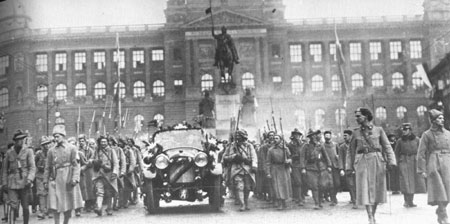
Thomas Masaryk entering Prague in 1919. Veterans of the Czech Legion march in with him, wearing Italian, French, Russian, nationalist paramilitary Sokol as well as the old Austro-Hungarian uniforms. |
|
| The other monumental and irreversible change occurring in the region during 19th and 20th centuries was a generalized "ethnic cleansing," which has led to the elimination of most ethnic minorities through assimilation, emigration, flight, expulsion, genocide, and the drastic redrawing of political boundaries. Therefore, for the first time in history, East Central Europe can boast of the presence of such nearly genuine "nation-states" as Poland, the Czech Republic, and Hungary. Clearly then, we shall also have to look into the rise and triumph of Central- and East Central European nationalisms, the dissolution of the multinational empires, and the still incomplete elimination of the ethnic minorities. What was once one of the most cosmopolitan regions in the world is now ethnically and culturally far less so. | |
|
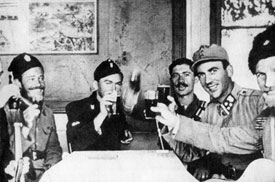
Cheerfully united anti-Communists in World War II Yugoslavia, from left to right, a Serbian Cetnik, a Croatian Ustasa, unidentified, a German, and a Cetnik. |
|
| Our goal is to look at the German and Habsburg-Austrian involvement in East Central European affairs as well as at the national histories of Germans and the East Central European countries. Topics of discussion will be arranged in a chronological order with emphasis on a few major developments and controversial questions, roughly between the Napoleonic Wars and the present. Because I would like to adjust our program to your particular needs and interests, I will draw up the topics for discussion only after the class has met. In the course of the semester, you will be expected to participate in two pre-arranged debates in which you should take a clear-cut position against an opponent who will take the opposite position. | |
| Prof.
Istvan Deak |
Class Meetings: |
| [email protected] instructor_webpage (212) 854-6598 Office hours: Tu 3-6 Office location: 1229 International Affairs |
Tu 6:10-8 1219 International Affairs Building |