DAILY
UPDATES
FRIDAY, MARCH
9
Getting In Tune With Israel
by George Bovenizer
 |
|
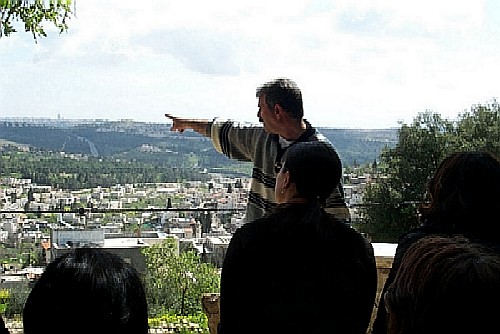
Our trip struck a minor sour chord to start with when the taxi driver, who had just dropped a couple of us off at John F. Kennedy International Airport, sped away with Professor Goldman's guitar in tow. Without music, but determined that our band of 16 students, led by Rabbi Paley and his wife, must play on, we climbed aboard El Al Flight LY0014 for the almost 11-hour flight to Tel Aviv. The flight was smooth, some slept others did not, but all emerged bleary eyed in Tel Aviv. We filed through immigrations and out into the warm Israeli sun that greeted us with temperatures in the high sixties. Professor Goldman, who had arrived two days earlier, welcomed us and introduced us to Jeff Abel, our guide for the first three days of our journey through the Holy Land. During the 45-minute bus ride from the airport to our first destination, Abu Gosh, Abel told of the history of this ancient land, pointing out certain sites and threading them into his lessons. It was information we had all learned during the first half of the semester, but to see the terrain first hand provided a layer one cannot get in books or lectures. Abu Gosh is an Arab village that is famous because it is the site of Kiryat Ye'arim (Town of Forests) where the Ark of the Covenant was kept for 20 years before King David moved it to Jerusalem (I Chronicles 13:5-8). Issa Jaber, a local Muslim Arab, took us up to the hill where the Notre Dame de l'Arche (Our Lady of the Ark of the Covenant) Church sits overlooking the town. Among olive trees that have stood for 1,500 years we listened to Jaber explain that we were sitting on the same spot that King David had sung and danced in front of the arc before bringing it 13-kilometers to Jerusalem. Jaber not only spoke of history, but also the present. He proudly told of the tolerance of the present day community of Abu Gosh, which along with its Arab majority is home to Christians and Jews. "We present a very unique model of people living together, of people of different backgrounds who respect each other and can coexist on the same land," Jaber said. Jaber then brought us to his home, where we met Dr. Ron Kronish, an ordained rabbi, who came to Israel from the United States in 1979. Kronish is the director of the Interreligious Coordinating Council In Israel, a non-profit association that seeks to bring better religious and cultural understanding between Christians, Jews and Muslims. "Politicians alone will not solve all our problems," said Kornish. He spoke about the peace process. Even though regional leaders currently are not at the bargaining table, said Kornish, his group is continuing interfaith dialogue, something that he believes is instrumental for understanding that will translate to a lasting peace. It is a dream he hopes will be realized in his lifetime. Accompanied by Kornish, a sudden driving rain and the background sounds of a sermon from a nearby Mosque playing over loud speakers, we enjoyed lunch at the nearby Caravan Inn. Buoyed by our meal, we headed for Jerusalem. The Dan Pearl Hotel, our first accommodation in Israel, sits just yards from the walls of the Old City of Jerusalem. Led by Rabbi Paley and Professor Goldman we ventured through the Armenian and Jewish Quarters towards the Western Wall, a stone wall that has stood since King Herod constructed the Second Temple in 20 BC. The sun was quickly falling and hundreds of Jews marched toward the most holy of all Jewish sites for the prayers of the Sabbath. Upon arriving at the Western Wall, many of us chose to venture among worshippers who were joyfully singing and dancing. Others at the Western Wall were dutifully chanting and bobbing from the waist up in prayer. Their faces were just inches from the worn crevices of the massive stones that house thousands of small paper-notes upon which are scrawled the prayers of people from all over the world. Illuminated by spotlights and an incredibly bright, full moon we soaked in the scene for 45-minutes. As we walked back to the hotel, our professors pointed out preserved Roman streets and towering walls built by the Ottomans. Famished by our incredible first day we sat down for bread, wine and dinner all blessed by Rabbi Paley in the Sabbath tradition. The blessing included singing songs and we all joined in, although many of us, not knowing the words, hummed along. However, we now knew that you do not need a guitar to make sweet music in Israel. |