DAILY
UPDATES
SUNDAY, MARCH
11
From Manhattan to Masada
by Vikram Sura
|
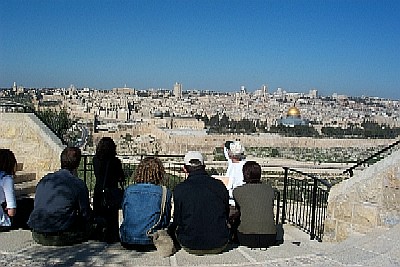
Ari Goldman turned sentimental today. Reticent Ari, as I call him secretly, said, "I like the way you people are sharing between yourselves. You're not just buying stuff for yourselves but instead buying things that you can share with others in the group." Professor Goldman said these words as we were traveling from Jerusalem toward the historic fort of Masada built by King Herod. Our bus took us through the West Bank to Masada, the second stop on our journey. But first we stopped by the Russian Orthodox Convent of St. Mary Magdalena. After checking out of our hotel in the morning, we headed for a morning mass at the convent on the Mount of Olives. The mass was sung in Church Slavonic, a language used only in the Russian Orthodox Church. It was followed by a silent Lenten meal prepared by the sisters. Sister Maria Stephanopoulos and Father Peter Lukianov spoke to the group about the church, which was built by the children of Tsar Alexander the Second. With its shiny gold domes and its ornate Eastern design in, the church of St. Mary Magdalene totally involved the worshippers. One hundred yards from the convent is the Garden of Gethsemene. The garden, sequestered behind an iron fence, contains olive trees between 1500 and 2000 years old. Our guide, Jeff, or "the non-believer" as he proudly called himself, entertained us at the garden. If it weren't for his subtly irreverent and intellectualized explanations about the holy places, the journey, at least for me, would have been less interesting. While clicking our cameras at the garden, Kevin and I had the same thoughts. "Oh, man" he said, "I can't believe we are here where Jesus was betrayed." Betrayal seems to be endemic in the Holy Land. The Jew, the Muslim and the Christian have all felt betrayed by one another at some point in their shared history. Right before we boarded the bus for the two-and-a-half hour ride toward Masada, a Muslim kid named Hamad tailed me, waving olive leaves he wanted to sell. I paid him a dollar for a handful of fresh leaves. King Herod built the fortress in 66 CE. Masada, which sits high on a solitary plateau overlooking the Dead Sea, was thought to be unassailable. But one hundred years after it was built, a splinter group of religious Jews fled Roman-controlled Jerusalem and violently took over the fortress. After a year-long siege by 10,000 Roman troops, nearly all of the 967 Jews decided to take their own lives rather than surrender to the Romans. The site has tremendous resonance for the present-day Jew. As we prepared to hike up the mountain in desert conditions, my American journo friends began complaining about the hot sun - what more can I say? And, as the story of the western tourist is told in the East, they all changed into shorts, stripped to t-shirts, donned baseball caps, applied sun tan lotion, bought bottled water and began the 263-meter walk to the top. The trail, known as the Snake Path, perilously winds its way to the fort. While admiring the spectacular scenery, we had to be careful not to slip on the loose rocks. Professor Goldman, in his shorts, made it to the top. I had my eye on him as he methodically wiped the sweat off his brow. Though he had a bounce in his step, he waited until all his students caught up with him-oh shame the youth, some were so slow-and followed the last of them. "Let it be written," Ari Goldman told me "that we did not take the cable car." The cable car cost 40 shekels. Jeff, characterized by silver hair that falls disinterestedly from under his cap to cover his ears and forehead in equal proportions, was there at the top as well. He shared a cig with me asking, "Is it all that you got? Nothing added to it? C'mon. You are college students." The tour of Masada took an hour-and-a-half. Rabbi Paley, the religious accompaniment to the choir of journalists on this pilgrimage, filled us in on the spiritual significance of the site. On our way to Be'er Sheva, our stop for the night, we visited a Bedouin encampment for dinner. As we settled on carpet-covered mattresses, our host, Salman, spoke to us about Bedouin culture. A younger Bedouin, Said, tended the fire and served us sweet tea, freshly roasted coffee spiced with cardamom, and fresh pita. Dinner consisted of turkey kebabs, saffron rice, and a traditional Middle Eastern mezzeh. Jeff left us at the Dan Paradise in Be'er Sheva and told us to be nice to the next guide, Ron. |