DAILY
UPDATES
MONDAY, MARCH
12
From Bedouins to Beaches
by Marguerite Reardon
 |
We awoke on the fourth day of our trip to a desert covered with a thick blanket of fog. We had pulled into the town of Be'er Sheva late the night before. It set the stage for a rather somber morning.
Sluggishly the group trickled down to the conference room for a lecture on the modern Bedouin given by Dr. Ismael Abu Saad, the director of the Center for Bedouin Studies at Ben-Gurion University. Saad's message was far less enchanting than the picture that was painted the night before as we gathered under the tent and dined with Salman, our leader at the Bedouin camp in the middle of the Negev.
While Salman talked about Bedouins wandering the desert and entertaining guests with bitter coffee and romantic stories of times past, Saad revealed a group of people struggling to find their place within the fabric of modern Israel. "We should go beyond the romantic aspects when we talk about the Bedouins," said Saad. "Everyone thinks of us as these fantastic wanderers like in Lawrence of Arabia, but that is not what we are."
He explained how Israel took the Bedouin's land that allowed them to sustain their nomadic lifestyle and in its place tried to relocate them into newly built towns. But the Israeli government failed to provide the education and services necessary for the Bedouin to make a living. In the seven Bedouin towns that have been created since 1968 there are only three banks, there are no libraries and no post offices. As a result, the Bedouins have the highest rate of unemployment, the lowest income levels, and the worst academic achievement in the country. After the lecture, Rabbi Paley led the class in an open discussion, where we first encountered our new tour guide, Ron. Issues of painful dislocation and accusations of discrimination stirred debate among us.
Finally, it was time to get on the bus as a long day of travel was ahead. We headed north through the Israeli countryside, past Haifa and up through the Galilee to the Ghetto Fighters kibbutz, our home base for the next few nights.
On our way out of the desert just north of Be'er-Sheva, we swung through Rahat, the second town established by the Israeli government for the Bedouins in 1970. From the bus we caught a glimpse of the problems Saad had described to us; it was not hard to tell that these people are struggling to assimilate. Two- story stone duplex houses, which often hold as many as three large families, lined the streets. Despite their modern homes, these families had still erected traditional Bedouin tents in the backyards, vestiges of their former way of life. Clothes lines sagged with drying laundry, and traditional Bedouin mats and rugs, like the ones we had sat on the night before during dinner, hung from some of the balconies.
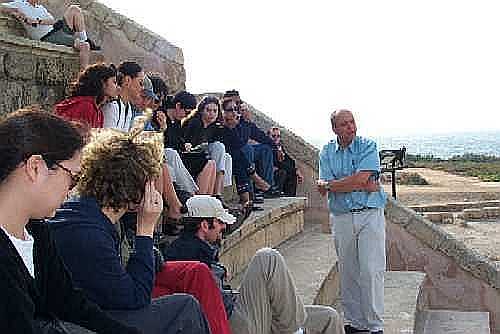
Soon the serious tone of the morning was left behind in the dust of the desert as our bus continued up the coast to our first and only official stop of the day, the ancient port of Ceasarea. In 22 BC Herod expanded this small Phoenician settlement into a great port city, complete with a manmade breakwater to protect merchant ships, an amphitheater, and an aqueduct system. After Herod's death it became the Roman capital of Judea and Pontius Pilate lived there as the governor from 26 to 36 AD. His name appeared on a plaque in the ruins of the amphitheater; the only place other than the Bible that verifies that Pilate, the man who sentenced Jesus Christ to death, actually lived.
The amphitheater, which faces the Mediterranean Sea, has been restored and musicians still perform there. To test the acoustic powers of the amphitheater, our own Jaime Bedrin serenaded the class with a rendition of "Somewhere Over the Rainbow". The Nigerian pilgrims sitting across the amphitheater joined us in giving her a standing ovation.
After the amphitheater we drove a few minutes down the road, winding through million dollar beach homes toward a spot where we could dip our toes into the blue of the Mediterranean. The air was cool but George and Kevin braved the cold and plunged into the waters.
Taking his cue from Jaime's performance, Professor Goldman waded through the knee- high surf to an old stone jetty. He climbed up, secured his footing on the slippery stones, raised his arms into the air, and belted out a song - "The Sun Will Come Out Tomorrow". We finally reached the Ghetto Fighters kibbutz where dinner was followed by a surprise. Michael had somehow acquired a guitar, and he and Professor Goldman took turns leading the group in whatever songs we could remember.