|
DAILY
UPDATES TUESDAY, MARCH 13
|
|
|
|
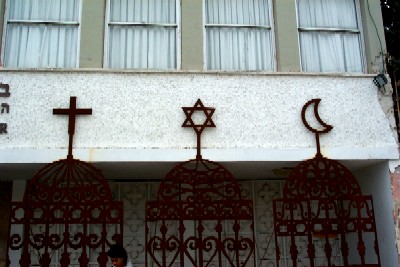
The first explosion thundered a little before 6:30 a.m. today, brutally waking Kevin and George. Then another loud explosion, then another. Roshni fell out of bed when she heard it, and others stumbled out in confusion to see what was going on. And there she was: Hay-Mie, in her blue, cotton pajamas and glasses, angrily pounding on each and every door. Day five of our religious adventure was about to begin. It was time to get up. After recovering from the initial shock, people made their way to the dining hall at the Ghetto Fighters Kibbutz, a community run by anti-religious, socialist Jews. We were craving coffee and the breakfast Goldman and Paley had been raving about since New York. The ums and ahs filled the room. A heavenly meal in a godless place. "This is the first time I've had real coffee since I left Germany," Kirsten said. "It's not like in America!" "Have you tasted this eggplant?" Annie said from across the table. "It's amazing!" The table in the middle of the room had a huge spread of delicious local dishes, many containing vegetables grown right here at the kibbutz. Even the herbs used in the tea were homegrown. But nothing lasts forever. We had an appointment in Haifa. It was time to go. As we drove into the city on the bay, a magnificent white palace with an orange-gold dome appeared on Mount Carmel. Leading up to it were hundreds of pearly white steps with nine lush terrace-gardens steeply layered on either side. Nine more terraces, under construction, fanned out behind the palace. When the whole garden is finished in May, it will be among the largest gardens around the Mediterranean. When the bus had twisted and turned to the top, we saw that the deep reds, blues and purples that specked the garden were exotic flowerbeds. We had reached the Baha'i World Center and the shrine of the Bab, the religion's Prophet-Herald. The religion of Baha'i, founded by Baha'ullah in the 1800s, is the youngest of the world's independent religions. It is also among the fastest growing. There are about 5 million Baha'i worldwide, and according to Anne Wong, our guide at the center, there are Baha'i in every country in the world. They believe that Baha'ullah was the last of a long line of prophets, including Moses, Zoroaster, Christ and Muhammad, and that human society should try to develop a peaceful world order. They work closely with the UN, since they see the organization as a tool to achieve that goal. The beautiful gardens, the soft blue carpets leading to the tomb of the Bab, and the chandeliers and flowers inside are not proscribed by the religion. They are there to create a setting. "When you see beauty and harmony around you," Wong said, "you feel spiritual and you know that you're in a holy place." With a quick glance, we soaked up the view of the sand-colored houses sprawling out below the palace and down to the water that lay sparkling in the morning sun. Then, our eyes looked down at our watches. It was time to move on. Three rusty screens stood almost a story high in front of the Beit Hagefen Arab Jewish Center in Haifa, each topped off with the symbol of one of the great monotheistic religions: Judaism, Christianity, and Islam. The center promotes inter-religious discussion and interaction. It arranges meetings between Muslim and Jewish children and youths, trying to get them to view each other as something other than as enemies. Hani El Far, director of the center, admitted that the program had met a lot more resistance since the violence broke out in September of last year, but that the center had received overwhelmingly positive reactions to their annual festival. The festival runs from November to May each year, and features artwork by 100 artists set up all around the small, mostly Arab neighborhood of Wadi Nisnas. This year the theme of the festival was children, and as we followed the painted, yellow footsteps that lead visitors from piece to piece, we admired colorful wall-paintings of dancing kids with no faces, sculptures of toys and butterflies, and a statue representing birth. At the center itself, a large barbed-wire globe with a barbed-wire child inside hung low over the stairwell, and the Little Prince sat proudly in a small airplane at the beginning of the walk. The more than 6,000 people living in the area didn't seem to mind that their neighborhood had been turned into an enormous art exhibit.. Not a single piece has been vandalized throughout the seven year the center has hosted the festival. Nama Ibrahim, a Christian Arab whose carpenter shop is surrounded by several of the pieces, said that he liked watching the artists work. "We like art that you make with your hands, that you sweat over," he said. After making a quick stop at a small, but gourmet, falafel shop, we wiped our mouths and inhaled the heavy smell of Arabic coffee coming from every window for one last time before climbing back on the bus. It was time to hit the road again. Our next stop was in a Druze village of Daliate el Carmel. A woman with a white headscarf and a long, blue dress, and a man wearing a small, white pill-box hat and a long, blue robe, looked curiously at the bus as we pulled to a stop. The man's clothing indicated that he was a religious Druze, but had we asked him what he believed in, he would not have told us. The religion of the Druze is a secret to all outsiders, as well as to the majority of members of the community. The Druze are split into two groups; only 10-12 percent of them belong to the inner circle, and know what the religion is really about. The rest of the community only gets to know a few basic rules and traditions. Only children of two Druze parents can become Druze themselves. It is strictly forbidden for anyone inside the religion to talk about their beliefs. This is something that has frustrated journalists before us, but today we lucked out. We met with Hasson Ramzi, the Tourism Director in the village, and his friend Massad Kador, who were both non-religious and willing to talk. The Druze are not connected with any of the great monotheistic faiths, but like the Baha'i, they believe that the prophets of Judaism, Christianity and Islam truly were messengers from God. The difference is that the Druze believe in reincarnation and think that all the prophets were one and the same person. They also think that every human being lives eternally in different human bodies (humans can only be reborn as humans), until judgment day, when they will be held responsible for the action of their last 15 lives. The Druze, therefore, have a special attitude towards death. They don't mark their graves, and they are known for their fearlessness in battle. Ramzi said that today many young Druze have started rethinking their religion, or moving away from it all together. "We want to keep the nice things," he said. "Not the bad things [like the alcohol prohibition]." "We drink alcohol, me and him!" he said nodding his head towards Kador. "I promise you that!" And no wonder he drinks alcohol! It turned out that Ramzi had spent years living in the Northern-most part of my home country, Norway. Speaking in fluent Norwegian with a Northern dialect, he talked of fishing and socializing with one of the most well known drinking nations in the world. "Ha det bra!" he said. "Good-bye!" It was getting late and we still had a lot to see. After a quick stop further down in the village, where we bought ice cream and unsuccessfully tried to "mingle with the locals," we had time for a rushed stop at the famous mosque in Akko, before moving on. The last stop of our long and eclectic day was at Nes Ammim Kibbutz, the only Christian kibbutz in Israel. It was founded in 1963 by European Christians in an effort to reconcile with Jews after the Holocaust. After dinner, an already interesting talk with one of its members, Job Van de Vendel, got more exciting when Rabbi Paley asked him why European Christians couldn't just leave Jews alone after a century full of persecution. Van de Vendel tried to explain that they came in peace. They don't display crosses, include the Jewish Torah reading in their weekly services, and didn't allow Germans to join the kibbutz until 1973. This didn't seem to satisfy Rabbi Paley, but Ron, our local guide, offered an Israeli perspective. "These people made a major gesture of goodwill toward the Israelis," he said. "They did not come here to wave their cross like the Crusaders." On that note, we put away our notebooks for the last time and ventured out into the pouring rain where the bus stood waiting, its headlights cutting through the darkness. It was time to go - to bed.
|