DAILY
UPDATES
WEDNESDAY, MARCH
14
Take Me To The River
by Valerie Thomas
 |
|
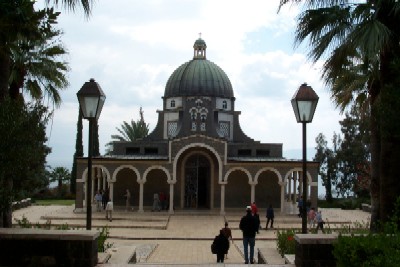
Today, our sixth day here, the pace of the past few days eased a little. We did not hurry; instead we allowed ourselves to linger in some of the most beautiful places in Israel. We spent most of the day outside, talking to each other and experiencing the country in a more intimate way. Pulling out of our home-base at 7:58 a.m., a record-setting two minutes ahead of schedule, we drove east from the Mediterranean Sea to the Sea of Galilee. As we wound through the mountains, we traveled along a route dotted with the graves of rabbis who had fled Jerusalem in the second century A.D. Our first stop was the tomb of Shimon Bar Yochai, a Jewish sage who had spent 12 years sequestered in a cave, living off nothing more than water from a stream and one carob tree. On our way out, we bought red thread, a symbol of the mystics, and we tied them around our wrists. A few miles up the mountain, through terraced hills and groves of flowering fruit trees, we arrived at Sefat, the highest town in Israel and one of the centers of Jewish mysticism. As we walked along the narrow, cobble-stoned streets, we were blessed with one of the first transforming events of the day. High above us a large flock of storks rode the wind currents, mid-way on their migration from Uganda to Central Europe. Like a handful of black pepper thrown into the air, they floated and sailed until we lost sight of them. Outside the H'Ari Synagogue, Rabbi Paley gave a talk about the roots of Kabala, the Jewish mystical tradition. Unlike most mystic traditions, the Jewish mystics who settled in Sefat in the 16th century, fleeing the Inquisition in Spain, did not look inwards, withdrawing from the world. Rather they envisioned their spiritual mission to be one of collective transformation, an outward expression of the search for the oneness with God. They hoped to return the world to what it was like at the beginning of time when there was nothing but light. After a stroll through town, we returned to the bus and headed east toward the source of the River Jordan. We came to the Mount of the Beatitudes, the spot where it is said that Jesus delivered his Sermon on the Mount and where he performed many of the miracles recorded in the Bible. Kevin read to us from the book of Matthew - "Blessed are the meek for they shall inherit the earth." As both pilgrims and journalists we decided to walk to our next stop, the Church of the Loaves and Fishes. In the church, which was built in the 1980's, are the remains of a small fourth century mosaic depicting a basket of loaves flanked by two fish. For many believers this marks the place where Jesus fed thousands of people with this meager meal. Unlike most of these sites we have visited so far, which have been eerily devoid of other tourists, pilgrims still come to the Galilee. Groups from Texas, Mexico, China milled about these same churches with us and walked the paths that Jesus likely walked. Continuing on foot, we followed the coast toward Capernaum. The sun was out, a breeze came off the lake, and the wild flowers lining the road were in full bloom. Whatever one's religious inclination, it was difficult not to sense the spiritual energy of this part of the country and to imagine the seeds of the Christian faith bursting to life on these hills. We ate lunch at an outdoor restaurant overlooking the water, a moment which both Rabbi Paley and Professor Goldman had been eagerly awaiting; we'd heard our fair share about the famed St. Peter's fish. Leaving a pile of fish heads and picked over bones on our plates, we understood why. We finally reached Capernaum, the site of a synagogue in which some believe that Jesus based his ministry. Although the remains sit next to a rather monstrous modern church, a giant cement mushroom, the large pillars and marble walls of the synagogue are majestic. Back on the bus for the last leg of our trip, we continued to hug the coastline, heading toward Tiberius. Perhaps emboldened by her debut at Caesaria, Jamie grabbed the microphone at the front of the bus and belted out a few show tunes. We all agreed that if J-school doesn't pan out, she shouldn't fret. Broadway would be lucky to have her. At the southern end of the lake, where the River Jordan begins its journey to the Dead Sea, we stopped at a spot along the river where Christian pilgrims come to immerse themselves in the very waters in which Jesus himself was baptized. We watched as a line of pilgrims, all wearing thin, white robes, waded into the water, one by one down the cement ramp, gripping the metal side rails. A minister stood waist deep in the river awaiting them. Once they had secured their footing, he placed one arm around their shoulders as he gently pulled them backwards into the river. Some laughed when they emerged, some wept, and all of them smiled for the clicking cameras recording the event. We were not expecting Hay-Mie to join in, but she boldly approached one of the drenched ministers and asked him if he would baptize her. Unlike most pilgrims there, who were renewing their commitment to God, Hay-Mie had never been baptized, and she decided to do it right then and there. Even the minister seemed moved and perhaps a little nervous at the prospect of leading someone he had met only moments before into a covenant with Jesus. Hay-Mie didn't don the robe, but simply stood on the bank of the river as the minister placed one hand on her forehead, asked her to declare a series of promises to God, and then released a handful of water over her head. In a matter of moments, the deed was done. Maggie, a practicing Catholic, was next, but not before confirming that the blessing of the Methodist minister wouldn't somehow violate her own faith. A few drops splashed on her forehead and she had renewed her vows to God. It was then Roshni and George's turn, but they had rented the six dollar robe and renewed their baptismal promises with full immersion in the river. We spent nearly two hours at the river, fascinated, moved, sometimes puzzled by these pilgrims, who were undoubtedly experiencing one of the high points of their lives. The day ended with beers in an outdoor café in the resort town of Tiberius. Reflecting on what we had witnessed at the river, many of us talked about what place religion has in our lives, if any at all. No doubt it's a conversation we will continue to have.
|