DAILY
UPDATES
THURSDAY, MARCH
15
In Which Tourists Become Foreign Correspondents
by Michael Petrocelli
 |
|
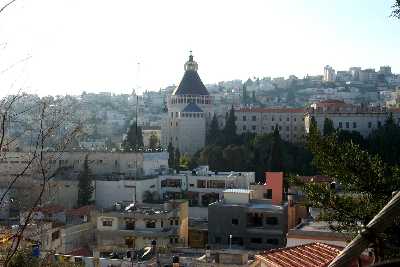
The troops awoke this morning seemingly refreshed by the spiritual adventures of yesterday. "The sun is shining, and I'm feeling good!" I heard George shout as I stuffed my notebook and pen into my daypack. Enriched by my first seven-hour night of sleep on the trip, I couldn't help but agree. In the dining room, meanwhile, Annie Paley continued her love affair with the Ghetto Fighters breakfast, first videotaping the exotic spread for posterity before diving in. "I'm just so excited!" she said, pointing to a slimy, green, decidedly unbreakfast-looking dish. "Did you know that's cactus?" Today promised to be difficult, with an emotional morning at a Holocaust museum and an afternoon practicing our profession in Nazareth. But as I sipped my second cup of gloriously rich coffee, I felt ready. Nervous, but ready. For three nights, Beit Lohame HaGeta'ot, Ghetto Fighters Kibbutz, had been little more than a place to rest our heads, plug in our laptops, and inhale the earthy smell of manure. This morning we learned what this place is really about. Ghetto Fighters was founded on April 19, 1945, the sixth anniversary of the Warsaw Ghetto Uprising. Its founders were veterans of the uprising and its first members were all Holocaust survivors. Today, 70 of its 270 members are survivors, and many more are descendants of survivors. Israel's first Holocaust Remembrance Day was observed here, and immediately after the Kibbutz's founding, members broke ground on a Holocaust museum. Simcha Stein, the museum's director, spoke to us briefly over breakfast about the history of the Kibbutz and the museum and we walked off in the bright sunlight to visit Yad Layeled, the children's wing of the museum. We began in a round, high-ceilinged room. Only natural light, filtered through stained-glass windows, lit up the room. The window on the ceiling depicted a butterfly with bright purple wings. The butterfly is the museum's emblem, and a quote from a poem by Pavel Friedman, a boy who lived in the Theresienstadt ghetto, is inscribed on the floor: "Butterflies don't live here, in the Ghetto." We each took the museum at our own pace, and I, for one, was glad to have the chance to experience it in solitude. The museum is impressive less for its content than for its design and the way the architecture and the exhibits are integrated. The design, by award winning Israeli architect Ram Karmi, forces you downward in a spiral. You begin in the streets, which are represented by grated, steel floors and signs in German including, "Walking on this side of the street forbidden for Jews." From there, you move into the ghetto, where the floors turn to wood and the spaces become tighter. Suddenly, the wood floors end, and railroad tracks begin, letting you know that the trip to the camps has begun. All the while, children's voices recount survivors' experiences in Hebrew. Eventually, the tracks end at a barrier, and you arrive at the end of the line, a dark room with an eternal flame at the bottom of a pit of circular benches and a video screen where survivors tell their stories. I found one of these tales particularly moving. A man named Itzhak Weinberg told that his parents bribed their way out of the Warsaw Ghetto and escaped to Budapest. When the Nazis arrived in Hungary, they secured a place for their two boys on a train that was supposed to take them to what is now Israel. The train was famously rerouted to Germany, however, after negotiations with Adolf Eichmann broke down. All of its passengers ended up in Bergen-Belsen concentration camp. Weinberg survived to tell the tale. Most didn't. This story stayed with me all day. I expect it will stay with me for a long time. Emerging into bright sunlight, we squinted at the Roman aqueduct that stretches from the museum to the horizon where it fades into a green forest. The museum curator, Judy Grossman, said that the architect integrated the aqueduct into his design as a symbol for life. It is certainly a nice touch. We then boarded the bus and tried to focus on the afternoon ahead. The kibbutz labor song that Ron had been welcoming us with for the last three mornings ("Bocher ba, l'avodah. Morning comes it's time to work.") was not received with the usual raucous applause, but it spoke to us more today than before. For the first time on the trip we would not be tourists. We would be journalists. Our assignment was to cover Nazareth, the city where Jesus spent his "hidden years." Nazareth is an entirely Arab city, mostly Muslim with a minority of Christians. In recent years, a conflict has emerged between the two religious groups over a mosque that is to be built on a parking lot next to the Church of the Annunciation, where Mary is said to have received word that she would bear a child. In October, Nazareth also received international attention when Israeli police killed three Arabs during a protest on the road to Nazareth-Illit, a government-planned Jewish town in the hills above the Arab city. Somewhere, in all of this, there was a story to be told. After a short bus-board briefing, we plunged into the holy city. We divided into groups to report all aspects of the story. Kirsten, Nina and Shelly covered the Muslim population; George, Maggie, and Valerie handled the Christians; Kevin, Roshni, and Vikram tackled the village's economy; and Hay-Mie, Jamie and I headed to the hills to report on the Jewish community. Charlie ran around town taking pictures, while Tarannum, who would write the final product, familiarized herself with the big picture. We reassembled on the church lawn in the afternoon to pool our notes and realized that the Muslim/Christian conflict wasn't the story. The Arab/Jewish conflict had overwhelmed it. The reporters acquitted themselves beautifully. Nazareth didn't know what hit it. After dinner in the seaside town of Naharia, we were entertained on the ride home by the most unlikely of hams. Hay-Mie, showing a shocking lust for the spotlight, grabbed the tour guide's microphone and began regaling the newly-baptized foreign correspondents with an enormous repertoire of jokes (Example: "What do you get when you drop a piano on an army base? A Flat Major."). We cheered all the way home. Back at the kibbutz, we held a class meeting on the lawn. Professor Goldman told us how proud he was of our efforts that day, and how far we had come since the beginning of the semester. Nourished with his praise, and several cups of Nescafe, the writers and editors settled in for a long night of work.
|