"READINGS IN URDU
LITERATURE"
 
==> PREREQUISITE! <==
Completion of the second semester of Intermediate Hindi-Urdu (MDES W1613y), or consent of the instructor. If you are uncertain about your eligibility, check with Prof. Pritchett <fp7@columbia.edu>.

General Course Description:

        This course is open to both undergraduates and graduates, subject to the above prerequisite. The course is repeatable, and the content changes every semester. It is two things at once: an advanced language course, with practice in speaking, understanding, vocabulary use, reading, writing, and grammatical analysis; and a literary course, with exposure in depth to some of the finest works of classical and modern Urdu prose and poetry.

        The Tuesday class will be devoted to work with written materials-- reading, grammar, writing practice, etc.-- and will be conducted by FWP. The Thursday class will vary in nature, but parts of it will often be used for conversation practice, and will sometimes feature topics and formats selected by students (playing games in Urdu is an option). 

        Because the course is repeatable, and naturally for other reasons as well, students in the course will have widely varying backgrounds in the language. Grading will therefore be entirely individual. Your grade will be determined by my assessment of your performance in relation to your background and capabilities, not by ranked comparison between you and the other students in the class.

        Grading will be based on two components. Half of your grade will be based on general class performance--including regular attendance (a record will be kept), participation, preparation of reading and homework assignments, and a two-hour final exam. The other half of the grade will be based on an individual project, suitable to your level, that you will discuss with me, formulate in writing, carry out in the course of the semester, and demonstrate to me in the course of an individual half-hour interview at the end of the semester. Projects can range from learning vocabulary words or memorizing poetry, through doing translations or readings, to writing major research papers or essays, in English or Urdu. THIS SEMESTER (Spring 2010), however, there will be an unusual and interesting "independent project" for everybody individually and also the whole group collectively. To opt out of it will require special permission and a good and persuasive reason. 


~~~~~~~
Readings in Urdu Literature
SPRING 2010
COURSE MATERIALS:

== This semester there will be NO paper course packet; instead, be sure you have good arrangements for printing out the appropriate materials (which will be indicated on the syllabus).

== REQUIRED: Access to a Platts’ Dictionary. It is strongly recommended that you get your own. I have some on hand right now (an exceptional value at $30) for those who want them. Copies are on reserve at Butler Library and the East Asia Library (3rd floor of Kent), and one is in the MEALAC reading room too. This is the best single work for any serious Urdu student to own. This invaluable text is also now online through the Digital South Asia Library.

== Highly recommended: M. A. R. Barker et al., Urdu-English Vocabulary: Students' Pronouncing Dictionary (Ithaca, NY: Spoken Language Services, Inc., 1991 [1980]). Excellent vocabulary-building tool, with frequency count so you can target the most common words. Available through amazon.com.

== If you feel the need of some review, take a look at C. M. Naim, Introductory Urdu, Volume 1 (Chicago: South Asia Language & Area Center University of Chicago, 1999: online through the Digital South Asia Library. (It is also on reserve at Butler.) To make this text more useful, I've given links to some of the *main grammar topics*.  This text also features a thorough account of the Urdu *SCRIPT*. I also have some *script-related thoughts of my own* online.

== You should also check out the Urdu/Hindi language/literature page on my website for many other resources. A notable one is the *THE DATELIST OF URDU LITERARY FIGURES*, a comprehensive database on Sean Pue's website.

== You also might find useful some of the audio- and videotapes in our Language Resource Center, or texts and grammar books in our Butler Reserve reference collection.

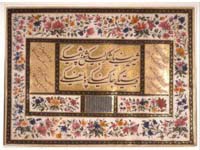
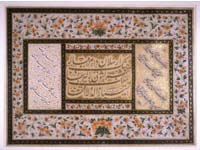
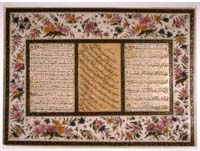
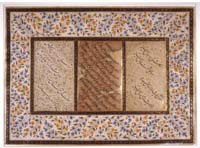
== Just for a treat, take a look at my calligraphy collection.

== You might also like to join the Urdulist, a small listserv based at Columbia for those who are seriously interested in Urdu literature: for full information, send an email to <majordomo@columbia.edu> with no header and only the words "info urdulist" (without quotes) in the body.

== Are you fond of modern poetry? M. A. R. Habib's facing-text reader, *An Anthology of Modern Urdu Poetry* (New York: MLA, 2003) is a bargain, and might be just what you'd enjoy.

== And if you are really serious about the poetry-- *Urdu Meter: A Practical Handbook* is at your service.


Syllabus for Spring 2010:
"From Hali to Iqbal: New Visions"

More details will be added here, and any necessary changes made, as the semester progresses. Please check this syllabus regularly for all current information.

*Urdu Meter: a Practical Handbook* (not required but very helpful)
*Platts* (Urdu); *Steingass* (Persian); *CRULP* (all-Urdu)


WORK IN PROGRESS!

WEEK ONE == Tu. Jan. 19, Th. Jan. 21
Introduction to *Altaf Husain Hali* (1837-1914), for which materials will be provided in class (selections from the *masnavi for children*); also, please read the introductory material, pp. 1-80, in *the Musaddas book*

WEEK TWO == Tu. Jan. 26
The original introduction to the *Musaddas* (1879); *the text for class*
= Th. Jan. 28: TBA

WEEK THREE == Tu. Feb. 2
*Musaddas*, bands 249-270; *the text for class*
= Th. Feb. 4: TBA

WEEK FOUR == Tu. Feb. 9
*Musaddas*, bands 271-294; *the text for class*
= Th. Feb. 11: TBA

WEEK FIVE == Tu. Feb. 16
Read *"How to read Iqbal" * by S. R. Faruqi (AUS, 2005)
For general interest: a great deal of *Iqbaliana*
*"Taranah-e hindi"* (1904); *the text for class*
*"Taranah-e milli"* (1910); *the text for class*
= Th. Feb. 18: TBA

WEEK SIX == Tu. Feb. 23
*"Shikvah"* (1911), bands 1-15; *the text for class*
= Th. Feb. 25: TBA

WEEK SEVEN  == Tu. Mar. 2
*"Shikvah"* (1911), bands 16-31; *the text for class*
= Th. Mar. 4: TBA

WEEK EIGHT == Tu. Mar. 9
*"Masjid-e Qurtuba"* (c.1932), bands 1-4; *the text for class*
= Th. Mar. 11: TBA

WEEK NINE == Tu. Mar. 23
*"Masjid-e Qurtuba"* (c.1932), bands 5-8; *the text for class*
= Th. Mar. 25: TBA

WEEK TEN == Tu. Mar. 30
*"Lenin"* (from Bal-e Jibril, 1935); *the text for class*
= Th. Apr. 1: TBA

WEEK ELEVEN == Tu. Apr. 6
*"Jibril o Iblis"* (Bal-e Jibril, 1935); *the text for class*
*"Insan"* (1905-08); *the text for class*
= Th. Apr. 8: TBA

WEEK TWELVE == Tu. Apr. 13
*"Sitaron se age"* (Bal-e Jibril, 1935); *the text for class*
*"Gesu-e tabdar ko"* (Bal-e Jibril, 1935); *the text for class*
*"Lalah-e sahra"* (Bal-e Jibril, 1935); *the text for class*
*"Kabhi ay haqiqat"* (Bang-e dara, 1924); *the text for class*
*"Apni jaulan-gah"* (Bal-e Jibril, 1935); *the text for class*
= Th. Apr. 15: TBA

WEEK THIRTEEN == Tu. Apr. 20
An overview of a few of his later poems of other kinds; this will be sight-reading and discussion in class, no advance preparation necessary
= Th. Apr. 23: TBA

WEEK FOURTEEN == Tu. Apr. 27
Class presentation of *"Javab-e Shikvah"*; *the text for class*
= Th. Apr. 29: TBA


PARTY at Prof. Pritchett's apt. (details to be given in class)


OTHER PAST (AND FUTURE) COURSE TOPICS:
 

Qissah-e Chahar Darvesh (Bagh o Bahar) == fall 1994
Ghalib == spring 1995; fall 2000; spring 2005 (half)
Classical ghazal == fall 1992; fall 1996; fall 1998; fall 2003; fall 2006
A marsiyah, Anis's Jab qata ki == spring 2004
A masnavi, either Zahr-e 'ishq or Sihr ul-bayan
Aab-e hayaat == spring 2008
Mirat ul-'Arus == fall 1993; spring 2002
Taubat un-Nusuh == fall 1991
Umrao Jan Ada == spring 1993; spring 1998; spring 2006
Bihishti Zevar == (deserves to be done sometime)
Manto and Ismat Chughtai == fall 1995
Premchand, Ismat, Manto == spring 1992; spring 2005 (half)
HHali and Iqbal == spring 2010
Faiz, N. M. Rashid, and Miraji == fall 1999; fall 2002
The Progressive Movement == spring 2007
Hali and Iqbal == spring 2010
Iqbal == fall 1997; fall 2001; fall 2004; fall 2007
Basti == spring 2000

Partition literature (Tahira Naqvi, spring 2001)
Modern literary memoirs (Andy McCord, spring 2003)
Urdu literature in historical perspective (Carla Petievich, fall 2005)


 -- back to top of page -- back to FWP's main page --