===
0757,
2
===
=== |
|
sang-saar karnaa : 'To stone to death'. (Platts p.686)
na;xl : 'Date-tree, palm-tree; (in P. & Urdu, also) a tree, a sapling, a plant; —a festoon, a thyrsus, a rod upon which flowers, interspersed with paper of different colours, are tied round to give it the appearance of a natural branch; an artificial tree'. (Platts p.1126)
taabuut : 'A bier; coffin; an oblong case placed over a grave; a wooden box or chest; the ark of the covenant (presented by God to Adam, and which, according to Mohammadans, contained the portraits of all the prophets); a representation or model of the mausoleum of Husain (carried in procession in the Moharram)'. (Platts p.303)
((alam : 'A spear; a flag (or strip of cloth, that is tied upon the spear); a banner, standard; the spear-headed banner of Hasan and Husain (that is carried in procession at the Moharram festival)'. (Platts p.764)
FWP:
SETS == WORDPLAY
MOTIFS == [DEAD LOVER SPEAKS]
NAMES
TERMS == MOOD; THEME; WARRANT; WORDPLAYFor discussion of textual problems in this ghazal, see {757,1}. I have used the kulliyat text rather than the one given in SSA.
Could the analogy of stones to the dates borne by a date-palm be part of the verse? The idea of 'fruit' seems to point in that direction (as in {702,7}). In Urdu, the sense of na;xl seems indeed to include stylized and artificial 'trees' of decorative kinds (see the definition above).
But I keep thinking, through the association with Muharram, that the 'tree of mourning' ought to be analogized to the tall tree-like poles or standards [((alam] (see the definition above) that are carried in the Muharram procession. I can't help but feel that they are evoked at least to some extent. By contrast, a bier or coffin [taabuut] (these are also called taaziyah ) seems much less tree-like.
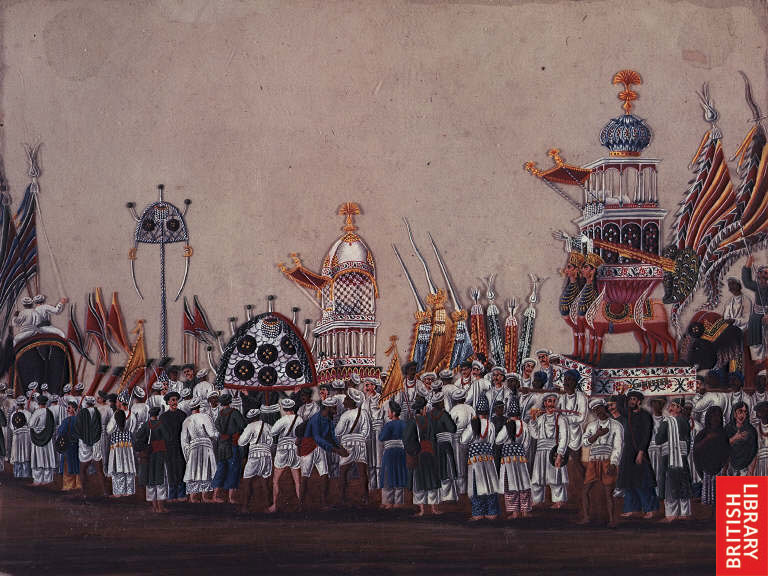
But then, these tabuts or taziyahs are often made extremely tall and vertical, so that they too could be considered to resemble trees. Here's an example, a watercolor c.1830-40 from the British Library collection that shows some very tall and relatively tree-like taziyahs:
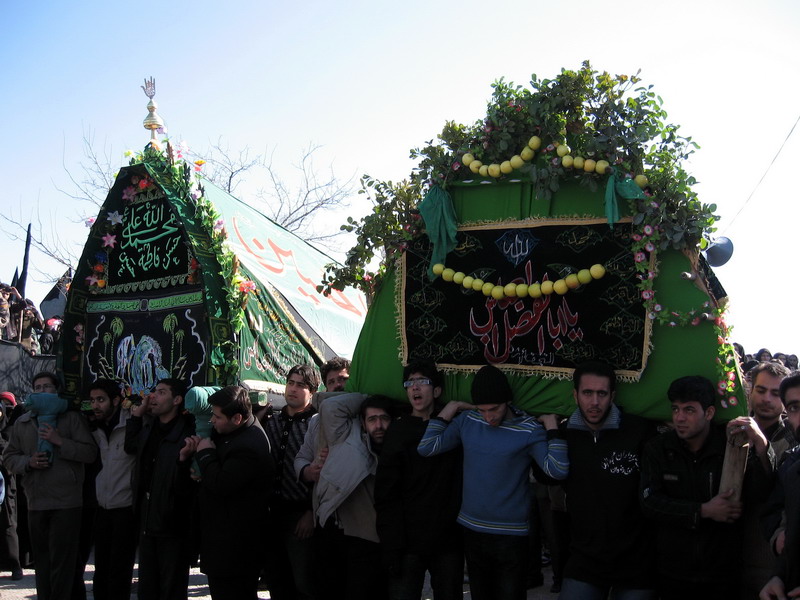
The modern Persian na;xl-e maatam actually has a tree-like shape (with thanks to Zahra Sabri for finding the image):