===
1312,
7
===

=== |
|
aaluudah ;xuu;N se naa;xun hai;N sher ke se har suu
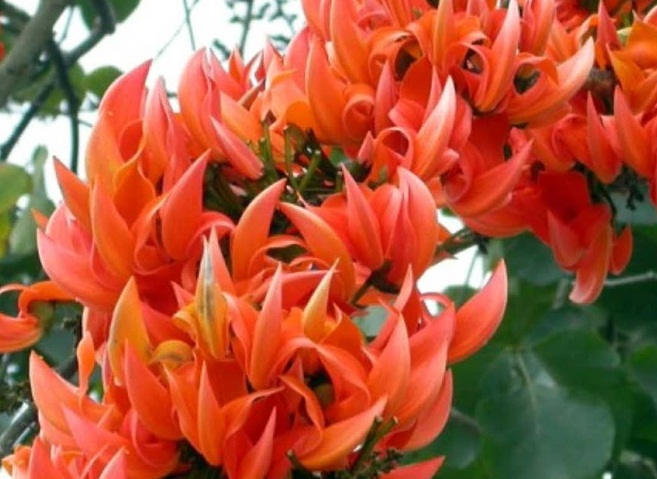
jangal me;N chal bane to phuulaa hai zor ;Dhaakaa
1) there are blood-smeared nails/claws like those of a tiger in every direction!
2) if/when one would manage to go into the jungle/wilderness, then the dhak-tree has powerfully/violently bloomed
zor : '(adv.) Vigorously, powerfully; violently, forcibly; extremely, very'. (Platts p.619)
;Dhaak : 'The Butea frondosa (syn. palaas ). The tree in full bloom presents a striking spectacle, like fire on the horizon; from natural fissures and incisions made in the bark, issues, during the hot season, a red juice, which soon hardens into a ruby-coloured, brittle, astringent gum, similar to kino, and sold as Bengal kino; lac is collected on the branchlets; the leaves are used as plates, &c., and instead of paper, to wrap up parcels, and are given as fodder to buffaloes; the flowers, with alum, are made into the yellow dye used in the Holi festival, and are also used medicinally; the seeds are given as purgative and anthelmintic, mostly in veterinary practice; the wood is used for coating wells, and for the sacrificial fire)'. (Platts p.569)
FWP:
SETS == MUSHAIRAH
MOTIFS
NAMES
TERMS == ZILAThe first line is simply frightening, like a cry of alarm. It's impossible to tell what's going on. Is the speaker calling out a warning? Is he in danger? Is he intoxicated? Hallucinating? Insane? We are forced to wait-- under mushairah performance conditions, as long as conveniently possible-- for enlightenment from the second line.
Even then, in true mushairah-verse style, the 'punch-word' ;Dhaakaa , which suddenly makes the whole verse intelligible, is withheld until the last possible moment. (And since this ghazal has no refrain, the last possible moment is actually the very end of the second line.)
Moreover, the adverb zor , with its meanings that include 'violently, forcibly, powerfully' (see the definition above), creates its own kind of connection with the first line. And within the second line it's been placed in the penultimate position, where its impact is guaranteed to be-- well, 'powerful'. Compare Ghalib's equally effective use of the adverb sa;xt :
G{167,2}.
Note for grammar fans: In the first line, the se is of course short for jaise . In the second line, phuulaa hai could either be the present perfect ('has bloomed') or a shortened form of the past participle ('is in a state of having bloomed'); it's not clear that it makes much difference in this case.