FWP:
SETS == DISRUPTION
EYES {3,1}
GAZE: {10,12}
PROPORTIONALITY: {6,4}
SKY {15,7}
For background see S. R. Faruqi's choices. This verse is NOT one of his choices; I thought it was unusually interesting and have added it myself. For more on Ghalib's unpublished verses, see the discussion in {4,8x}.
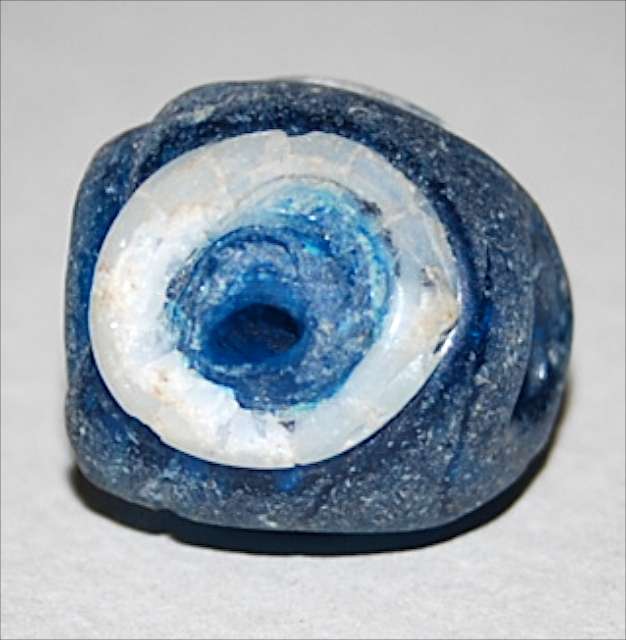
Are we to consider the sphere of the sky itself in the first line-- with its highlighted qualities of revolving and 'going around', and surrounding or 'embracing'-- to be the same as the round eyeball of the 'azure eye' in the second line? It's of course an attractive idea. Alternatively, we could consider the flirtatious beloved in the second line to be a separate presence; though indeed, as Zamin and Gyan Chand observe, a blue-eyed beloved is not part of the ghazal tradition (any more than a woman with straight or blonde hair, or one with a non-microscopic mouth or waist).
Above all, however, it's the paa))e-maal that fascinates me. In the first line we have the set of round and circling entities gardish , mu;hii:t , falak ; in the second line we have ;Gamzah , chashm . All the imagery is related to round, rolling, enclosing things. Then suddenly one of these round, rolling things is made to destroy the lover-- but not by rolling over him, or by shooting into him the eyelash-'arrow' of a glance.
Rather, he is 'trampled underfoot' by a 'wink, amorous glance'. Eyes are round and rolling, and have winks and amorous glances-- but since when do they have legs and feet, for 'trampling underfoot'? Ghalib has thrown a spanner into the works of his own imagery here; and since he's the kind of poet he is, it can hardly have been accidental. Another classic case of this kind of disruption is {116,9}, which jarringly equips the rippling waves of the ocean [mu;hii:t] with the 'arms and legs' of a human swimmer.
Compare {400x,6}, another verse that juxtaposes a powerful eyeball and the heavenly sphere.
Asi:
That is, as long as the sky kept encircling the revolving of cruelty/tyranny, so long did I remain constantly trampled by the wink of an azure eye. He has said 'trampled' with regard to the revolving of the sky.
== Asi, p. 52