FWP:
SETS == KYA
FLAME/STRAW: {21,5}; {25,6}; {34,5};
{64,5}; {73,1};
{87,11}; {113,7};
{155,3}; {190,10}
All the commentators that I've read confine themselves to (2a), which is the obvious, indisputable, prima facie interpretation. This being Ghalib, we should of course also dig deeper. For in fact the quick extinction of Desire might not be simply equatable with the crude satisfaction of lust that Nazm and the others envision. The beloved's unbearable beauty might have the power to subdue even Desire/lust.
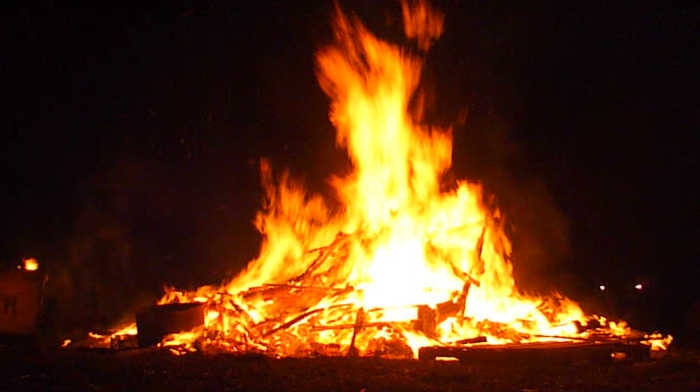
When a fire in straw burns itself out, in the space of a single breath, it's dead. By personifying Desire as an entity that has the capacity to show (or not show) 'respect', Ghalib has endowed it with a moral sensibility. Perhaps it has committed an instantaneous suicide? Why might it have done so?
=Out of an unselfish fear of lingering in the lover's heart, and thus compromising the honor of faithfulness? (If the lover had any havas , in short, its quick self-sacrifice would leave him with only vafaa , which is just as it should be.)
=Out of shame, since it can't bear its failure to measure up to the standards of faithfulness? (This emotion is to its credit, of course.)=Out of its own form of faithfulness? After all, in one single breath it has totally and instantly consumed itself, and what more passion can even the most faithful lover show than this? In fact, self-obliteration in a single breath is even more than the faithful lover normally achieves-- the lover usually has to obtain at least one direct all-consuming glance from the beloved first, which may take quite a while (as in {78,5}), and in the process he may complain a lot (as in {21,4}). By contrast, Desire consumes itself in a breath, before it even has time to complain.
In short, as in (2c), Desire's behavior may indeed show what a great deal of respect Desire has for faithfulness.
And of course, given the mutual exclusiveness of (2a) and
(2c), the genuine question of (2b) can always be asked-- when we
come right down to it, how much respect does Desire have for faithfulness?
We might ask with considerable earnestness, and really want to know. But as
usual Ghalib has so arranged it that we can't ever be sure. (For more on kyaa
see {21,1}.)
Nazm:
In this verse is a taunt directed at the Rival: that he does not feel passion, he feels lust. His love is insubstantial, like a fire in dried grass. As if he would have any respect for honor and faithfulness! (22)
== Nazm page 22