FWP:
For background see S. R. Faruqi's choices. For more on Ghalib's unpublished verses, see the discussion in {4,8x}.
On har-chand , see {59,7}; for a discussion of other parrot and mirror verses, see {29,2}.
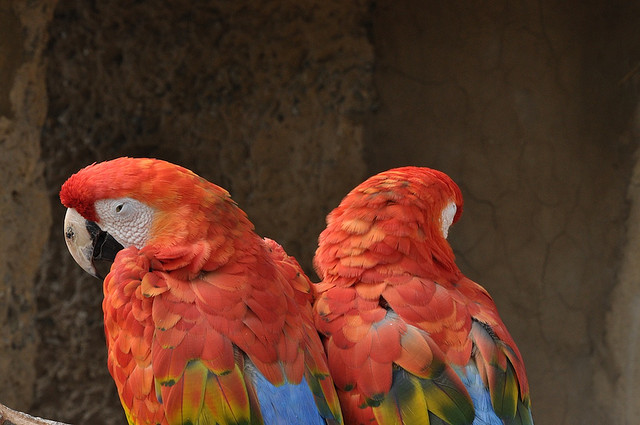
What it might mean for a 'parrot of sweet speech' to be now (though apparently not formerly) deprived of a mirror? Here are some possibilities:
=He is no longer able to practice and refine his 'speech', the way it would be possible to practice before a mirror.
=His 'speech' is so potent that no mirror (with a parrot-trainer behind it?) could long endure to confront him.
=No poet now alive is capable of confronting him as an equal, so he doesn't get a chance for the real exercise of his 'speech'/poetry.
=There is no longer any connoisseur who could appreciate and encourage his 'speech'/poetry.
The parrot is alone, with no 'mirror' or sounding-board,
no peer or 'frenemy', no listener, no sympathizer or connoisseur. For another verse about the crucial
importance of such an interlocutor, see {60,7}.
Asi:
That is, 'Although I am a parrot of sweet speech, I am the kind of parrot before whom a mirror has never remained, such that I would have said some things'. The meaning is that I am accomplished, but I never obtained an occasion for showing my accomplishments.
== Asi, p. 71