FWP:
SETS == BASKIH
WINE: {49,1}
WINE-HOUSE: {33,6}
For background see S. R. Faruqi's choices. For more on Ghalib's unpublished verses, see the discussion in {4,8x}.
ABOUT THE 'LINE' OF THE GLASS: According to S. R. Faruqi (Aug. 2008), a line was commonly engraved into wine-glasses to mark the maximum level to which they should be filled; a well-bred person would never pour himself wine beyond the level of that line. Other examples of the same image: {28,1} a line on a jaam ; {33,2}, a line on an ayaa;G ; {199,1}, a line on a piyaalah . There are also {117,4x} and {145,7x}, with a line on a miinaa ; though that is identified as 'the sacred-thread of the wine-flagon' and explained by Gyan Chand as an idiomatic way of describing the level of wine in a vessel that's half-full and half-empty.
The 'line of the glass' thus seems to be a somewhat abstract concept about which commentators have different theories. Faruqi's suggestion works plausibly as a ghazal convention, even if it wasn't actually a real-world custom. (And it does sound very unlikely as a real-world custom.) Compare also {267x,3}; {274x,3}, scanned ;xa:t:t ; {315x,1}; {351x,2}; {354x,1}; {376x,6}; {406x,2}; {425x,3}; {425x,5}.
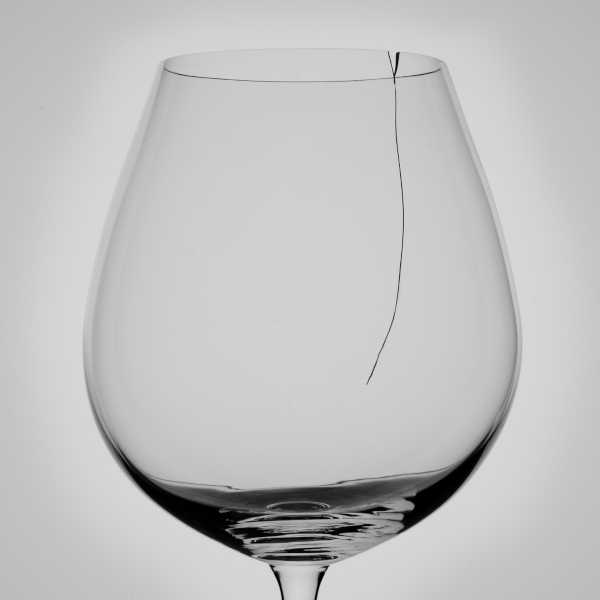
The second line of the present verse juxtaposes a 'hair' of the 'glass, bottle' to a 'line' of the 'cup, bowl, goblet'. (For more about Ghalib's various terms for wine-containers, see {28,1}.) What about the relationship between the 'line' (discussed above) and the 'hair'? The 'hair' might be taken to be a 'hairline crack' in the glass; for another (equally obscure) example of this usage, see {192,4}, which similarly features a muu-e shiishah , and even locates it at the same point in the verse. In the present verse, both Asi and Gyan Chand assume that an actual, undesirable hair has somehow fallen into the wine. My intuition is against this literal reading, and in favor of the 'hairline crack'.
In any case, these two readings of baskih also yield opposite possibilities:
='Although' the speaker is extremely drunk, he still clumsily tries to do the elegant thing: he treats any old hairline crack in the wine-glass as though it were the 'line', and confusedly refrains from filling his glass beyond that level; perhaps he's even making that error of judgment on purpose, and pouring out less wine in order to help prevent himself from becoming any drunker.
=The speaker is so drunk, he's impaired 'to such an extent', that he actually confuses a random hairline crack in the wine-glass with the 'line' that should mark the limit of the wine-pouring.
Gyan Chand points out the wordplay: bishkan is related to shikan ('breaking, crushing, overthrowing, routing', Platts p.731), so that there's an enjoyable affinity with the 'hairline crack'. (And with the English idiom of being very drunk as being 'smashed'.)
Asi:
Since we are deeply intoxicated by the revelry of the wine-house, the hair that falls (in that condition) into the wine-glass, we consider to be the 'line of the glass'. And the second meaning of bishkan is the act of breaking. Thus from the effect of this name, the 'hair of the glass' that is an effect of revelry and is a bad thing-- that too seems pleasing to us, like the 'line of the glass'. The 'line of the glass' is those traces of lines that are usually in glasses, etc.
== Asi, pp. 156-157